An online study resource
Biblical and World History: Side by Side Quick key: BC years count down; AD years count up. “About” means approximate. Dates and label meanings · Words used here
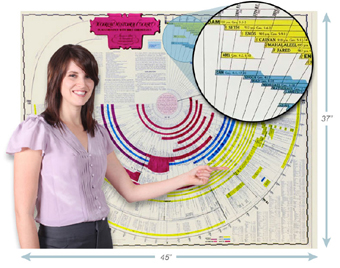
Reading key Find a person or event, follow a Biblical account, and discover what else was happening around the world. Explore this online version on its own or alongside the Amazing Bible Timeline with World History wall chart.
Find a person or event Choose a period Compare history Date key Find a person, place or event Try Moses, Abraham, Rome or a Bible translation. Results search the explanations across all 19 periods; a match does not mean every entry uses the same dating tradition.
You can also browse the people-and-events index without search.
Search needs JavaScript. The period choices and the full linked index below work without it.
Show more results How dates work This resource follows the Biblical chronology used in the Amazing Bible Timeline with World History, based primarily on James Ussher’s calculations. World-history dates use the historical sources cited in each entry. Different chronological approaches can place events in different years.
Timeline chronology A date calculated within this resource’s Biblical framework.
Historical estimate A date or range drawn from historical or archaeological research. “About” and “approximately” mark an estimate.
Dating debated More than one dating proposal remains in use. Read the entry for the particular disagreement. Why some dates differ Biblical dates can be calculated from ages, intervals and connections between passages. Textual choices matter too. In our chronology, the 430 years in Exodus 12:40 span time in Canaan and Egypt, following a reading in the Septuagint—the ancient Greek Old Testament.
A different calculation is a chronology difference. An unconfirmed event or an uncertain identification needs its own explanation; neither is resolved just by choosing another chronology.
How we count the 430 years .
Choose a period Choose by dates or by the people and subjects below. Early Biblical dates follow this resource’s timeline chronology.
4004 BC–3004 BC Genesis: Adam and early families 3004 BC–2348 BC Noah, the Flood and Egypt 2348 BC–2004 BC Babel, families and early civilizations 2004 BC–1754 BC Abraham, Sarah and ancient kingdoms 1754 BC–1504 BC Jacob, Joseph and Egypt 1504 BC–1254 BC Moses, the Exodus and Joshua 1254 BC–1004 BC Judges, Saul and David 1004 BC–754 BC Solomon, prophets and divided kingdoms 754 BC–504 BC Exile, return and ancient empires 504 BC–254 BC Persia, Greece and the Hebrew Scriptures 254 BC–1 BC Judea, Rome and the birth of Jesus 1 AD–250 AD Jesus, apostles and the Roman world 250 AD–500 AD Early church, councils and late Rome 500 AD–750 AD Byzantium, missions and Maya cities 750 AD–1000 AD Medieval churches, Baghdad and East Asia 1000 AD–1250 AD Crusades, Mali and Song China 1250 AD–1500 AD Wycliffe, Mongols and medieval kingdoms 1500 AD–1750 AD Reformation, Bible translation and empires 1750 AD–Modern Era Churches, nations, science and society The story across all 19 periods Start with these examples, then open a period to compare more regions. A broad period is not one simultaneous event. Early Biblical years follow this resource’s timeline chronology; archaeological and historical dates use their own evidence. Ranges may extend beyond a page’s boundaries.
Biblical account Adam and Eve
Adam: 930 years in Genesis; Eve’s lifespan not stated here
Genesis 5:5 gives Adam a lifespan of 930 years. Eve’s lifespan is not given in this passage.
Genesis family context These opening entries follow the Genesis family lines. Explore overlapping lifespans within this resource’s chronology.
Explore this period
Biblical account The Flood in Genesis
2348 BC · Timeline chronology
Genesis 7 recounts the Flood in Noah’s six-hundredth year.
The wider world Egypt’s Old Kingdom and pyramid building
Old Kingdom approximately 2649–2130 BC in the cited museum chronology · Historical estimate
Egypt’s Old Kingdom includes major pyramid building.
The wall chart uses a broader Pyramid Age range of 3000–2000 BC.
Explore this period
Biblical account The Tower of Babel
About 2200 BC · Timeline chronology
Genesis 11 recounts the city and tower in Shinar, the confounding of language and the scattering of its builders.
The wider world Japan: Jōmon communities
Jōmon culture during this period
Jōmon communities made pottery, lived in settlements and exchanged materials long before Japan’s written chronicles.
Later Chinese influence does not explain all of Japan’s earlier history.
Explore this period
Biblical account Abraham and Sarah
Abraham: 1996–1821 BC · Timeline chronology
God’s promises and the birth of Isaac are central to Abraham and Sarah’s story in Genesis.
The wider world Egypt’s Middle Kingdom and later Hyksos rule
Middle Kingdom approximately 2030–1650 BC · Historical estimate
Egypt’s Middle Kingdom includes the Twelfth Dynasty. Hyksos rule followed later, around 1650–1550 BC.
The Hyksos belong after this period’s 2004–1754 BC boundaries.
Explore this period
Biblical account Joseph interprets dreams and prepares for famine
1697 BC: end of the famine · Timeline chronology
Genesis describes Joseph interpreting dreams and preparing Egypt for seven years of plenty followed by seven years of famine.
The 1697 BC date marks the famine’s end in this resource’s chronology; Genesis does not name the pharaoh.
The wider world The Second Intermediate Period and the Hyksos
Approximately 1650–1550 BC · Historical estimate
Hyksos rulers controlled the Nile Delta; their expulsion helped usher in the New Kingdom.
This does not identify the Hyksos with the Israelites.
Explore this period
Biblical account Moses and Aaron
Exodus and wilderness: 1491–1451 BC · Timeline chronology
Moses and Aaron lead Israel’s deliverance in Exodus; the story continues through the wilderness journey.
The wider world New Kingdom pharaohs across several centuries
Fifteenth–thirteenth centuries BC · Historical estimate
Successive New Kingdom pharaohs ruled across these centuries, including Thutmose I and II and Ramesses II.
The chart names Thutmose II under ‘Greatest Egyptian Power’; the major imperial expansion discussed here concerns Thutmose III.
Explore this period
Biblical account David’s anointing and reign
Approximate reign calculation from the chart: 1055–1015 BC · Timeline chronology
David rules first at Hebron and then at Jerusalem. Second Samuel 5 gives a total reign of forty years.
Samuel’s earlier anointing is a separate event from David’s accession.
The wider world Ramesses III and the Sea Peoples
Approximately 1184–1153 BC · Historical estimate
Ramesses III fought Libyans and groups called the Sea Peoples; his temple at Medinet Habu commemorates the campaigns.
Explore this period
Biblical account Solomon’s temple
Construction: 1011–1004 BC · Timeline chronology
First Kings describes seven years of temple construction, followed by its dedication.
The chart’s 1011 BC label combines milestones that did not all occur in one year.
The wider world Olmec centers and influence
Approximately 1200–400 BC · Historical estimate
Olmec centers such as San Lorenzo and La Venta shaped art and religious imagery across Mesoamerica.
Their influence does not establish one government over the whole region.
Explore this period
Biblical account Return under Cyrus and rebuilding
Return and early rebuilding, approximately 538–536 BC · Historical estimate
Ezra describes Cyrus’s permission to return, renewed worship and the laying of the temple foundations.
The Cyrus Cylinder gives broader historical context; it is not the same document as Ezra’s decree.
The wider world Nineveh’s fall
612 BC
Nineveh fell in 612 BC, while resistance and campaigns continued beyond the loss of the capital.
The wall chart gives 602 for the imperial endpoint, a different milestone from the city’s fall.
Explore this period
Biblical account Nehemiah and Jerusalem’s wall
Artaxerxes’s twentieth year, conventionally 445/444 BC
Nehemiah recounts permission to rebuild Jerusalem and completion of the wall in fifty-two days.
The conversion of the king’s twentieth year to 445/444 BC depends on regnal-calendar reckoning.
The wider world Zapotec cities: Monte Albán and Mitla
Monte Albán, approximately 500 BC–AD 850; Mitla flourished later · Historical estimate
Monte Albán became a major Zapotec center; Mitla’s prominence came later.
The chart’s broad 400 BC–AD 1500 band combines places with different histories.
Explore this period
Biblical account The birth of Jesus
Matthew 2:1; the exact year is not stated
Matthew describes Jesus’s birth in Bethlehem during Herod’s reign. Luke also recounts his birth and its Roman setting.
The exact year is not stated in the Gospels; the BC/AD calendar has no year zero.
The wider world The growth of Teotihuacan
Growth before AD 1; major monumental city in the following centuries · Historical estimate
Teotihuacan developed in the Valley of Mexico; much of its monumental growth belongs to the following AD centuries.
Explore this period
Biblical account Jesus’s ministry and the apostolic mission
AD 30–33 in the chart’s framework · Timeline chronology
The Gospels recount Jesus’s ministry, crucifixion and resurrection. Acts follows his ascension and the disciples’ witness at Pentecost.
The precise year of the crucifixion is debated.
The wider world Teotihuacan’s population and urban growth
A large city; the precise AD 1 population is uncertain
Teotihuacan grew into a major Mesoamerican city during the first several AD centuries.
The wall chart’s population of 40,000 at AD 1 is not verified for that exact year by the cited site account.
Explore this period
Christian history Nicaea and the confession of Christ
Council of Nicaea, AD 325
Nicaea’s creed confesses the Son as of one substance with the Father; the controversy continued afterward.
The familiar creed also reflects the later council of Constantinople in 381.
The wider world Teotihuacan at its height
A major city during these centuries
Teotihuacan’s monumental city and extensive connections made it an influential Mesoamerican center.
Its ‘peak’ was a phase, not one agreed year.
Explore this period
Christian history Augustine’s mission and the Synod of Whitby
Mission in 597; synod in 664
Augustine’s mission reached Kent in 597. At Whitby in 664, Northumbrian leaders adopted the Roman calculation of Easter.
The wall chart gives 666 for Whitby; this entry uses 664.
The wider world Pakal of Palenque dies
AD 683; approximately eighty years old · Historical estimate
Inscriptions describe Pakal’s long rule at Palenque, ending with his death in 683.
He ruled a particular Maya kingdom, not every Maya city.
Explore this period
Christian history Images: Nicaea, renewed iconoclasm and restoration
Council in 787; renewed prohibition in 815; restoration in 843
Nicaea in 787 defended the veneration of icons. A renewed prohibition followed, before restoration in 843.
Christians disputed the meaning of veneration and worship; the final restoration was in 843, not the chart’s 820.
The wider world The Abbasids and Baghdad
Abbasid dynasty from 750; Baghdad founded in 762
The Abbasid dynasty began in 750; Baghdad was founded as its capital in 762.
The dynasty and its city did not begin in the same year.
Explore this period
Christian history Fifth Crusade
1217–1221
The Fifth Crusade’s Egyptian campaign began in 1218, within the wider expedition of 1217–1221.
The wall chart gives 1222.
The wider world Sundiata Keita and Mali
Reign approximately 1235–1255 · Historical estimate
Sundiata Keita founded the Mali Empire and ruled approximately 1235–1255.
His exact life dates remain uncertain; later oral tradition is important to his story.
Explore this period
Christian history The Wycliffite Bible
Late 14th century · Historical estimate
The Wycliffite Bible made Scripture available in English through a late-fourteenth-century movement associated with Wycliffe’s followers.
The chart’s 1383 is not a verified publication date for a book translated solely by Wycliffe.
The wider world Mali: Sundiata, Mansa Musa and changing power
Thirteenth-century foundation; pilgrimage in 1324–1325; later regional change · Historical estimate
Mansa Musa’s pilgrimage through Cairo in 1324–1325 displayed Mali’s wealth and international connections.
Sundiata’s precise life dates are less secure than this pilgrimage chronology.
Explore this period
Christian history The Authorized or King James Version
First published in AD 1611
A group of translators produced the King James Bible, first published in 1611, drawing on earlier translations and Biblical-language texts.
The wider world Peter the Great and the Russian state
Joint rule from 1682; sole rule from 1696; imperial title in 1721
Peter the Great’s reign included shared and sole rule, military successes and major state and church reforms.
Russian state supervision of the church did not make him the spiritual head of all Orthodox Christians.
Explore this period
The wider world Franklin and lightning
1752
Benjamin Franklin reports an experiment demonstrating the electrical nature of lightning in 1752.
The wall chart gives 1757.
Explore this period
The online version and the wall chart No poster is needed to use this resource. The Amazing Bible Timeline with World History wall chart brings the whole story together at a glance; this online version offers searchable entries, explanations and sources.
Specific notes beside an entry explain significant differences in date or meaning. Its source notes preserve the exact wall-chart wording. The physical chart has not changed.
See the complete wall timeline How to read the timeline Find an entry or choose a period. Dates can identify an event, lifespan, reign or longer development. Approximate dates remain approximate.Look across the world. Compare events within the same broad time band. Sharing a band does not mean they happened simultaneously or caused one another.Explore the context. Read the explanation, then open “Context, sources and timeline wording” for more detail. Selected entries also link to related blog articles.The Christian perspective is retained. Biblical testimony, traditional chronology, Christian interpretation and historical evidence are distinguished where needed.
People-and-events index Browse a period’s entries without typing a search. These titles link directly to their explanations, including undated labels and entries whose explained dates fall outside a page’s boundaries.
4004 BC–3004 BC · Genesis: Adam and early families (22 entries) 3004 BC–2348 BC · Noah, the Flood and Egypt (12 entries) Egypt’s Old Kingdom and pyramid building Old Kingdom approximately 2649–2130 BC in the cited museum chronology · Historical estimate Enos 905-year Biblical lifespan; calculated lifespan ends 2864 BC · Timeline chronology Cainan 910-year Biblical lifespan; calculated lifespan ends 2769 BC · Timeline chronology Mahalaleel 895-year Biblical lifespan; calculated lifespan ends 2714 BC · Timeline chronology Jared 962-year Biblical lifespan; calculated lifespan ends 2582 BC · Timeline chronology Methuselah 969-year Biblical lifespan; calculated lifespan ends 2348 BC · Timeline chronology Lamech, Noah’s father 777-year Biblical lifespan; calculated lifespan ends 2353 BC · Timeline chronology Noah 950-year lifespan in Genesis; spans the period boundary The Flood in Genesis 2348 BC · Timeline chronology Shem 600-year lifespan in Genesis Ham No lifespan or BC birth year stated here Japheth No lifespan or BC birth year stated here 2348 BC–2004 BC · Babel, families and early civilizations (25 entries) 2004 BC–1754 BC · Abraham, Sarah and ancient kingdoms (40 entries) 1754 BC–1504 BC · Jacob, Joseph and Egypt (25 entries) 1504 BC–1254 BC · Moses, the Exodus and Joshua (22 entries) 1254 BC–1004 BC · Judges, Saul and David (30 entries) Saul, Israel’s first king Approximately 1095–1055 BC, calculated from the chart’s royal bands · Timeline chronology From the tribes and judges to kings Saul, David and Solomon: the chart’s three royal bands · Timeline chronology David’s anointing and reign Approximate reign calculation from the chart: 1055–1015 BC · Timeline chronology David and the neighboring kingdoms Within David’s reign · Timeline chronology Hiram and David Within David’s reign · Timeline chronology Merneptah Approximately 1213–1203 BC · Historical estimate The Trojan War tradition About 1184 BC in the chart’s Greek chronology · Traditional dating Ramesses III and the Sea Peoples Approximately 1184–1153 BC · Historical estimate Tiglath-pileser I and Assyrian power Approximately 1114–1076 BC · Historical estimate Egypt after the New Kingdom Third Intermediate Period, approximately 1070–664 BC · Historical estimate The beginning of Zhou rule Western Zhou, approximately 1050–771 BC · Historical estimate Jephthah and the later judges Judges 10–12: a sequence, not simultaneous reigns Samson and the Philistines Judges 13–16 Eli and the ark’s capture and return 1 Samuel 4–7 Samuel’s judgeship 1 Samuel 7 Deborah and Barak Judges 4–5 Gideon and Midianite oppression Judges 6–8 Tola and Jair Judges 10:1–5 Abimelech at Shechem Judges 9 Solomon and Absalom in David’s household 2 Samuel 12 and 15–18 Sabbatical years and Jubilee Leviticus 25 Ishmael’s continuing family track A genealogical connection, not a later lifespan David and Goliath 1 Samuel 17, before David becomes king Tyre and western maritime trade Different stages of Phoenician seafaring Babylonia and Assyria Changing control, not one continuous command Aeneas and the origins of Rome Roman foundation legend Cecrops and Athens Athenian foundation tradition Indo-European languages and Sanskrit Language relationships, not a single migration event Zoroaster and the Indo-European language headings Zoroaster’s date is disputed · Dating debated Court and building practices in China Broad social labels, not dated inventions 1004 BC–754 BC · Solomon, prophets and divided kingdoms (41 entries) 754 BC–504 BC · Exile, return and ancient empires (50 entries) The last centuries of Judah’s monarchy Chart framework through Jerusalem’s destruction · Timeline chronology Jerusalem’s deliverance in Kings Sennacherib’s Judah campaign, 701 BC Return under Cyrus and rebuilding Return and early rebuilding, approximately 538–536 BC · Historical estimate Darius confirms the temple work Temple completed about 515 BC · Historical estimate The oracle at Delphi Sanctuary develops from the eighth century BC Rome’s foundation and early peoples 753 BC: traditional foundation date · Traditional dating Rome’s kings and the early Republic Traditional royal era, 753–509 BC · Traditional dating Assyria’s successive rulers Tiglath-pileser III through Sennacherib Assyrian rule in Babylon Tiglath-pileser III takes Babylon in 729 BC Pekah, Hoshea and Samaria’s fall Samaria falls, approximately 722–721 BC · Historical estimate The Spring and Autumn tradition The annals cover approximately 722–481 BC · Traditional dating Carthage’s maritime power Developing influence during the first millennium BC Assyrian invasions of Egypt Approximately 671–663 BC · Historical estimate Ashurbanipal’s library and Sardanapalus Ashurbanipal, approximately 668–631 BC · Historical estimate Nabopolassar and Nebuchadnezzar II Neo-Babylonian rise; Nebuchadnezzar II reigns 605–562 BC Athens: lawgivers and tyrants Late seventh through sixth centuries BC Nineveh’s fall 612 BC Nebuchadnezzar and Judah: several campaigns 605 BC accession; Jerusalem campaign documented in 597 BC Jerusalem’s destruction and the exile 587/586 BC; calendar reconstructions differ · Dating debated Cyrus and the conquest of Media Cyrus’s reign, about 559–530 BC; Media defeated 550/549 · Historical estimate Confucius Traditional dates, 551–479 BC · Traditional dating Belshazzar and Babylon’s conquest 539 BC Persia conquers Egypt 525 BC Darius I organizes the empire Darius I, 522–486 BC Tribute and the first deportations Different episodes in 2 Kings 15 Josiah and Huldah 2 Kings 22–23 Habakkuk and the Chaldeans Habakkuk 1 Judah’s kings before Josiah Jotham, Ahaz, Hezekiah, Manasseh and Amon Judah’s final kings Jehoahaz, Jehoiakim, Jehoiachin and Zedekiah The chart’s Ezra interval The “79 yrs.” annotation is a calculation Jehoiachin released from prison 2 Kings 25:27–30 Jeremiah, Ezekiel and Daniel Judah, exile and royal courts Azariah and neighboring peoples Uzziah/Azariah’s reign Micah and the divided kingdoms Micah 1:1 Sabbatical years and Jubilee Leviticus 25 Moab and Ammon in the late monarchy 2 Kings 24:1–2 Aram-Damascus and Judah 2 Kings 16 Hoshea’s appeal to Egypt 2 Kings 17:4 Necho and Josiah 2 Kings 23 The ten tribes in 2 Esdras A later visionary account referring to the exile Joseph’s fruitful branch Genesis 49:22 Ishmael and Arab peoples Genealogical tradition and later regional history Tyre and Babylonian pressure Nebuchadnezzar’s long siege; not a single verified 575 event Egypt’s overlapping dynasty bands Dynasties 22–30 and later foreign rule Rome’s walls and calendar tradition Different traditional attributions The Medes and Deioces A foundation account in Greek tradition Zoroaster and the Indo-European language headings Zoroaster’s date is disputed · Dating debated The tithing theme in China An undated fiscal theme Illinois burial mounds About 500 BC as a broad Woodland marker · Historical estimate The Buddha and Magadha Buddha active around 450 BC in the cited reconstruction · Historical estimate 504 BC–254 BC · Persia, Greece and the Hebrew Scriptures (41 entries) From monarchy to imperial rule Judea in the Persian and Hellenistic eras Esther and Mordecai Persian court setting, commonly associated with Xerxes I Ezra’s return and the 457 marker 458/457 BC in the chart’s return-and-rebuilding sequence · Timeline chronology Nehemiah and Jerusalem’s wall Artaxerxes’s twentieth year, conventionally 445/444 BC The Spring and Autumn tradition The annals cover approximately 722–481 BC · Traditional dating Confucius Traditional dates, 551–479 BC · Traditional dating Phoenician cities under successive empires Persian rule before Alexander’s conquest in 332 BC Egypt and Persian conquest Cambyses conquers Egypt in 525 BC The Roman Republic Conventionally 509–27 BC · Traditional dating Zapotec cities: Monte Albán and Mitla Monte Albán, approximately 500 BC–AD 850; Mitla flourished later · Historical estimate Postumius and Lake Regillus 496 BC in the chart’s early Roman chronology · Traditional dating Classical Greece and Macedonian expansion Persian Wars, Athenian leadership and Macedonian conquest An early agrarian-law proposal 486 BC in the traditional Roman chronology · Traditional dating The later Achaemenid kings Xerxes I through Darius III Learning and warfare in Zhou China Warring States, commonly about 475–221 BC; boundaries vary · Historical estimate The Twelve Tables Traditionally 451–450 BC · Traditional dating Changes in Olmec centers Major changes around 400 BC and afterward · Historical estimate Plebeian access to the consulship 366 BC in the Roman annalistic chronology · Traditional dating Rome’s treaty with Carthage 348 BC Rome and the Samnites Wars across the later fourth and early third centuries BC · Historical estimate Alexander and Jerusalem Macedonian conquest, 333–332 BC; a later visit narrative The Ptolemies in Egypt Ptolemaic power, 323–30 BC; kingship from 305 BC Greek as a shared language Especially the Hellenistic centuries Chandragupta and the Maurya empire Maurya dynasty, approximately 321–185 BC · Historical estimate Seleucus and the first Antiochus kings Seleucus I, Antiochus I and Antiochus II Early Maya calendar evidence A calendar sign from approximately 300–200 BC · Historical estimate The Greek Scriptures and the Septuagint Pentateuch translation in the third century BC; further books over time · Historical estimate Judea under the Ptolemies Mainly the third century BC · Historical estimate Rome, southern Italy and Greece 282 BC belongs to conflict in southern Italy, not the conquest of mainland Greece Malachi A postexilic prophetic setting; no explicit 408 BC date Sabbatical years and Jubilee Leviticus 25 The development of Maya political centers A long Preclassic development Food in the ancient Andes A broad subsistence theme A proposed Pacific coastal voyage Specific voyage claim not established Languages and movements of peoples Broad labels, not one dated migration Camillus and Cincinnatus in Roman memory Different episodes in the fifth and fourth centuries BC Greek writers, philosophy and public speech Distinct fifth- and fourth-century BC careers Zoroaster and the Indo-European language headings Zoroaster’s date is disputed · Dating debated Nasca culture Approximately 100 BC–AD 700; some chronologies begin around AD 100 · Historical estimate Moche culture Approximately AD 100–800 · Historical estimate Arabia and the later kingdom of Himyar Himyar flourished from the first century BC into late antiquity · Historical estimate 254 BC–1 BC · Judea, Rome and the birth of Jesus (44 entries) Judea before the New Testament era Ptolemies, Seleucids, Hasmoneans and Herod Basketmaker communities of the Southwest Broad Basketmaker sequence; regional boundaries differ · Historical estimate The Nasca and Palpa geoglyphs Made over centuries, approximately 500 BC–AD 500 · Historical estimate Zapotec cities: Monte Albán and Mitla Monte Albán, approximately 500 BC–AD 850; Mitla flourished later · Historical estimate Cerros: a developing Maya center Late Preclassic setting, approximately 400 BC–AD 250 · Historical estimate The Ptolemies in Egypt Ptolemaic power, 323–30 BC; kingship from 305 BC The Greek Scriptures and the Septuagint Pentateuch translation in the third century BC; further books over time · Historical estimate Judea under the Ptolemies Mainly the third century BC · Historical estimate Ashoka and Buddhist patronage Approximately 273–232 BC in the cited museum chronology · Historical estimate Qin unification and the Great Wall Qin dynasty, 221–206 BC; wall linking around 220 BC Hannibal’s invasion and Fabius Maximus 218–217 BC Roman expansion in Iberia Roman campaigns in Iberia, 218–206 BC; later conquest continued Han China and western exchange Han dynasty, 202 BC–AD 220 in this chronology Macedonia and Greece under Roman dominance War in 200–197 BC, settlement in 196; further conquest by 146 Unalakleet and Alaska’s coastal communities House remains dated approximately 200 BC–AD 300 · Historical estimate Seleucid rule and the Maccabean revolt Seleucid rule from about 198 BC; revolt beginning in the 160s BC · Historical estimate Maccabean and Hasmonean leaders From Judas’s revolt to Alexander Jannaeus · Historical estimate The growth of Teotihuacan Growth before AD 1; major monumental city in the following centuries · Historical estimate Cimbri and Teutones in Roman accounts 113–101 BC in the conventional sequence The late Republic’s competing leaders First-century BC political and civil conflicts Arabia and the later kingdom of Himyar Himyar flourished from the first century BC into late antiquity · Historical estimate Nasca culture Approximately 100 BC–AD 700; some chronologies begin around AD 100 · Historical estimate Syria becomes a Roman province 64 BC Pompey captures Jerusalem 63 BC Caesar and Ariovistus 58 BC Cleopatra, Antony and Roman annexation Cleopatra VII reigns 51–30 BC; annexation in 30 BC The Julian calendar Reform in 46 BC; new calendar effective 45 BC Herod becomes king Roman appointment in 40 BC; control of Jerusalem in 37 BC Octavian and the emergence of imperial rule Actium in 31 BC; title Augustus in 27 BC Herod enlarges the Jerusalem temple Work begins about 20/19 BC · Historical estimate Roman campaigns toward the Elbe Drusus’s campaigns, 12–9 BC John the Baptist’s birth Luke 1, before Jesus’s birth The birth of Jesus Matthew 2:1; the exact year is not stated Sabbatical years and Jubilee Leviticus 25 A proposed Pacific coastal voyage Specific voyage claim not established Peoples of the Pacific Northwest Long regional histories; no single founding date Mi’kmaq writing traditions The familiar prayer-writing system is documented much later Languages and movements of peoples Broad labels, not one dated migration Scythians and Cimmerians Distinct ancient groups, not a single migrating nation Zoroaster and the Indo-European language headings Zoroaster’s date is disputed · Dating debated The chart’s warfare theme in China An undated summary, not an unbroken condition Moche culture Approximately AD 100–800 · Historical estimate Changes in Olmec centers Major changes around 400 BC and afterward · Historical estimate Buddhism reaches China Evidence of Buddhist patronage in AD 65 1 AD–250 AD · Jesus, apostles and the Roman world (47 entries) Jesus’s ministry and the apostolic mission AD 30–33 in the chart’s framework · Timeline chronology The fire of Rome and persecution AD 64; other persecutions occurred in different reigns The Nasca and Palpa geoglyphs Made over centuries, approximately 500 BC–AD 500 · Historical estimate Zapotec cities: Monte Albán and Mitla Monte Albán, approximately 500 BC–AD 850; Mitla flourished later · Historical estimate Han China and western exchange Han dynasty, 202 BC–AD 220 in this chronology Hopewell earthworks and exchange Approximately 200 BC–AD 500 in the Ohio Valley chronology · Historical estimate Arabia and the later kingdom of Himyar Himyar flourished from the first century BC into late antiquity · Historical estimate Nasca culture Approximately 100 BC–AD 700; some chronologies begin around AD 100 · Historical estimate Egypt within the Roman empire Roman administration throughout this period Arminius and Rome’s northern frontier Teutoburg in AD 9; further campaigns afterward The Julio-Claudian emperors Tiberius AD 14–37; Caligula 37–41; Claudius 41–54; Nero 54–68 Roman Britain and campaigns in the north Invasion in AD 43; northern campaigns in the later first century · Historical estimate The Flavian emperors Vespasian AD 69–79; Titus 79–81; Domitian 81–96 Jerusalem and the temple destroyed AD 70 Josephus as a witness and historian Writing in the later first century AD · Historical estimate Vesuvius buries Pompeii AD 79 Trajan through Marcus Aurelius Trajan 98–117; Hadrian 117–138; Antoninus Pius 138–161; Marcus Aurelius 161–180 Monte Albán in the early AD centuries AD 100–200 within a much longer urban history Moche culture Approximately AD 100–800 · Historical estimate Trajan’s conquests and their limits Dacian and eastern campaigns in the early second century Hadrian and the Bar Kokhba revolt AD 132–135 Marcus Aurelius and the Marcomannic wars Later second-century frontier wars · Historical estimate Commodus, Severus Alexander and Decius Commodus alone from 180; Severus Alexander 222–235; Decius 249–251 Mogollon traditions in the Southwest Distinctive archaeological pattern from about AD 200 · Historical estimate The Maya Classic period Conventionally begins around AD 250; regional boundaries vary · Historical estimate The birth of Jesus Matthew 2:1; the exact year is not stated John on Patmos Revelation 1:9; later tradition associates the exile with Domitian Stephen and Saul Acts 7–9; early apostolic period The apostles’ deaths: text and tradition Different deaths and different kinds of evidence Remembering Christian martyrs Early commemoration, not a single documented Roman introduction Teotihuacan’s population and urban growth A large city; the precise AD 1 population is uncertain Diaspora and the language of Deuteronomy A Biblical warning and a long historical process Early Tiwanaku Earlier settlement before the city’s later expansion El Mirador before the Classic period A major Preclassic Maya center Early Christian baptismal practices Early evidence and later denominational differences The Eucharist and transubstantiation Early Eucharistic belief; later technical terminology The idea of an early apostasy A theological interpretation, not an agreed AD 100 event Languages and movements of peoples Broad labels, not one dated migration Huns, Turks and later steppe histories The named groups and westward movements belong to different periods Peoples around the Roman frontiers Changing groups along the North Sea, Rhine, Danube and Black Sea Which Pliny? The brief label does not securely identify a date or one author AD 180 as a turning point A historical interpretation, not an agreed beginning of decline Buddhism spreads across Asia over centuries Different regions received Buddhism in different periods The tithing theme in China An undated fiscal theme The chart’s warfare theme in China An undated summary, not an unbroken condition Early evidence for tea Tea predates the proposed AD 222 first mention Decius dies fighting the Goths AD 251 250 AD–500 AD · Early church, councils and late Rome (46 entries) Third-century and Diocletianic persecution Major episodes around 250 and from 303 · Historical estimate Eusebius, Laodicea and the Biblical canon Fourth-century evidence; Laodicea’s precise date is uncertain · Historical estimate Constantine and Christianity’s changing position Imperial favor after 312; baptism in 337 Nicaea and the confession of Christ Council of Nicaea, AD 325 Imperial support for Nicene Christianity Theodosius’s edict in AD 380 Jerome and the Latin Bible Revision and translation over several decades · Historical estimate Patrick’s mission in Ireland Fifth century; the poster uses AD 450 · Historical estimate Zapotec cities: Monte Albán and Mitla Monte Albán, approximately 500 BC–AD 850; Mitla flourished later · Historical estimate Nasca culture Approximately 100 BC–AD 700; some chronologies begin around AD 100 · Historical estimate Moche culture Approximately AD 100–800 · Historical estimate China after the Han Three Kingdoms 220–280; Sixteen Kingdoms conventionally 304–439 Teotihuacan at its height A major city during these centuries Egypt within the Roman empire Egypt under Roman and eastern Roman rule during this period Religious traditions in South Asia Brahmanical and Buddhist traditions coexist The Early Classic Maya period Approximately AD 250–600 · Historical estimate Decius dies fighting the Goths AD 251 Roman rulers through the fourth and fifth centuries A succession of rulers, shared offices and civil wars Buddhist images and local traditions in China Western Jin example, AD 265–316 Roman withdrawal from Dacia Under Aurelian, in the early 270s · Historical estimate Tacitus: emperor or historian? The emperor Tacitus ruled AD 275–276 Constantinople becomes an imperial capital AD 330 The Huns and Attila Hunnic expansion in the late fourth century; Attila’s rule in the fifth · Historical estimate Teotihuacan and the Maya world AD 378 is a major marker in the Tikal inscriptions The battle of Adrianople AD 378 Western and eastern Roman government Division after 395; western imperial deposition in 476 Monte Albán as a Zapotec capital An established center around AD 400 Migration to Britain, Iberia and North Africa Different movements in the fifth century · Historical estimate Changing Hopewell exchange networks Late in the Ohio Hopewell sequence · Historical estimate Tiwanaku’s urban expansion Major urban growth around AD 400–900 · Historical estimate Gothic attacks and the sack of Rome Alaric’s sack of Rome, AD 410 Attila checked in Gaul The Catalaunian battle, conventionally AD 451 Odoacer in Italy Rule in Italy, AD 476–493 The birth of Jesus Matthew 2:1; the exact year is not stated Mesoamerican calendars and comparisons with Asia A historical comparison, not a demonstrated AD 250–500 connection El Tajín and water management A Gulf Coast city; its specific ethnic attribution needs care Early Tiwanaku Earlier settlement before the city’s later expansion The disputed age of Serpent Mound Proposed construction dates differ by more than a millennium The Eucharist and transubstantiation Early Eucharistic belief; later technical terminology Describing Indigenous religious traditions Many peoples and traditions, not one continental creed Peoples around the Roman frontiers Changing groups along the North Sea, Rhine, Danube and Black Sea Sunday worship and imperial legislation Christian Sunday gatherings predate Constantine The ten kingdoms and Biblical interpretation A historicist reading of Daniel and Revelation The end of the ancient Olympic Games Conventionally late fourth century; the precise endpoint is debated Sushen and later Manchu ancestry traditions An ancestry claim, not a securely dated arrival in Japan Learning and literary activity at Chang’an An important center; the exact “seven schools” label is uncertain Aksumite intervention in Yemen Mainly the sixth century, outside this period · Historical estimate 500 AD–750 AD · Byzantium, missions and Maya cities (45 entries) 750 AD–1000 AD · Medieval churches, Baghdad and East Asia (35 entries) 1000 AD–1250 AD · Crusades, Mali and Song China (75 entries) 1250 AD–1500 AD · Wycliffe, Mongols and medieval kingdoms (73 entries) The Augustinian friars 1244 and 1256 Boniface VIII 1294–1303 John Wycliffe 14th century; dies 1384 · Historical estimate Franciscan Christianity in Yuan China Montecorvino’s report in 1305; archiepiscopal appointment in 1307 Clement V 1305–1314 The Avignon papacy 1309–1377 The Avignon papacy and French influence Avignon residence, conventionally 1309–1377 John XXII 1316–1334 Renaissance humanism and the Reformation 15th–16th centuries · Historical estimate Three rival papal claimants From 1409 Alexander V and the Western Schism 1409–1410 Baldassarre Cossa as John XXIII 1410–1415 Eugene IV 1431–1447 Nicholas V 1447–1455 Paul II 1464–1471 The Spanish Inquisition 1478 authorization; 1480 tribunal Martin Luther’s lifetime 1483–1546; indulgence controversy 1517 Alexander VI 1492–1503 Philipp Melanchthon is born 1497 Wycliffe’s criticism of the papacy 1378–1384 The stone-built city of Great Zimbabwe Construction and growth over centuries · Historical estimate Maya political change after Chichén Itzá Postclassic regional reorganization · Historical estimate Yoruba cities and the art of Ife Medieval artistic and urban traditions · Historical estimate Mali: Sundiata, Mansa Musa and changing power Thirteenth-century foundation; pilgrimage in 1324–1325; later regional change · Historical estimate Osman and the beginnings of Ottoman power Late thirteenth- and early fourteenth-century state formation · Historical estimate Chimú expansion and Inca conquest Chimú growth before conquest in the later fifteenth century · Historical estimate Swahili cities and Indian Ocean exchange Established coastal communities continue to flourish Japan during the age of Mongol expansion Kamakura and later medieval political settings Byzantine restoration at Constantinople 1261 Louis IX’s crusade to Tunis AD 1270; usually called the Eighth Crusade The Yuan dynasty and Mongol rule in China Yuan proclaimed in 1271; Southern Song defeated in 1279 The Mongol invasions of Japan 1274 and 1281 Expulsion of Jews from England 1290 Pueblo communities and larger towns Regional aggregation over generations · Historical estimate Inca rulers and imperial expansion Earlier Cuzco rulers; major imperial expansion conventionally from 1438 Tenochtitlan in the Basin of Mexico Traditional foundation date, AD 1325 The kingdom of Kongo A kingdom formed around the later fourteenth century · Historical estimate Ottoman expansion into southeastern Europe A foothold at Gallipoli in 1354; later expansion toward the Danube · Historical estimate The Ottoman capture of Adrianople The 1360s; the precise conquest year is disputed · Dating debated The Ming and later imperial institutions Ming dynasty, AD 1368–1644 Acamapichtli and early Mexica kingship Conventionally about AD 1375–1395 · Historical estimate The Wycliffite Bible Late 14th century · Historical estimate Expulsion of Jews from French royal domains 1394 The battle of Nicopolis AD 1396 Machu Picchu Built in the fifteenth century · Historical estimate The Mexica empire and Ahuitzotl Expansion in the fifteenth century; Ahuitzotl 1486–1502 Wallachia and Ottoman tributary relations A changing relationship, with a major settlement around 1417 · Historical estimate Smyrna and Ottoman consolidation Consolidation in the 1420s · Historical estimate Siege and conquest of Constantinople Unsuccessful siege in 1422; conquest in 1453 Ottoman expansion in Epirus Ioannina’s surrender in 1430 is a documented milestone Portuguese settlement authorization in the Azores Royal authorization in 1439 Moctezuma I AD 1440–1469 European expansion and Atlantic slave trading Portuguese maritime trafficking expands in the fifteenth century · Historical estimate The end of Eastern Roman power 1453; separate 1449 source label unresolved The fall of Constantinople 1453 The Hospitallers defend Rhodes Ottoman siege of AD 1480 Cyprus becomes a Venetian possession Formal Venetian annexation in 1489 Henry VIII is born 1491 Columbus reaches the Caribbean October 12, 1492, in the expedition’s calendar Expulsion decrees in Spain and Sicily 1492 decrees The fall of Granada AD 1492 Vespucci and European knowledge of South America Voyage of 1499–1500 · Historical estimate Materialism and pantheism as historical judgments A broad criticism, not a dated creed held by everyone Lombards in the prophetic diagram Undated diagram label Franks in the prophetic diagram Undated diagram label Huns in the prophetic diagram Undated diagram label Burgundians in the prophetic diagram Undated diagram label Saxons in the prophetic diagram Undated diagram label Ottoman power toward Hungary Repeated frontier campaigns, not a securely identified 1402 conquest Marco Polo’s account of Asia Late-thirteenth-century travels and an account written afterward Zapotec cities: Monte Albán and Mitla Monte Albán, approximately 500 BC–AD 850; Mitla flourished later · Historical estimate From Early to Late Classic Maya history Late Classic conventionally about AD 600–900 · Historical estimate The Dominican order Undated label; confirmation 1216 1500 AD–1750 AD · Reformation, Bible translation and empires (61 entries) Reformation in the Netherlands Sixteenth-century Reformation and later renewal Popes in the Reformation and early-modern period Selected pontificates, AD 1503–1724 John Calvin is born AD 1509 Luther’s challenge to indulgences Ninety-five Theses, AD 1517 Luther at the Diet of Worms AD 1521 England’s break with papal authority A sequence of changes, including the Act of Supremacy in 1534 Trent and restrictions on Bible reading Council of Trent, 1545–1563; Index rules, 1564 Christian missions and persecution in Japan Xavier’s arrival in 1549; later suppression · Historical estimate The Peace of Augsburg AD 1555 John Knox and the Scottish Reformation Scottish Reformation settlement, AD 1560 The Saint Bartholomew’s Day massacres Beginning in Paris, August AD 1572 Early Baptist congregations Helwys in England, 1612; Williams in Providence, conventionally 1638–1639 · Historical estimate George Fox and the Society of Friends Fox’s experience in 1647; movement growth in the following years · Historical estimate Pascal’s night of religious conviction November 23, AD 1654 The Massachusett-language Bible New Testament in 1661; complete Bible in 1663 The Edict of Nantes is revoked Edict of Fontainebleau, AD 1685 Venetian losses in the Morea Ottoman gains around AD 1500 Enslavement and the Atlantic colonies A system expanding over centuries China’s overseas trade and Jesuit contacts Sixteenth- and seventeenth-century encounters Ponce de León reaches Florida Spanish expedition, AD 1513 Balboa reaches the Pacific from Panama AD 1513 Suleiman the Magnificent Reign of AD 1520–1566 Tyndale’s English New Testament Incomplete Cologne printing in 1525; Worms edition in 1526 Coverdale and the Great Bible Coverdale Bible in 1535; Great Bible in 1539 De Soto’s expedition reaches the Mississippi AD 1541 The Geneva Bible New Testament in 1557; complete Bible in 1560 Huguenot settlement ventures 1562 and 1564; poster's 1535 event unresolved William Shakespeare is born April, AD 1564 The Spanish founding of St. Augustine 1565 Ottoman conquest of Cyprus Conquest in AD 1570–1571 Drake’s circumnavigation Voyage of AD 1577–1580 The end of Songhay imperial power AD 1591 Oliver Cromwell is born AD 1599 Jamestown and English Virginia Jamestown founded in AD 1607 Champlain establishes Québec 1608 The Authorized or King James Version First published in AD 1611 The first Romanov tsars Michael from 1613; Alexis from 1645 The Plymouth settlement AD 1620 New Netherland becomes New York Dutch colonization in the 1620s; English takeover in 1664 Dutch trading on the Connecticut River Trading post at present-day Hartford, AD 1633 The French settlement of Montréal Ville-Marie founded in AD 1642 The New England Confederation Agreement of AD 1643 Qing rule and the queue hairstyle Qing rule in China from 1644; revolution and abdication in 1911–1912 The Ottoman–Venetian war over Crete War of AD 1645–1669 Mehmed IV and changing Ottoman fortunes Reign of AD 1648–1687 The Dutch station at the Cape AD 1652 Two French Mississippi expeditions 1673 and 1682 Pennsylvania’s charter and Philadelphia’s founding Charter in 1681; city planning and settlement in 1682–1683 Peter the Great and the Russian state Joint rule from 1682; sole rule from 1696; imperial title in 1721 The Salem witchcraft trials AD 1692 Fort Maurepas and colonial Louisiana 1699 Asante expansion and Atlantic commerce Early eighteenth-century growth · Historical estimate The eighteenth-century Atlantic slave trade A major century of forced transportation Benjamin Franklin is born AD 1706 Belgrade between empires Habsburg rule between AD 1718 and 1739 The Swahili epic of Tambuka Manuscript tradition dated AD 1728 Georgia’s charter and Savannah’s settlement 1732–1733 Thomas Jefferson is born AD 1743 Ottoman territorial change and Habsburg expansion A long process, not a single date of collapse Peoples in the chart’s prophetic diagram A historicist reading of Daniel and Revelation Later Russo–Turkish wars Wars of 1768–1774 and 1787–1792; outside this period 1750 AD–Modern Era · Churches, nations, science and society (164 entries) Mission San Diego de Alcalá July 16, 1769 Clement XIV 1769–1774 Suppression of the Society of Jesus 1773 George Liele and the Silver Bluff congregation c. 1773–1775 Capture of Quebec City September 18, 1759 Catherine II 1762–1796 Stamp Act and its repeal 1765–1766 Russo-Ottoman War of 1768–1774 1768–1774 First Continental Congress September 5–October 26, 1774 Franklin and lightning 1752 Alexander Hamilton’s uncertain birth year 1755 or 1757 Pius VI 1775–1799 Methodist Episcopal Church 1784 Papal territorial rule: interruption and later end 1798; papal rule restored before the final 1870 end American War for Independence 1775-1783 Declaration of Independence 1776 Russo-Ottoman War of 1787–1792 1787–1792 First Fleet and Sydney Cove 1788 George Washington 1789–1797 British control at the Cape 1795; 1803; 1806; 1814 Paul I of Russia 1796–1801 Olaudah Equiano’s autobiography 1789 Pius VII 1800-1823 Annexation of the Papal States May–July 1809 African Methodist Episcopal Church 1816 Leo XII 1823–1829 Alexander I of Russia 1801 Napoleon’s Russian campaign June–December 1812 Shaka and the Zulu kingdom 1816–1828 James Monroe 1817–1825 Greek independence 1821–1832 Liberia: settlement and independence 1822; 1847 Monroe’s foreign-policy declaration December 2, 1823 Haitian independence 1804 Pius VIII 1829–1830 Gregory XVI 1831–1846 Judson’s Burmese New Testament 1832 Oxford Movement and Tracts for the Times 1833–1841 Tracts era Judson’s complete Burmese Bible 1834; 1835 David Livingstone 1841–1873 (lived 1813–1873) Pius IX 1846–1878 Fundamental Statute of the Papal States 1848 Nicholas I and the Decembrist uprising 1825–1855 Treaty of Nanking 1842 Mexican-American War 1846-1848 California and the Treaty of Guadalupe Hidalgo 1848 British slavery abolition and apprenticeship 1833–1838 Amistad captives’ freedom 1839–1842 Vatican I and papal infallibility July 18, 1870 Responsible government in Australian colonies 1854-1856 Second Opium War 1856-1860 Abraham Lincoln and emancipation 1861–1865 Alaska purchase March–October 1867 First U.S. transcontinental railroad 1862–1869 Mary Slessor 1876–1915 (lived 1848–1915) Leo XIII 1878–1903 English Revised Version 1881; 1885 Independence recognized at Berlin 1878 Bulgaria under Ottoman suzerainty 1878 British occupation and protectorate in Egypt 1882; 1914 Grover Cleveland 1885–1889 and 1893–1897 First Sino-Japanese War 1894-1895 Battle of Adwa March 1, 1896 McKinley and the war with Spain 1897–1901; war in 1898 South African War October 11, 1899–May 31, 1902 Bell’s telephone patent and transmission March 7–10, 1876 Edison’s early phonograph 1877; 1878 Edison’s incandescent lighting system 1879 Edison’s improved phonographs 1888 Russian Social Democratic Labour Party 1898 Azusa Street Revival 1906 Mother Teresa 1910–1997 Benedict XV 1914–1922 Pius XI and Vatican City 1922–1939 Qing queue policy and later decrees 1645; 1911–1912 Boxer movement and intervention 1899–1901 Russo-Japanese War 1904–1905 Italy and Libya’s Ottoman provinces 1912 New Mexico and Arizona statehood January 6 and February 14, 1912 Balkan Wars 1912–1913 Jerusalem surrenders to British forces December 9, 1917 Russian revolutions March and November 1917 (New Style) Wilson’s Fourteen Points January 8, 1918 Western Front armistice November 11, 1918 Plans to partition the Ottoman Empire 1919–1920 Treaty of Sèvres 1920 Palestine mandate 1920; 1922; 1923 Communist Party ban on factions 1921 Egypt’s recognized independence 1922 Panama Canal opens August 15, 1914 Rutherford’s nuclear transmutation 1919 Jewish immigration to Mandatory Palestine 1920s Bolshevik and Menshevik factions 1903 C. S. Lewis’s Christian conversion 1931 Billy Graham’s commitment to Christ 1934 Pius XII 1939–1958 World Council of Churches 1948 Great Depression 1929–1941 Rhineland remilitarization and invasion of Poland 1936; 1939 Pearl Harbor and wider Pacific attacks December 7, 1941 D-Day landings June 6, 1944 Atomic bombings of Hiroshima and Nagasaki August 6 and 9, 1945 Israel declares independence May 14-15, 1948 People’s Republic of China October 1, 1949 Republic of China government relocates to Taiwan December 1949 First jet aircraft 1939 and 1941 Manhattan Project and first nuclear test 1942–July 16, 1945 U.S. stock market crash 1929 Palestinian Arab displacement 1947-1949 John XXIII 1958–1963 Second Vatican Council 1962–1965 Paul VI 1963–1978 Chinese military entry into Tibet 1950–1951 Stalin’s death March 5, 1953 Alaska and Hawai‘i statehood January 3 and August 21, 1959 Dahomey’s independence August 1, 1960 Berlin Wall construction Beginning August 13, 1961 John F. Kennedy’s assassination November 22, 1963 Six-Day War June 5–10, 1967 DNA double-helix model 1953 Sputnik 1 October 4, 1957 Apollo 11 Moon landing 1969 Intel 4004 microprocessor 1971 Mau Mau uprising 1952-1960 Dedan Kimathi’s capture October 21, 1956 Civil Rights Act and Voting Rights Act July 2, 1964; August 6, 1965 John Paul I August 26–September 28, 1978 John Paul II 1978–2005 Falklands/Malvinas War April 2–June 14, 1982 Opening and removal of the Berlin Wall November 9, 1989–1991 Soviet coup attempt and dissolution August 19–21 and December 25–26, 1991 Altair 8800 1975 Genocide against the Tutsi in Rwanda 1994 Benedict XVI 2005–2013 September 11 and U.S. legislation September–October 2001 U.S.-led invasion of Iraq March 19–20, 2003 Mahmoud Abbas becomes prime minister April 29, 2003 Sudan’s Comprehensive Peace Agreement January 9, 2005 Global financial crisis 2008–2009 Barack Obama’s election and inauguration Elected November 4, 2008; inaugurated January 20, 2009 Death of Osama bin Laden 2011 Russia’s occupation of Crimea 2014 Donald Trump’s first inauguration 2017 Joe Biden’s inauguration 2021 Full-scale Russian invasion of Ukraine 2022 China’s first crewed spaceflight 2003 North Korea’s first announced nuclear test 2006 COVID-19 pandemic designation 2020 Indian Ocean tsunami 2004 Hurricane Katrina and New Orleans flooding August 29, 2005 China’s economy passes Japan’s 2010 End of the temporal power of the Pope 1798 Theme or label, not a separate dated event Turkey under Christian sway 1830 Theme or label, not a separate dated event Slavery in America Theme or label, not a separate dated event Turkey loses domain generally Theme or label, not a separate dated event “And in the days of these Kings shall the God of Heaven set up a kingdom.” Dan. 2:34-44 Theme or label, not a separate dated event Lombards Theme or label, not a separate dated event Franks Theme or label, not a separate dated event Huns Theme or label, not a separate dated event Burgundians Theme or label, not a separate dated event Saxons Theme or label, not a separate dated event Japan Theme or label, not a separate dated event National Awakening Theme or label, not a separate dated event China Theme or label, not a separate dated event Prefer a printed reading copy? Find a period’s PDF . Choose a visual study guide or compact reference, in Letter or A4.
Dates and label meanings
BC and AD BC means “Before Christ.” AD stands for anno Domini , Latin for “in the year of the Lord”; it does not mean “after death.” BC year numbers decrease as time moves forward: 1000 BC comes before 500 BC. AD year numbers increase. There is no year zero between 1 BC and AD 1.
BCE and CE “Before Common Era” and “Common Era” use the same year numbering as BC and AD, respectively. You may see these labels in sources.
About, approximately, c. or ca. The date is an estimate, not a known exact year. The abbreviations c. and ca. stand for circa , meaning “about.”
Century A span of 100 years. The first century AD is AD 1–100; the fifth century BC is 500–401 BC.
A range or a time band A range may describe a lifetime, reign, war or longer development; the entry says which. A comparison band groups events within a span of time, not necessarily the same year. A lifespan bar shows duration within this timeline’s chronological framework, not an independently measured date.
Timeline chronology A date calculated within this resource’s Biblical framework. Historical estimate A date or range drawn from historical or archaeological research. “About” and “approximately” mark an estimate. Dating debated More than one dating proposal remains in use. Read the entry for the particular disagreement.
Traditional dating Dates drawn from a culture’s historical or literary traditions, such as the traditional foundation of Rome or the Trojan War. These are not labeled as Ussher-based Biblical dates. The entry explains its basis.
Biblical account, Christian interpretation and historical evidence A Biblical account describes what the Bible says. Christian interpretation explains a religious understanding of a text or event and may differ among Christians. Historical evidence includes documents, inscriptions, objects and other sources used to investigate the past. These descriptions identify the kind of information, not a score for its importance.
Dating disputed / undated / outside this period “Disputed” means different dates or interpretations remain in use. “Undated” means no reliable absolute year is assigned here. “Outside this period” keeps an entry findable when its explained dates fall beyond this page’s boundaries.
Context, sources and timeline wording Each entry works on its own. Open its notes for sources, fuller explanations and original wording from the wall chart. Significant differences in date or meaning are identified beside the entry.
Back to the page introduction
Words used on this page Short definitions for this reading page. Entry cards also offer word help that opens in place, so you can read a definition without leaving the entry.
Chronology The order of events and the dates assigned to them. Different calculations or sources can produce different dates. Dynasty A line of rulers, usually from the same family. A dynasty’s dates describe its rule, not one person’s lifetime. Reign The time a king, queen or other ruler holds power. These are not necessarily the years of that person’s life. Accession The beginning of a ruler’s time in power. Regnal year A year counted from the start of a ruler’s reign. Different calendar and counting practices can affect its conversion to a BC or AD year. Pontificate and papacy A pontificate is a pope’s time in office. Papacy means the office of the pope or the institution associated with it. Kiva A room used by Pueblo people for ceremonies and, in some settings, community work. Kivas are part of living Pueblo traditions as well as ancestral sites. National Park Service: Pueblo ceremonial room Byzantine A name historians use for the eastern Roman Empire and its culture, centered on Constantinople, now Istanbul. Hellenistic Connected with Greek-speaking kingdoms and cultural influence after Alexander the Great. It does not mean every local culture became Greek. Levant The eastern Mediterranean region. Its boundaries vary by context; it is not the name of one present-day country. Mesopotamia The region around the Tigris and Euphrates rivers, largely in present-day Iraq and neighboring areas. Genealogy An account of family descent: who is related to whom across generations. Diaspora Communities living outside an ancestral homeland. A diaspora can develop through migration, trade, exile and other circumstances. Exile Living away from one’s homeland, especially after being forced to leave. A reference to exile does not necessarily mean every inhabitant left. Postexilic After the exile. In the Biblical entries, this usually refers to the period following the Babylonian exile. Iconoclasm Opposition to religious images, sometimes involving their removal or destruction. Byzantine Christians disputed the proper use of images in worship. The Metropolitan Museum of Art: Iconoclasm Huguenots A historical name for French Protestants. Protestant Museum: Huguenot refugees Jōmon A long prehistoric cultural period in Japan, named for cord-marked pottery. It is earlier than Japan’s written historical chronicles. Torah / Pentateuch In this timeline, the first five books of the Bible: Genesis, Exodus, Leviticus, Numbers and Deuteronomy. Septuagint / LXX Ancient Greek translations of Jewish Scriptures, commonly called the Greek Old Testament. LXX is its traditional abbreviation; the translations were not all made at one time. Historicist interpretation An approach that connects Biblical prophecy with a sequence of events across later history. Christians differ over those connections. Canon When discussing Scripture, the collection of books accepted as authoritative by a religious community. A church council’s “canons” instead means its rules. Bible references and KJV Genesis 5:5 means the book of Genesis, chapter 5, verse 5; 5:5–8 means verses 5 through 8. “II Kings” means Second Kings. Gen., Exod. and Rev. shorten Genesis, Exodus and Revelation. KJV means King James Version, the English Bible translation used by many linked passages. Back to the page introduction