Related articles offer further reading. Each entry’s sources support its specific explanation.
People and events
The Augustinian friars
1244 and 1256
Christian history
The Austin Friars are the Augustinian friars. Their order takes shape through a union in 1244 and a larger union in 1256.
The poster names the order without supplying a year.
Names and identities: Historical name explained; two institutional stages distinguished
Context, sources and timeline wording
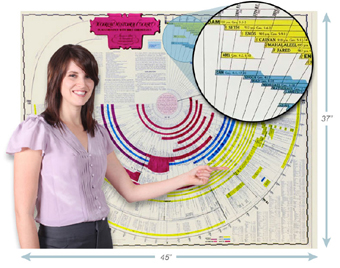
On the Amazing Bible Timeline with World History
Order of Austin Friars
Compare AD 1250–AD 1300Reading options
Boniface VIII
1294–1303
Christian history
Boniface VIII serves as pope, 1294–1303. The poster gives the beginning year.
Context, sources and timeline wording
On the Amazing Bible Timeline with World History
BONIFACE VIII 1294
Compare AD 1250–AD 1300Compare AD 1300–AD 1400Reading options
John Wycliffe
14th century; dies 1384 · Historical estimate
Christian history
John Wycliffe, English theologian and church reformer, dies in 1384. His birth year is uncertain: the poster gives 1328, and modern reference works differ.
Context: Death year supported; birth year remains uncertain
Context, sources and timeline wording
On the Amazing Bible Timeline with World History
1328-1384 John Wycliff
Compare AD 1300–AD 1400Reading options
Franciscan Christianity in Yuan China
Montecorvino’s report in 1305; archiepiscopal appointment in 1307
Christian history and East Asia
John of Montecorvino described preaching and translating Christian texts in China before his appointment as archbishop in 1307. Christianity had also been present under the Tang centuries earlier.
The poster’s 1307 should therefore identify this Latin mission’s institutional milestone, not the first Christian presence in China.
Context: A later mission, not the first introduction of Christianity.
Context, sources and timeline wording
On the Amazing Bible Timeline with World History
Christianity introduced 1307
Selected label(s) from the corresponding poster track; joined fragments share this quotation and explanation.
Compare AD 1300–AD 1400Reading options
Clement V
1305–1314
Christian history
Clement V serves as pope, 1305–1314. The poster gives the beginning year.
Context, sources and timeline wording
On the Amazing Bible Timeline with World History
CLEMENT V 1305
Compare AD 1300–AD 1400Reading options
The Avignon papacy
1309–1377
Christian history
The Avignon papacy is conventionally dated 1309–1377, ending with Gregory XI's return to Rome. The poster's endpoint of 1374 remains visible as a difference; it is not the usual endpoint of this period.
Dates: Avignon period endpoint clarified
Word help: Pontificate and papacy
- Pontificate and papacy
- A pontificate is a pope’s time in office. Papacy means the office of the pope or the institution associated with it.
Context, sources and timeline wording
On the Amazing Bible Timeline with World History
Popes residence changes to Avignon 1309-1374
Compare AD 1300–AD 1400Reading options
The Avignon papacy and French influence
Avignon residence, conventionally 1309–1377
Christian history
The papal court’s residence at Avignon placed it in a setting closely connected to French political power. The poster’s “dependent on France” expresses a judgment about that influence; it does not mean the papacy was simply a French government office in every respect.
Context: Residence, influence and complete political dependence are not identical claims.
Word help: Pontificate and papacy
- Pontificate and papacy
- A pontificate is a pope’s time in office. Papacy means the office of the pope or the institution associated with it.
Context, sources and timeline wording
On the Amazing Bible Timeline with World History
Pope dependent on France 1309
Selected label(s) from the corresponding poster track; joined fragments share this quotation and explanation.
Compare AD 1300–AD 1400Reading options
John XXII
1316–1334
Christian history
John XXII serves as pope, 1316–1334, as the poster states.
Context, sources and timeline wording
On the Amazing Bible Timeline with World History
JOHN XXII 1316-1334
Compare AD 1300–AD 1400Reading options
Renaissance humanism and the Reformation
15th–16th centuries · Historical estimate
Christian history
Renaissance humanists' study of ancient languages and Biblical texts helps prepare the setting for the Reformation. The poster presents a broad connection between movements, not a single dated event.
Context, sources and timeline wording
On the Amazing Bible Timeline with World History
Renaissance adds impetus to Reformation.
Compare AD 1400–AD 1500Reading options
Three rival papal claimants
From 1409
Christian history
The Council of Pisa's election of Alexander V in 1409 leaves three rival papal claimants because Gregory XII and Benedict XIII reject their removal. The poster describes the resulting conflict of authority, not three universally recognized popes.
Context, sources and timeline wording
On the Amazing Bible Timeline with World History
Three Popes claim Vicarship of God.
Compare AD 1400–AD 1500Reading options
Alexander V and the Western Schism
1409–1410
Christian history
Alexander V is elected by the Council of Pisa in 1409 and dies in 1410. He is one of the rival papal claimants of the Western Schism, later classified as an antipope.
The poster gives his final year, not his election year.
Dates: Rival claimant identified; 1410 explained as the final year
Word help: Antipope
- Antipope
- A rival claimant to the papacy whom the Catholic Church does not recognize as the legitimate pope. The term concerns a disputed claim to office, not a person’s opposition to religion. Catholic Encyclopedia: Antipope
Context, sources and timeline wording
On the Amazing Bible Timeline with World History
Alexander V 1410
Compare AD 1400–AD 1500Reading options
Baldassarre Cossa as John XXIII
1410–1415
Christian history
Baldassarre Cossa claims the papacy as John XXIII from 1410 until his deposition in 1415. He is classed as an antipope.
The poster's 1415 marks his deposition, not the start of his claim.
Context: Identity and end-year clarified
Word help: Pontificate and papacy · Antipope
- Pontificate and papacy
- A pontificate is a pope’s time in office. Papacy means the office of the pope or the institution associated with it.
- Antipope
- A rival claimant to the papacy whom the Catholic Church does not recognize as the legitimate pope. The term concerns a disputed claim to office, not a person’s opposition to religion. Catholic Encyclopedia: Antipope
Context, sources and timeline wording
On the Amazing Bible Timeline with World History
JOHN XXIII 1415
Compare AD 1400–AD 1500Reading options
Eugene IV
1431–1447
Christian history
Eugene IV serves as pope, 1431–1447. The poster gives the beginning year.
Context, sources and timeline wording
On the Amazing Bible Timeline with World History
EUGENE IV 1431
Compare AD 1400–AD 1500Reading options
Nicholas V
1447–1455
Christian history
Nicholas V serves as pope, 1447–1455. The poster gives the beginning year.
Context, sources and timeline wording
On the Amazing Bible Timeline with World History
NICHOLAS V 1447
Compare AD 1400–AD 1500Reading options
Paul II
1464–1471
Christian history
Paul II serves as pope, 1464–1471. The poster gives the beginning year.
Context, sources and timeline wording
On the Amazing Bible Timeline with World History
PAUL II 1464
Compare AD 1400–AD 1500Reading options
The Spanish Inquisition
1478 authorization; 1480 tribunal
Christian history
The Spanish Inquisition receives papal authorization in 1478; its first tribunal is established at Seville in 1480.
Dates: The wall chart’s 1480 label refers to the first tribunal; papal authorization came in 1478.
Context, sources and timeline wording
On the Amazing Bible Timeline with World History
SPANISH INQUISITION 1480
Compare AD 1400–AD 1500Reading options
Martin Luther’s lifetime
1483–1546; indulgence controversy 1517
Christian history
Martin Luther lives from 1483 to 1546. His 1517 challenge to indulgences and his teaching on justification by faith belong mainly to the next period, not to the year of his birth.
Word help: Indulgence
- Indulgence
- In Catholic teaching, a release from some or all of the remaining punishment for sins already forgiven. It is distinct from forgiveness of the sin itself. Catholic Catechism, 1471–1473
Context, sources and timeline wording
On the Amazing Bible Timeline with World History
MARTIN LUTHER denounced the sale of indulgences: taught the doctrine of justification by faith. 1483-1546.
Compare AD 1400–AD 1500Reading options
Alexander VI
1492–1503
Christian history
Alexander VI serves as pope, 1492–1503. The poster gives the beginning year; his pontificate continues into the next period.
Word help: Pontificate and papacy
- Pontificate and papacy
- A pontificate is a pope’s time in office. Papacy means the office of the pope or the institution associated with it.
Context, sources and timeline wording
On the Amazing Bible Timeline with World History
ALEXANDER VI 1492
Compare AD 1400–AD 1500Reading options
Philipp Melanchthon is born
1497
Christian history
Philipp Melanchthon is born in 1497 and later works alongside Martin Luther in the Reformation. The poster's birth date is supported; his collaboration with Luther comes later.
Context, sources and timeline wording
On the Amazing Bible Timeline with World History
MELANCTHON b. 1497. (Luther's co-worker).
Compare AD 1400–AD 1500Reading options
Wycliffe’s criticism of the papacy
1378–1384
Christian interpretation
From the Western Schism of 1378, Wycliffe develops an increasingly severe criticism of the papacy using the language of Antichrist. This records his theological interpretation; his fuller arguments develop through 1383–1384.
Christian interpretation: Theological viewpoint attributed; development distinguished from a single declaration
Word help: Pontificate and papacy
- Pontificate and papacy
- A pontificate is a pope’s time in office. Papacy means the office of the pope or the institution associated with it.
Context, sources and timeline wording
On the Amazing Bible Timeline with World History
Wycliff declared papacy anti-Christ 1378
Compare AD 1300–AD 1400Reading options
The stone-built city of Great Zimbabwe
Construction and growth over centuries · Historical estimate
Africa
Great Zimbabwe was an African political and commercial center whose stone architecture developed over generations. Its enclosures, settlements and ritual spaces cannot all be reduced to storehouses built in 1250.
The site belongs to the history of ancestral Shona-speaking communities and regional exchange.
Context: The monument is a complex urban site, not simply a collection of storage buildings.
Context, sources and timeline wording
On the Amazing Bible Timeline with World History
1250 Stone houses of Zimbabwe constructed
Selected label(s) from the corresponding poster track; joined fragments share this quotation and explanation.
Compare AD 1250–AD 1300Compare AD 1300–AD 1400Compare AD 1400–AD 1500Reading options
Maya political change after Chichén Itzá
Postclassic regional reorganization · Historical estimate
Americas
Chichén Itzá’s changing fortunes did not end Maya history. Other cities and political networks continued or grew.
The chart’s “revival” is a broad narrative label, not proof that all Maya civilization first collapsed and then restarted in 1250.
Context: Regional changes rather than one universal collapse and rebirth.
Context, sources and timeline wording
On the Amazing Bible Timeline with World History
1250 Maya revival following collapse of Chichen Itza
Selected label(s) from the corresponding poster track; joined fragments share this quotation and explanation.
Compare AD 1250–AD 1300Reading options
Yoruba cities and the art of Ife
Medieval artistic and urban traditions · Historical estimate
Africa
Ile-Ife was an important center of Yoruba sacred kingship and artistic production. Its celebrated terracotta and metal traditions belong to a broad medieval period.
The poster’s 1260 marker does not establish the beginning of Yoruba people or culture.
Dates: A period marker, not a people’s founding date.
Context, sources and timeline wording
On the Amazing Bible Timeline with World History
1260 Yoruban culture
Selected label(s) from the corresponding poster track; joined fragments share this quotation and explanation.
Compare AD 1250–AD 1300Compare AD 1300–AD 1400Reading options
Mali: Sundiata, Mansa Musa and changing power
Thirteenth-century foundation; pilgrimage in 1324–1325; later regional change · Historical estimate
Africa
Sundiata is remembered as the founder of Mali in both historical writing and oral epic. The poster’s precise lifespan is not securely established here.
Mansa Musa’s pilgrimage through Cairo in 1324–1325 displayed Mali’s wealth and international connections. Later reductions in Mali’s power did not erase its people or all its institutions at once.
Dates: The founder’s life dates are less secure than the pilgrimage chronology.
Context, sources and timeline wording
On the Amazing Bible Timeline with World History
1217-1260 Sundiata Keita, Mali’s Lion Prince — 1324-1325 Mansa Musa pilgrimage to Mecca — As Mali Empire declines 1400’s
Selected label(s) from the corresponding poster track; joined fragments share this quotation and explanation.
Compare AD 1250–AD 1300Compare AD 1300–AD 1400Compare AD 1400–AD 1500Reading options
Osman and the beginnings of Ottoman power
Late thirteenth- and early fourteenth-century state formation · Historical estimate
Anatolia
Osman’s frontier principality grew into the Ottoman state. The conventional 1299 foundation is a retrospective marker rather than a surviving founding charter, and his exact birth year is uncertain.
Expansion against Byzantine territory continued under Orhan; the capture of Nicomedia, now İzmit, is dated 1337 rather than 1299.
Context: The founder, dynasty and later conquests are distinguished.
Word help: Dynasty · Byzantine
- Dynasty
- A line of rulers, usually from the same family. A dynasty’s dates describe its rule, not one person’s lifetime.
- Byzantine
- A name historians use for the eastern Roman Empire and its culture, centered on Constantinople, now Istanbul.
Context, sources and timeline wording
On the Amazing Bible Timeline with World History
OSMAN born 1259 — Osman invades East Rome — The OTTOMAN Empire founded 1299 — 1299 Osmans’ invasion into East Rome (Nicomedia)
Selected label(s) from the corresponding poster track; joined fragments share this quotation and explanation.
Compare AD 1250–AD 1300Compare AD 1300–AD 1400Reading options
Chimú expansion and Inca conquest
Chimú growth before conquest in the later fifteenth century · Historical estimate
Americas
The Chimú kingdom, centered on Chan Chan, expanded along Peru’s northern coast and reached its height in the fifteenth century. Inca conquest ended its independent political power, but Chimú people and artistic knowledge continued.
The chart’s 1250 and 1470s are broad markers, not the start and disappearance of an entire culture.
Context: Political conquest is distinguished from cultural disappearance.
Context, sources and timeline wording
On the Amazing Bible Timeline with World History
1250 Chimu people expand in Peru — 1470’s Collapse of Chimu culture in northern Peru
Selected label(s) from the corresponding poster track; joined fragments share this quotation and explanation.
Compare AD 1250–AD 1300Compare AD 1300–AD 1400Compare AD 1400–AD 1500Reading options
Swahili cities and Indian Ocean exchange
Established coastal communities continue to flourish
Africa
Swahili coastal cities linked African hinterlands with Indian Ocean trade. Their societies were rooted in African communities and shaped by long-distance exchange, Islam and local political histories.
“Cities rise” is a broad phase, not a claim that the coast had no earlier towns.
Context, sources and timeline wording
On the Amazing Bible Timeline with World History
Swahili cities rise
Selected label(s) from the corresponding poster track; joined fragments share this quotation and explanation.
Compare AD 1250–AD 1300Compare AD 1300–AD 1400Compare AD 1400–AD 1500Reading options
Japan during the age of Mongol expansion
Kamakura and later medieval political settings
East Asia
Japan’s military government and regional warriors operated alongside the imperial court. The failed Mongol invasions were important episodes within that longer history, not Japan’s first contact with the wider Asian world.
The plain country label supplies context rather than a separate dated event.
Context, sources and timeline wording
On the Amazing Bible Timeline with World History
JAPAN
Selected label(s) from the corresponding poster track; joined fragments share this quotation and explanation.
Compare AD 1250–AD 1300Compare AD 1300–AD 1400Compare AD 1400–AD 1500Reading options
Byzantine restoration at Constantinople
1261
Byzantium
Byzantine rule is restored in Constantinople in 1261, ending the Latin Empire established there after the Fourth Crusade.
Word help: Byzantine
- Byzantine
- A name historians use for the eastern Roman Empire and its culture, centered on Constantinople, now Istanbul.
Context, sources and timeline wording
On the Amazing Bible Timeline with World History
1261 End of Latin Empire
Compare AD 1250–AD 1300Reading options
Louis IX’s crusade to Tunis
AD 1270; usually called the Eighth Crusade
Mediterranean
The 1270 expedition is conventionally numbered the Eighth Crusade, while the Seventh is dated 1248–1250. Crusade numbering can vary, so the event and destination matter more than the ordinal alone.
Context: The current standard numbering is distinguished from the poster’s label.
Context, sources and timeline wording
On the Amazing Bible Timeline with World History
Seventh Crusade 1270
Selected label(s) from the corresponding poster track; joined fragments share this quotation and explanation.
Compare AD 1250–AD 1300Reading options
The Yuan dynasty and Mongol rule in China
Yuan proclaimed in 1271; Southern Song defeated in 1279
East Asia
Khubilai Khan proclaimed the Yuan dynasty and completed the conquest of the Southern Song. The dynasty’s rule in China is conventionally dated 1271–1368; the poster’s 1280 is close to completed conquest, whereas 1234–1305 is not the standard Yuan span or Khubilai’s reign.
Dates: Dynasty, ruler and conquest dates are separated.
Word help: Dynasty · Reign
- Dynasty
- A line of rulers, usually from the same family. A dynasty’s dates describe its rule, not one person’s lifetime.
- Reign
- The time a king, queen or other ruler holds power. These are not necessarily the years of that person’s life.
Context, sources and timeline wording
On the Amazing Bible Timeline with World History
1234-1305 Yuan Dynasty Kubla Khan (Mongol) ruled China — Mongols rule 1280
Selected label(s) from the corresponding poster track; joined fragments share this quotation and explanation.
Compare AD 1250–AD 1300Compare AD 1300–AD 1400Reading options
The Mongol invasions of Japan
1274 and 1281
East Asia
Yuan and Goryeo forces invade Japan in 1274 and 1281 without conquering it.
Dates: The wall chart gives 1275; the two invasions are dated 1274 and 1281 here.
Context, sources and timeline wording
On the Amazing Bible Timeline with World History
Mongols fail to subdue Japan 1275
Compare AD 1250–AD 1300Reading options
Expulsion of Jews from England
1290
Europe
Edward I orders the expulsion of Jews from England in 1290. The order is issued in July, with departure required by November 1.
This is a forced expulsion, not voluntary migration.
Context, sources and timeline wording
On the Amazing Bible Timeline with World History
Jews driven from England 1290
Compare AD 1250–AD 1300Reading options
Pueblo communities and larger towns
Regional aggregation over generations · Historical estimate
Americas
Ancestral Pueblo communities moved, regrouped and built larger settlements in different parts of the Southwest. The poster’s 1400 is a broad marker for town life, not the first Pueblo settlement or evidence that all communities moved together.
Their descendants remain living communities.
Context, sources and timeline wording
On the Amazing Bible Timeline with World History
1400 Pueblo people gather in large towns
Selected label(s) from the corresponding poster track; joined fragments share this quotation and explanation.
Compare AD 1300–AD 1400Compare AD 1400–AD 1500Reading options
Inca rulers and imperial expansion
Earlier Cuzco rulers; major imperial expansion conventionally from 1438
Americas
Inca power grew from the Cuzco region into a vast Andean empire. Colonial accounts name Viracocha as the eighth ruler and Pachacuti as a major conqueror, but their early reign dates and succession stories differ.
The chart’s 1390 and 1438 should not be treated as independently exact life dates. Spanish conquest unfolded in the 1530s, with Inca resistance continuing afterward; 1538 is not the disappearance of the Inca people.
Dates: Traditional ruler chronology, imperial expansion and conquest are distinct.
Word help: Reign
- Reign
- The time a king, queen or other ruler holds power. These are not necessarily the years of that person’s life.
Context, sources and timeline wording
On the Amazing Bible Timeline with World History
1300 Incas expand to central Andes — 1390 Viracocha becomes eighth Inca ruler — 1438 Inca emperor Viracocha dies — 1438-1538 AD Inca empire
Selected label(s) from the corresponding poster track; joined fragments share this quotation and explanation.
Compare AD 1300–AD 1400Compare AD 1400–AD 1500Reading options
Tenochtitlan in the Basin of Mexico
Traditional foundation date, AD 1325
Americas
Mexica tradition dates the foundation of Tenochtitlan to 1325 on an island in Lake Texcoco. The city expanded into a major political and ceremonial center.
Its remains lie beneath central Mexico City, but the modern city is not simply the unchanged island settlement.
Context, sources and timeline wording
On the Amazing Bible Timeline with World History
1325 Aztec city of Tenochtitlan (now Mexico City) on an island in Lake Texcoco
Selected label(s) from the corresponding poster track; joined fragments share this quotation and explanation.
Compare AD 1300–AD 1400Reading options
The kingdom of Kongo
A kingdom formed around the later fourteenth century · Historical estimate
Africa
Kongo developed a centralized kingdom in west-central Africa, spanning areas within several present-day countries. “Modern Zaire” is an older geographic shorthand, not its historical name or an exact match to its borders.
Dates: The poster’s geographic shorthand is updated without projecting modern borders backward.
Context, sources and timeline wording
On the Amazing Bible Timeline with World History
1480 Kingdom of Kongo. Modern Zaire
Selected label(s) from the corresponding poster track; joined fragments share this quotation and explanation.
Compare AD 1300–AD 1400Compare AD 1400–AD 1500Reading options
Ottoman expansion into southeastern Europe
A foothold at Gallipoli in 1354; later expansion toward the Danube · Historical estimate
Europe
Ottoman forces established a lasting foothold at Gallipoli after the 1354 earthquake and expanded into the Balkans. The poster’s Gallipoli date of 1253 is a century too early for that event.
Its 1326 and 1336 Danube markers precede the documented later-fourteenth-century expansion; they are retained as differences, not assigned to invented campaigns.
Names and identities: The related labels do not all describe one campaign or one ruler.
Context, sources and timeline wording
On the Amazing Bible Timeline with World History
1253 Osmans take Gallipoli — 1326 Osmans on the Danube — Turkey pushed as far as the Danube 1336 — Turkish domain in Europe 1357
Selected label(s) from the corresponding poster track; joined fragments share this quotation and explanation.
Compare AD 1300–AD 1400Reading options
The Ottoman capture of Adrianople
The 1360s; the precise conquest year is disputed · Dating debated
Europe
Adrianople, now Edirne, became an important Ottoman center. Historical studies propose different conquest dates within the 1360s.
The poster’s 1365 should be read alongside that uncertainty, not replaced with an equally overconfident single year.
Names and identities: The short place name refers to Adrianople; the exact year is debated.
Context, sources and timeline wording
On the Amazing Bible Timeline with World History
1365 Osmans take Adrian
Selected label(s) from the corresponding poster track; joined fragments share this quotation and explanation.
Compare AD 1300–AD 1400Reading options
The Ming and later imperial institutions
Ming dynasty, AD 1368–1644
East Asia
The Ming replaced Yuan rule in China and built enduring imperial institutions. Some arrangements influenced the succeeding Qing, but the dynasty itself did not last until 1912.
The poster’s “legal form until 1912” is a broad institutional claim rather than an extension of Ming rule.
Context: Dynastic duration and later institutional continuities are different.
Word help: Dynasty
- Dynasty
- A line of rulers, usually from the same family. A dynasty’s dates describe its rule, not one person’s lifetime.
Context, sources and timeline wording
On the Amazing Bible Timeline with World History
1368-1644 Ming Dynasty the legal form until 1912
Selected label(s) from the corresponding poster track; joined fragments share this quotation and explanation.
Compare AD 1300–AD 1400Compare AD 1400–AD 1500Reading options
Acamapichtli and early Mexica kingship
Conventionally about AD 1375–1395 · Historical estimate
Americas
Acamapichtli is remembered as an early ruler of Tenochtitlan. INAH’s chronology dates his government to 1375–1395; the poster’s 1370 is an earlier accession marker.
Early dynastic chronology is reconstructed from later records, not modern civil registrations.
Dates: The accession date is approximate and differs from the poster.
Word help: Dynasty · Accession
- Dynasty
- A line of rulers, usually from the same family. A dynasty’s dates describe its rule, not one person’s lifetime.
- Accession
- The beginning of a ruler’s time in power.
Context, sources and timeline wording
On the Amazing Bible Timeline with World History
1370 Acampitchtli chosen king of Aztecs
Selected label(s) from the corresponding poster track; joined fragments share this quotation and explanation.
Compare AD 1300–AD 1400Reading options
The Wycliffite Bible
Late 14th century · Historical estimate
Bible translation
The Wycliffite Bible belongs to the late-fourteenth-century movement to make the Bible available in English. Surviving manuscripts are associated with Wycliffe’s followers.
Dates and authorship: The wall chart marks 1383. That is not a verified publication date for one book translated solely by Wycliffe.
Context, sources and timeline wording
On the Amazing Bible Timeline with World History
Wycliff's Bible 1383
Compare AD 1300–AD 1400Reading options
Expulsion of Jews from French royal domains
1394
Europe
Charles VI orders Jews expelled from his domains in 1394. The poster gives 1395; the researched decree year is 1394.
The king's domains should not be equated with all of modern France.
Context: Decree year corrected; territorial limits stated
Context, sources and timeline wording
On the Amazing Bible Timeline with World History
Jews driven from France 1395
Compare AD 1300–AD 1400Reading options
The battle of Nicopolis
AD 1396
Europe
Bayezid I defeated a crusading coalition near Nicopolis on the Danube. The event strengthened Ottoman power in southeastern Europe.
The source’s “Bajazet” and “Niopoli” refer to Bayezid and Nicopolis, not different people or places.
Context, sources and timeline wording
On the Amazing Bible Timeline with World History
Crusaders are defeated by Bajazet at Nicopoli in 1396
Selected label(s) from the corresponding poster track; joined fragments share this quotation and explanation.
Compare AD 1300–AD 1400Reading options
Machu Picchu
Built in the fifteenth century · Historical estimate
Americas
Machu Picchu’s architecture and landscape belong to the Inca imperial world. UNESCO dates construction broadly to the fifteenth century.
The poster’s 1450 is a conventional approximate marker, not a precisely documented year in which the entire complex was built.
Dates: The construction date is approximate.
Context, sources and timeline wording
On the Amazing Bible Timeline with World History
1450 Inca city of Machu Picchu built Peru
Selected label(s) from the corresponding poster track; joined fragments share this quotation and explanation.
Compare AD 1400–AD 1500Reading options
The Mexica empire and Ahuitzotl
Expansion in the fifteenth century; Ahuitzotl 1486–1502
Americas
Mexica-led imperial expansion brought many communities into tribute relationships. Ahuitzotl’s reign extended that reach.
The poster’s 1519 endpoint marks the arrival of Cortés’s expedition; the fall of Tenochtitlan followed in 1521 through warfare involving Spanish forces and Indigenous allies. “Height” describes political reach, not a condition shared equally by conquered peoples.
Dates: 1519 contact and 1521 conquest are different endpoints.
Word help: Reign
- Reign
- The time a king, queen or other ruler holds power. These are not necessarily the years of that person’s life.
Context, sources and timeline wording
On the Amazing Bible Timeline with World History
1400-1519 AD Aztec empire — 1486-1502 Rule of Aztec emperor Ahuitzotl — Aztec empire at height in Mexico
Selected label(s) from the corresponding poster track; joined fragments share this quotation and explanation.
Compare AD 1400–AD 1500Reading options
Wallachia and Ottoman tributary relations
A changing relationship, with a major settlement around 1417 · Historical estimate
Europe
Wallachian rulers alternated resistance, alliances and tributary arrangements in relations with the Ottomans. The poster’s 1416 is near a conventional 1417 submission marker, but a tribute obligation did not mean immediate direct annexation or the end of local government.
Context: Tributary status and direct provincial rule differ.
Context, sources and timeline wording
On the Amazing Bible Timeline with World History
1416 Osmans make Walladia tributary
Selected label(s) from the corresponding poster track; joined fragments share this quotation and explanation.
Compare AD 1400–AD 1500Reading options
Smyrna and Ottoman consolidation
Consolidation in the 1420s · Historical estimate
Anatolia
Ottoman control around Smyrna, now İzmir, emerged through conflicts with local rulers, including Cüneyd. The chart’s 1426 fits the period of his defeat, but “takes Smyrna” compresses a sequence of changing control rather than one uncontested transfer.
Context: Control changed through a sequence of campaigns.
Context, sources and timeline wording
On the Amazing Bible Timeline with World History
1426 Osmans take Smyrna
Selected label(s) from the corresponding poster track; joined fragments share this quotation and explanation.
Compare AD 1400–AD 1500Reading options
Siege and conquest of Constantinople
Unsuccessful siege in 1422; conquest in 1453
Byzantium and the Ottomans
Murad II besieged Constantinople in 1422 without taking it. Mehmed II captured the city in 1453.
Calling 1422 the “first siege” is too broad, since the city had faced earlier sieges and Ottoman blockades.
Context: The failed siege and final conquest remain separate events.
Context, sources and timeline wording
On the Amazing Bible Timeline with World History
First siege of Constantinople 1422 — Constantinople taken by Mohammedans 1453
Selected label(s) from the corresponding poster track; joined fragments share this quotation and explanation.
Compare AD 1400–AD 1500Reading options
Ottoman expansion in Epirus
Ioannina’s surrender in 1430 is a documented milestone
Europe
Ottoman expansion into Epirus involved different towns and rulers. Ioannina surrendered in 1430, while other territories followed different paths.
The poster’s “Epirus 1436” does not identify which event it intends; it should not be treated as one date for the conquest of the entire region.
Context: The region and one documented city event are distinguished.
Context, sources and timeline wording
On the Amazing Bible Timeline with World History
1436 Osmans take Epirus
Selected label(s) from the corresponding poster track; joined fragments share this quotation and explanation.
Compare AD 1400–AD 1500Reading options
Portuguese settlement authorization in the Azores
Royal authorization in 1439
Atlantic world
A royal letter of 1439 authorized settlement of the then-known Azores islands and referred to earlier placement of livestock. The chart’s “takes the Azores” is a compressed political label, not proof that every island was first encountered or settled in that year.
Context: Authorization, exploration and settlement are different milestones.
Context, sources and timeline wording
On the Amazing Bible Timeline with World History
1439 Portugal takes the Azores
Selected label(s) from the corresponding poster track; joined fragments share this quotation and explanation.
Compare AD 1400–AD 1500Reading options
Moctezuma I
AD 1440–1469
Americas
Moctezuma Ilhuicamina, or Moctezuma I, ruled during an important phase of Mexica expansion. He is not Moctezuma II, who encountered Cortés’s expedition.
INAH dates his reign to 1440–1469; the poster ends it in 1468.
Dates: The two Moctezumas are distinguished; the reign endpoint differs by one year.
Word help: Reign
- Reign
- The time a king, queen or other ruler holds power. These are not necessarily the years of that person’s life.
Context, sources and timeline wording
On the Amazing Bible Timeline with World History
1440-68 Reign of Aztec emperor Montezuma I conquer eastern Mexico
Selected label(s) from the corresponding poster track; joined fragments share this quotation and explanation.
Compare AD 1400–AD 1500Reading options
European expansion and Atlantic slave trading
Portuguese maritime trafficking expands in the fifteenth century · Historical estimate
Atlantic world
Portuguese voyages expanded the capture and purchase of enslaved Africans for Atlantic transport. A major sale at Lagos is recorded in 1444.
The poster’s phrase does not date the beginning of every European form of slavery; enslavement and slave trading had much older histories.
Context: A particular expansion in maritime trafficking, not the invention of slavery.
Context, sources and timeline wording
On the Amazing Bible Timeline with World History
European slave trade begins
Selected label(s) from the corresponding poster track; joined fragments share this quotation and explanation.
Compare AD 1400–AD 1500Reading options
The end of Eastern Roman power
1453; separate 1449 source label unresolved
Byzantium
Constantinople falls to the Ottoman Turks in 1453, ending the Eastern Roman Empire centered there. The poster's separate 'Fall of East Rome 1449' label is retained for comparison, but 1449 is not supported as the fall of the capital.
Dates: 1449 source date conflicts with the supported 1453 conquest
Context, sources and timeline wording
On the Amazing Bible Timeline with World History
1449 Fall of East Rome
Compare AD 1400–AD 1500Reading options
The fall of Constantinople
1453
Byzantium
Ottoman forces capture Constantinople in 1453. This event is distinct from the separate 1449 “East Rome” label.
Context, sources and timeline wording
On the Amazing Bible Timeline with World History
1453 Fall of Constantinople
Compare AD 1400–AD 1500Reading options
The Hospitallers defend Rhodes
Ottoman siege of AD 1480
Mediterranean
The Knights of Saint John, or Hospitallers, defended Rhodes against an Ottoman siege in 1480. This was not the later siege that forced the order to leave the island.
Their history continues through the subsequent move to Malta.
Context, sources and timeline wording
On the Amazing Bible Timeline with World History
Knights of St. John defend Rhodes 1480
Selected label(s) from the corresponding poster track; joined fragments share this quotation and explanation.
Compare AD 1400–AD 1500Reading options
Cyprus becomes a Venetian possession
Formal Venetian annexation in 1489
Mediterranean
After a period of growing Venetian influence, Catherine Cornaro’s abdication brought Cyprus formally under Venetian rule. This later changed with the Ottoman conquest in the next period.
Context, sources and timeline wording
On the Amazing Bible Timeline with World History
Cyprus ceded to Venetians
Selected label(s) from the corresponding poster track; joined fragments share this quotation and explanation.
Compare AD 1400–AD 1500Reading options
Henry VIII is born
1491
Europe
Henry VIII is born in England in 1491. The poster gives 1481; the researched birth year is ten years later.
Dates: Birth year clarified; original 1481 remains visible
Context, sources and timeline wording
On the Amazing Bible Timeline with World History
HENRY VIII, born 1481 England
Compare AD 1400–AD 1500Reading options
Columbus reaches the Caribbean
October 12, 1492, in the expedition’s calendar
Atlantic world
Columbus’s expedition reached an inhabited Caribbean island in 1492. The arrival initiated sustained contact, colonization and profound disruption across the Atlantic.
“Discovered America” describes a European viewpoint; Indigenous peoples already knew and inhabited the Americas.
Context: The event is retained with its geographic and human context.
Context, sources and timeline wording
On the Amazing Bible Timeline with World History
Oct. 12, 1492 AMERICA — 1492 Columbus discovered America
Selected label(s) from the corresponding poster track; joined fragments share this quotation and explanation.
Compare AD 1400–AD 1500Reading options
Expulsion decrees in Spain and Sicily
1492 decrees
Europe
Expulsion decrees in 1492 target Jewish communities in the Spanish monarchs' realms, including Sicily. The poster's date is supported as the year of the decrees; it need not imply that every departure took place in that calendar year.
Dates: 1492 decrees identified; a single departure date is not assumed
Context, sources and timeline wording
On the Amazing Bible Timeline with World History
Jews driven from Spain and Sicily 1492
Compare AD 1400–AD 1500Reading options
The fall of Granada
AD 1492
Iberia
The surrender of Granada ended Nasrid rule and brought the city under Ferdinand and Isabella. It was a political conquest with major consequences for Muslim and Jewish communities, not the immediate disappearance of all non-Christian people or traditions.
Context, sources and timeline wording
On the Amazing Bible Timeline with World History
1492 Fall of Granada
Selected label(s) from the corresponding poster track; joined fragments share this quotation and explanation.
Compare AD 1400–AD 1500Reading options
Vespucci and European knowledge of South America
Voyage of 1499–1500 · Historical estimate
Atlantic world
Amerigo Vespucci participated in Atlantic exploration associated with the South American coast. Reports of these voyages helped Europeans understand the lands as distinct from Asia and influenced later mapping.
This was an expansion of European knowledge, not the first human discovery of inhabited lands.
Context, sources and timeline wording
On the Amazing Bible Timeline with World History
1499 Amerigo Vespucci South America
Selected label(s) from the corresponding poster track; joined fragments share this quotation and explanation.
Compare AD 1400–AD 1500Reading options
Families, traditions and undated themes
Explore family lines, successive Biblical episodes, cultural traditions and themes spanning several generations. Their date lines identify the kind of connection and any uncertainty.
Materialism and pantheism as historical judgments
A broad criticism, not a dated creed held by everyone
Christian interpretation
Materialism and pantheism denote different philosophical positions. The “common creed” label names neither a movement nor a population for which that claim can be established.
It is a Christian author’s broad evaluation, not a census of late-medieval belief.
Christian interpretation: The interpretation is retained without universalizing it.
Context, sources and timeline wording
On the Amazing Bible Timeline with World History
Materialism and pantheism become common creed.
Selected label(s) from the corresponding poster track; joined fragments share this quotation and explanation.
Other families and themesReading options
Lombards in the prophetic diagram
Undated diagram label
Christian interpretation
Lombards: a retained label from the poster's branching historical diagram, not a dated event in AD 1250–1500. It appears within the poster's “The Ten Kingdoms” grouping.
The connection with the visions of Daniel and Revelation is a historicist Christian interpretation, not a statement that these peoples first appeared during this period.
Word help: Historicist interpretation
- Historicist interpretation
- An approach that connects Biblical prophecy with a sequence of events across later history. Christians differ over those connections.
Context, sources and timeline wording
On the Amazing Bible Timeline with World History
LOMBARDS
Other families and themesReading options
Franks in the prophetic diagram
Undated diagram label
Christian interpretation
Franks: a retained label from the poster's branching historical diagram, not a dated event in AD 1250–1500. It appears within the poster's “The Ten Kingdoms” grouping.
The connection with the visions of Daniel and Revelation is a historicist Christian interpretation, not a statement that these peoples first appeared during this period.
Word help: Historicist interpretation
- Historicist interpretation
- An approach that connects Biblical prophecy with a sequence of events across later history. Christians differ over those connections.
Context, sources and timeline wording
On the Amazing Bible Timeline with World History
FRANKS
Other families and themesReading options
Huns in the prophetic diagram
Undated diagram label
Christian interpretation
Huns: a retained label from the poster's branching historical diagram, not a dated event in AD 1250–1500. It appears within the poster's “The Ten Kingdoms” grouping.
The connection with the visions of Daniel and Revelation is a historicist Christian interpretation, not a statement that these peoples first appeared during this period.
Word help: Historicist interpretation
- Historicist interpretation
- An approach that connects Biblical prophecy with a sequence of events across later history. Christians differ over those connections.
Context, sources and timeline wording
On the Amazing Bible Timeline with World History
HUNS
Other families and themesReading options
Burgundians in the prophetic diagram
Undated diagram label
Christian interpretation
Burgundians: a retained label from the poster's branching historical diagram, not a dated event in AD 1250–1500. It appears within the poster's “The Ten Kingdoms” grouping.
The connection with the visions of Daniel and Revelation is a historicist Christian interpretation, not a statement that these peoples first appeared during this period.
Word help: Historicist interpretation
- Historicist interpretation
- An approach that connects Biblical prophecy with a sequence of events across later history. Christians differ over those connections.
Context, sources and timeline wording
On the Amazing Bible Timeline with World History
BURGUNDIANS
Other families and themesReading options
Saxons in the prophetic diagram
Undated diagram label
Christian interpretation
Saxons: a retained label from the poster's branching historical diagram, not a dated event in AD 1250–1500. It appears within the poster's “The Ten Kingdoms” grouping.
The connection with the visions of Daniel and Revelation is a historicist Christian interpretation, not a statement that these peoples first appeared during this period.
Word help: Historicist interpretation
- Historicist interpretation
- An approach that connects Biblical prophecy with a sequence of events across later history. Christians differ over those connections.
Context, sources and timeline wording
On the Amazing Bible Timeline with World History
SAXONS
Other families and themesReading options
Ottoman power toward Hungary
Repeated frontier campaigns, not a securely identified 1402 conquest
Europe
Ottoman and Hungarian powers confronted one another along the Balkan and Danube frontiers. Bayezid’s defeat of the Nicopolis crusade in 1396 is a documented milestone.
The poster’s 1402 Hungary label does not specify a battle or annexation, and should not imply that Hungary became an Ottoman province then.
Dates: The precise intended 1402 event remains unidentified.
Context, sources and timeline wording
On the Amazing Bible Timeline with World History
1402 Osmans as far as Hungary
Selected label(s) from the corresponding poster track; joined fragments share this quotation and explanation.
Other families and themesReading options
Marco Polo’s account of Asia
Late-thirteenth-century travels and an account written afterward
East Asia and Europe
Marco Polo’s description of Asia helped shape European views of Khubilai’s realm. The poster’s 1300 is a broad marker near the circulation of his account, not a securely established date of arrival in China.
Individual details in travel narratives require comparison with other evidence.
Dates: Travel, composition and publication are not the same date.
Context, sources and timeline wording
On the Amazing Bible Timeline with World History
MARCO POLO in China 1300
Selected label(s) from the corresponding poster track; joined fragments share this quotation and explanation.
Other families and themesReading options