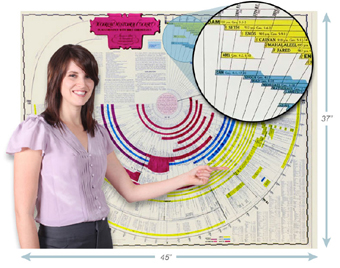
Related articles offer further reading. Each entry’s sources support its specific explanation.
People and events
Reformation in the Netherlands
Sixteenth-century Reformation and later renewal
Christian history
Reformed Christianity developed in the Netherlands over the sixteenth century. The poster’s 1520 is an early Reformation marker, not a demonstrated single foundation date of the Dutch Reformed Church.
Its additional 1600 “Second Reformation” label describes a later current of religious renewal, not a second creation of the same church.
Context, sources and timeline wording
On the Amazing Bible Timeline with World History
1520 Dutch Reformed — 1600 Dutch Second Reformation
Selected label(s) from the corresponding poster track; joined fragments share this quotation and explanation.
The concise dates should not be treated as formal foundation certificates.
Compare AD 1500–AD 1600Compare AD 1600–AD 1700Reading options
Popes in the Reformation and early-modern period
Selected pontificates, AD 1503–1724
Christian history
Selected pontificates include Julius II (1503–1513), Leo X (1513–1521), Clement VII (1523–1534), Paul III (1534–1549), Gregory XIII (1572–1585), Innocent XI (1676–1689) and Innocent XIII (1721–1724). These are accession and reign dates, not descriptions of everything each pope did.
The claim that Innocent XIII was the eighth pope in his family is not established by the papal chronology.
Unconfirmed detail: The family count remains unconfirmed.
Word help: Reign · Accession · Pontificate and papacy
- Reign
- The time a king, queen or other ruler holds power. These are not necessarily the years of that person’s life.
- Accession
- The beginning of a ruler’s time in power.
- Pontificate and papacy
- A pontificate is a pope’s time in office. Papacy means the office of the pope or the institution associated with it.
Context, sources and timeline wording
On the Amazing Bible Timeline with World History
JULIUS II 1503 — LEO X 1513 — CLEMENT VII 1523 — PAUL III 1534 — GREGORY XIII 1572 — INNOCENT XI 1676 — INNOCENT XIII 1721 (the 8th Pope in his family).
Selected label(s) from the corresponding poster track; joined fragments share this quotation and explanation.
Compare AD 1500–AD 1600Compare AD 1600–AD 1700Compare AD 1700–AD 1750Reading options
John Calvin is born
AD 1509
Christian history
John Calvin was born in France in 1509. His later writings and work in Geneva became influential in Reformed Christianity; this entry marks his birth, not the founding of a church.
Context, sources and timeline wording
On the Amazing Bible Timeline with World History
John Calvin b. 1509 (Fr.)
Selected label(s) from the corresponding poster track; joined fragments share this quotation and explanation.
Compare AD 1500–AD 1600Reading options
Luther’s challenge to indulgences
Ninety-five Theses, AD 1517
Christian history
Martin Luther’s challenge to indulgences became a major starting point of the Protestant Reformation. The Lutheran churches developed through later controversies and institutional changes; 1517 is not the date every Lutheran body was formally founded.
Word help: Indulgence
- Indulgence
- In Catholic teaching, a release from some or all of the remaining punishment for sins already forgiven. It is distinct from forgiveness of the sin itself. Catholic Catechism, 1471–1473
Context, sources and timeline wording
On the Amazing Bible Timeline with World History
1517 Lutheran Reform movement begins
Selected label(s) from the corresponding poster track; joined fragments share this quotation and explanation.
Compare AD 1500–AD 1600Reading options
Luther at the Diet of Worms
AD 1521
Christian history
Luther appeared before Emperor Charles V and the imperial assembly and refused to retract his writings without being convinced of error. The Edict of Worms condemned him and his works.
The event was a political and religious confrontation, not a modern parliamentary debate.
Context, sources and timeline wording
On the Amazing Bible Timeline with World History
Diet of: Worms, 1521
Selected label(s) from the corresponding poster track; joined fragments share this quotation and explanation.
Compare AD 1500–AD 1600Reading options
England’s break with papal authority
A sequence of changes, including the Act of Supremacy in 1534
Christian history
The English break with Rome proceeded through political and ecclesiastical measures in the 1530s. The 1534 Act of Supremacy declared Henry VIII supreme head on earth of the Church of England.
The poster’s 1532 and 1534 mark stages of a process, not two unrelated church foundations.
Context, sources and timeline wording
On the Amazing Bible Timeline with World History
1534 Anglican Church — England withdraws from Roman Church 1532
Selected label(s) from the corresponding poster track; joined fragments share this quotation and explanation.
Compare AD 1500–AD 1600Reading options
Trent and restrictions on Bible reading
Council of Trent, 1545–1563; Index rules, 1564
Christian history
Catholic authorities restricted access to some Biblical translations. Rule IV of the 1564 Index required written permission for reading Catholic vernacular translations; other rules prohibited particular editions.
This was a restrictive policy, but not a decree in 1545 forbidding every person from reading all Scripture in every language.
Dates: The date, kinds of translation and conditions of permission matter.
Context, sources and timeline wording
On the Amazing Bible Timeline with World History
Scripture reading forbidden at Council of Trent 1545
Selected label(s) from the corresponding poster track; joined fragments share this quotation and explanation.
Compare AD 1500–AD 1600Reading options
Christian missions and persecution in Japan
Xavier’s arrival in 1549; later suppression · Historical estimate
Christian history and East Asia
Francis Xavier arrived in Japan in 1549. Christian communities grew, but later authorities restricted and suppressed the religion.
Different rulers and regions responded differently, and hidden communities continued to practice. The geographical heading “Japan” is not a separate dated event.
Context: Mission, conversion and persecution occurred over a longer sequence.
Context, sources and timeline wording
On the Amazing Bible Timeline with World History
JAPAN — Christianity introduced by Francis Xavier. (Jesuit) — Great persecution of Christians
Selected label(s) from the corresponding poster track; joined fragments share this quotation and explanation.
Compare AD 1500–AD 1600Compare AD 1600–AD 1700Reading options
The Peace of Augsburg
AD 1555
Christian history
The settlement recognized coexistence between Catholic and Lutheran imperial estates and gave rulers important religious powers over their territories. It did not grant equal religious freedom to everyone or include every Protestant confession.
Context, sources and timeline wording
On the Amazing Bible Timeline with World History
Augsburg 1555
Selected label(s) from the corresponding poster track; joined fragments share this quotation and explanation.
Compare AD 1500–AD 1600Reading options
John Knox and the Scottish Reformation
Scottish Reformation settlement, AD 1560
Christian history
John Knox helped establish the Reformed Church of Scotland in 1560. Presbyterian institutions developed over time.
Knox’s birth year is uncertain; modern references often place it around 1513–1514 rather than the poster’s 1503.
Context: The Reformation milestone is firmer than the stated birth year.
Context, sources and timeline wording
On the Amazing Bible Timeline with World History
1560 Presbyterian — John Knox b. 1503 in Scotland. Pioneer in Puritanism.
Selected label(s) from the corresponding poster track; joined fragments share this quotation and explanation.
Compare AD 1500–AD 1600Reading options
The Saint Bartholomew’s Day massacres
Beginning in Paris, August AD 1572
Christian history
The killing of Huguenot leaders in Paris was followed by wider violence against Protestants there and in other French towns. This episode belongs to the French Wars of Religion; a brief label should not reduce its causes or participants to every member of a Christian denomination.
Word help: Huguenots
- Huguenots
- A historical name for French Protestants. Protestant Museum: Huguenot refugees
Context, sources and timeline wording
On the Amazing Bible Timeline with World History
Massacre of St. Bartholomew 1572
Selected label(s) from the corresponding poster track; joined fragments share this quotation and explanation.
Compare AD 1500–AD 1600Reading options
Early Baptist congregations
Helwys in England, 1612; Williams in Providence, conventionally 1638–1639 · Historical estimate
Christian history
Baptist beginnings involve different congregations rather than one worldwide founding date. Thomas Helwys established a congregation in England in 1612.
The poster instead highlights Roger Williams’s early congregation in Providence, usually dated 1638 or 1639. These are different places and milestones.
Context: The American congregation is not the beginning of the entire Baptist tradition.
Context, sources and timeline wording
On the Amazing Bible Timeline with World History
1638 First Baptist Church founded by Roger Williams
Selected label(s) from the corresponding poster track; joined fragments share this quotation and explanation.
Compare AD 1600–AD 1700Reading options
George Fox and the Society of Friends
Fox’s experience in 1647; movement growth in the following years · Historical estimate
Christian history
George Fox’s spiritual experience in 1647 was important to his later ministry. The Society of Friends, or Quakers, emerged through preaching and gathered communities in the years that followed.
The poster’s date marks a formative experience rather than a single charter founding every Friends meeting.
Context, sources and timeline wording
On the Amazing Bible Timeline with World History
1647 Religious Society of Friends (Quakers)
Selected label(s) from the corresponding poster track; joined fragments share this quotation and explanation.
Compare AD 1600–AD 1700Reading options
Pascal’s night of religious conviction
November 23, AD 1654
Christian history
Blaise Pascal recorded a profound religious experience that he understood as an encounter with the God of Abraham, Isaac and Jacob and of Jesus Christ. His note, often called the Memorial, belongs to his personal Christian testimony rather than a publicly verifiable supernatural event.
Context, sources and timeline wording
On the Amazing Bible Timeline with World History
1654 Conversion of Pascal
Selected label(s) from the corresponding poster track; joined fragments share this quotation and explanation.
Compare AD 1600–AD 1700Reading options
The Massachusett-language Bible
New Testament in 1661; complete Bible in 1663
Christian history and Americas
The translation associated with John Eliot appeared as a New Testament in 1661 and a complete Bible in 1663. Indigenous translators and the Nipmuc printer Wowaus, known as James Printer, were essential to the work.
Massachusett is an Algonquian language; “Indian tongue” should not imply one language spoken by all Indigenous peoples.
Dates: The two publication dates identify different editions.
Context, sources and timeline wording
On the Amazing Bible Timeline with World History
1661 Bible published in Algonkian Native American Language — John Eliot translated the Bible into the Indian tongue 1663
Selected label(s) from the corresponding poster track; joined fragments share this quotation and explanation.
Compare AD 1600–AD 1700Reading options
The Edict of Nantes is revoked
Edict of Fontainebleau, AD 1685
Christian history
Louis XIV revoked the Edict of Nantes in 1685, intensifying restrictions on French Protestants and contributing to flight and clandestine worship. The poster prints 1675; the revocation belongs ten years later.
Dates: The revocation date is 1685, not 1675.
Context, sources and timeline wording
On the Amazing Bible Timeline with World History
1675 Edict of Nantes revoked
Selected label(s) from the corresponding poster track; joined fragments share this quotation and explanation.
Compare AD 1600–AD 1700Reading options
Venetian losses in the Morea
Ottoman gains around AD 1500
Mediterranean
The Ottoman capture of Venetian strongholds in the Morea, the Peloponnese, weakened Venice’s position around 1500. The label compresses changes at particular ports; it does not mean Venice never again held territory there.
Context, sources and timeline wording
On the Amazing Bible Timeline with World History
Venetians driven from Morea 1500
Selected label(s) from the corresponding poster track; joined fragments share this quotation and explanation.
Compare AD 1500–AD 1600Reading options
Enslavement and the Atlantic colonies
A system expanding over centuries
Atlantic world
European colonial economies in the Americas increasingly depended on the forced labor of enslaved Africans and their descendants. Atlantic trafficking began before the poster’s 1517 marker and expanded unevenly by colony and period.
A single date cannot identify the beginning of all slavery in either the Caribbean or the Americas.
Names and identities: The poster’s historical terminology is preserved in the notes; the explanation identifies people subjected to enslavement.
Context, sources and timeline wording
On the Amazing Bible Timeline with World History
1517 Negro slavery introduced into West Indies — SLAVERY IN AMERICA
Selected label(s) from the corresponding poster track; joined fragments share this quotation and explanation.
Compare AD 1500–AD 1600Compare AD 1600–AD 1700Compare AD 1700–AD 1750Reading options
China’s overseas trade and Jesuit contacts
Sixteenth- and seventeenth-century encounters
East Asia
Portuguese, Spanish and Dutch traders participated in different Asian maritime networks, while Jesuits established new Christian missions and scholarly exchanges in China. These were not one coordinated “opening,” and Christianity had reached China in earlier periods.
Contact and access remained subject to Chinese political decisions and changing restrictions.
Context: Trade and mission histories are related but distinct.
Context, sources and timeline wording
On the Amazing Bible Timeline with World History
CHINA — Opening to Dutch, Portuguese, and Spanish — Christianity spread by the Jesuits
Selected label(s) from the corresponding poster track; joined fragments share this quotation and explanation.
Compare AD 1500–AD 1600Compare AD 1600–AD 1700Compare AD 1700–AD 1750Reading options
Ponce de León reaches Florida
Spanish expedition, AD 1513
Americas
Ponce de León’s expedition reached Florida in 1513. The date marks Spanish exploration of an already inhabited region, not its first human discovery or the establishment of a lasting colony.
Context, sources and timeline wording
On the Amazing Bible Timeline with World History
1513 Ponce de Leon in Florida
Selected label(s) from the corresponding poster track; joined fragments share this quotation and explanation.
Compare AD 1500–AD 1600Reading options
Balboa reaches the Pacific from Panama
AD 1513
Americas
Balboa’s expedition crossed the Isthmus of Panama and reached the Pacific in 1513. His claim for the Spanish Crown was an assertion of European sovereignty, not the discovery of an ocean unknown to its Indigenous coastal peoples.
Context, sources and timeline wording
On the Amazing Bible Timeline with World History
1513 Balboa discovered Pacific
Selected label(s) from the corresponding poster track; joined fragments share this quotation and explanation.
Compare AD 1500–AD 1600Reading options
Suleiman the Magnificent
Reign of AD 1520–1566
Ottoman Empire
Suleiman the Magnificent ruled during a major period of Ottoman military power, administration and artistic patronage. He is conventionally numbered Suleiman I today.
The poster’s “Solyman II” should not be confused with the later seventeenth-century sultan of that number.
Dates: The reign identifies Suleiman I in current numbering.
Word help: Reign
- Reign
- The time a king, queen or other ruler holds power. These are not necessarily the years of that person’s life.
Context, sources and timeline wording
On the Amazing Bible Timeline with World History
Turkey flourished under SOLYMAN II (sultan) 1520-1566
Selected label(s) from the corresponding poster track; joined fragments share this quotation and explanation.
Compare AD 1500–AD 1600Reading options
Tyndale’s English New Testament
Incomplete Cologne printing in 1525; Worms edition in 1526
Bible translation
Tyndale translated the New Testament into English from Greek. A 1525 printing attempt survives in an incomplete fragment; the complete printed edition appeared in 1526.
Both dates belong to the publication story, but do not identify the same edition.
Context: The printing attempt and complete edition are distinguished.
Context, sources and timeline wording
On the Amazing Bible Timeline with World History
Tyndale translated the New Testament 1525
Selected label(s) from the corresponding poster track; joined fragments share this quotation and explanation.
Compare AD 1500–AD 1600Reading options
Coverdale and the Great Bible
Coverdale Bible in 1535; Great Bible in 1539
Bible translation
Myles Coverdale’s 1535 publication was a complete printed English Bible, not only an Old Testament. The Great Bible followed in 1539 for use in English churches.
They belong to a sequence of translations and revisions rather than one unchanged edition.
Context: “Old Bible” should not be read as limiting Coverdale’s work to the Old Testament.
Context, sources and timeline wording
On the Amazing Bible Timeline with World History
First edition of the Old Bible by Coverdale 1535 — Great Bible 1539
Selected label(s) from the corresponding poster track; joined fragments share this quotation and explanation.
Compare AD 1500–AD 1600Reading options
De Soto’s expedition reaches the Mississippi
AD 1541
Americas
Hernando de Soto’s expedition reached the Mississippi River in 1541 during its violent passage through Indigenous territories. “Discovered” expresses the expedition’s European viewpoint; the river was already known and used by the people living there.
Context, sources and timeline wording
On the Amazing Bible Timeline with World History
1541 De Soto discovered Miss. River
Selected label(s) from the corresponding poster track; joined fragments share this quotation and explanation.
Compare AD 1500–AD 1600Reading options
The Geneva Bible
New Testament in 1557; complete Bible in 1560
Bible translation
The Geneva New Testament preceded the complete Geneva Bible. The poster’s 1557 date applies to the New Testament; the whole Bible appeared in 1560 and became influential among English-speaking Protestants.
Dates: The date depends on which edition is meant.
Context, sources and timeline wording
On the Amazing Bible Timeline with World History
Geneva Bible 1557
Selected label(s) from the corresponding poster track; joined fragments share this quotation and explanation.
Compare AD 1500–AD 1600Reading options
Huguenot settlement ventures
1562 and 1564; poster's 1535 event unresolved
Americas
French Huguenot settlement ventures in southeastern North America include Ribault’s expedition in 1562 and Laudonnière’s Fort Caroline settlement in 1564.
Unconfirmed detail: The wall chart gives 1535, but the particular event intended by that date has not been identified.
Word help: Huguenots
- Huguenots
- A historical name for French Protestants. Protestant Museum: Huguenot refugees
Context, sources and timeline wording
On the Amazing Bible Timeline with World History
1535 Huguenots (Fr.) in America
Compare AD 1500–AD 1600Reading options
William Shakespeare is born
April, AD 1564
Europe
Shakespeare was born in Stratford-upon-Avon in 1564. His baptism on April 26 is documented; the frequently celebrated April 23 birthday is traditional, not established by a surviving birth record.
Context, sources and timeline wording
On the Amazing Bible Timeline with World History
William Shakespeare born 1564
Selected label(s) from the corresponding poster track; joined fragments share this quotation and explanation.
Compare AD 1500–AD 1600Reading options
The Spanish founding of St. Augustine
1565
Americas
Pedro Menéndez de Avilés and Spanish settlers establish St. Augustine in Florida in 1565.
The poster marks the settlement '(Fr.)'; the founding expedition was Spanish.
Names and identities: Founders identified as Spanish, not French
Context, sources and timeline wording
On the Amazing Bible Timeline with World History
1565 St. Augustine founded (Fr.)
Compare AD 1500–AD 1600Reading options
Ottoman conquest of Cyprus
Conquest in AD 1570–1571
Mediterranean
Ottoman forces conquered Cyprus from Venice during a military campaign completed with the fall of Famagusta. “Ceded” should not imply a peaceful voluntary transfer in 1571.
Context: The change of rule followed conquest.
Context, sources and timeline wording
On the Amazing Bible Timeline with World History
Cyprus ceded to Turkey by Venice 1571
Selected label(s) from the corresponding poster track; joined fragments share this quotation and explanation.
Compare AD 1500–AD 1600Reading options
Drake’s circumnavigation
Voyage of AD 1577–1580
Atlantic and Pacific
Francis Drake’s expedition sailed around the world between 1577 and 1580. The voyage combined exploration with attacks on Spanish shipping and possessions; it was not the first circumnavigation of the globe.
Context, sources and timeline wording
On the Amazing Bible Timeline with World History
1577-1580 Sir Francis Drake sailed the Pacific and circled the globe
Selected label(s) from the corresponding poster track; joined fragments share this quotation and explanation.
Compare AD 1500–AD 1600Reading options
The end of Songhay imperial power
AD 1591
Africa
The Songhay empire’s political dominance ended with the Moroccan invasion in 1591. This did not erase the region’s peoples or cultural traditions.
The nearby 1572 on the poster belongs to the Saint Bartholomew entry, not the Songhay event.
Context, sources and timeline wording
On the Amazing Bible Timeline with World History
1591 Fall of Songhai Empire
Selected label(s) from the corresponding poster track; joined fragments share this quotation and explanation.
Compare AD 1500–AD 1600Reading options
Oliver Cromwell is born
AD 1599
Europe
Oliver Cromwell was born in 1599. His military and political prominence belongs to the seventeenth-century civil wars and Commonwealth, not this birth year.
Context, sources and timeline wording
On the Amazing Bible Timeline with World History
Oliver Cromwell born 1599
Selected label(s) from the corresponding poster track; joined fragments share this quotation and explanation.
Compare AD 1500–AD 1600Reading options
Jamestown and English Virginia
Jamestown founded in AD 1607
Americas
English colonists established Jamestown in 1607 within the homeland of the Powhatan peoples. It became a lasting English settlement, not the beginning of Virginia’s human history.
Context, sources and timeline wording
On the Amazing Bible Timeline with World History
1607 Virginia settled by the English
Selected label(s) from the corresponding poster track; joined fragments share this quotation and explanation.
Compare AD 1600–AD 1700Reading options
Champlain establishes Québec
1608
Americas
Samuel de Champlain establishes Québec in 1608, as the current poster states.
Context, sources and timeline wording
On the Amazing Bible Timeline with World History
1608 Quebec founded by Samuel De Champlain
Compare AD 1600–AD 1700Reading options
The Authorized or King James Version
First published in AD 1611
Bible translation
The King James Bible was produced by a group of translators and first published in 1611. It drew on earlier English translations as well as Biblical-language texts.
“Authorized Version” is its familiar English title, not a claim that it was the first English Bible.
Context, sources and timeline wording
On the Amazing Bible Timeline with World History
Authorized Version 1611
Selected label(s) from the corresponding poster track; joined fragments share this quotation and explanation.
Compare AD 1600–AD 1700Reading options
The first Romanov tsars
Michael from 1613; Alexis from 1645
Russia
Michael Romanov became tsar in 1613, followed by his son Alexis in 1645. “First” and “second” identify their place in the Romanov dynasty, not the first and second rulers ever to bear the title tsar.
Context: Dynastic numbering is distinguished from the older title.
Word help: Dynasty
- Dynasty
- A line of rulers, usually from the same family. A dynasty’s dates describe its rule, not one person’s lifetime.
Context, sources and timeline wording
On the Amazing Bible Timeline with World History
Michael Romanov first Czar 1613 — Alexis I second Czar 1645
Selected label(s) from the corresponding poster track; joined fragments share this quotation and explanation.
Compare AD 1600–AD 1700Reading options
The Plymouth settlement
AD 1620
Americas
The Mayflower settlers established Plymouth in 1620. They included Separatist Christians often called Pilgrims; “Puritans” is a broader label and should not blur Plymouth with the later Massachusetts Bay settlement.
The colony was established in Wampanoag homelands.
Context: Plymouth’s Pilgrims and later Puritan migration are related but distinct.
Context, sources and timeline wording
On the Amazing Bible Timeline with World History
1620 Plymouth settled by Pilgrims — 1620 Puritans found Plymouth MA USA
Selected label(s) from the corresponding poster track; joined fragments share this quotation and explanation.
Compare AD 1600–AD 1700Reading options
New Netherland becomes New York
Dutch colonization in the 1620s; English takeover in 1664
Americas
Dutch trading and voyages preceded formal colonization. Settlers arrived at Governors Island in 1624, and New Amsterdam developed on Manhattan in the following years.
English forces took the colony in 1664. The poster’s 1613 is an early-contact marker, not the standard foundation date of New Amsterdam.
Context: Trading contact, settlement and change of government are separated.
Context, sources and timeline wording
On the Amazing Bible Timeline with World History
1613 New York by Dutch — 1664 N.Y. taken by the English
Selected label(s) from the corresponding poster track; joined fragments share this quotation and explanation.
Compare AD 1600–AD 1700Reading options
Dutch trading on the Connecticut River
Trading post at present-day Hartford, AD 1633
Americas
The Dutch House of Hope trading post belongs to the early colonial contest over the Connecticut River. The label does not mean that all Connecticut was founded as a Dutch colony or that the area lacked Indigenous inhabitants.
Context, sources and timeline wording
On the Amazing Bible Timeline with World History
1633 Connecticut settled by Dutch
Selected label(s) from the corresponding poster track; joined fragments share this quotation and explanation.
Compare AD 1600–AD 1700Reading options
The French settlement of Montréal
Ville-Marie founded in AD 1642
Americas
French settlers founded Ville-Marie, the settlement that became Montréal, in 1642. The commemorated foundation is a colonial milestone in a region with a much longer Indigenous history.
Context, sources and timeline wording
On the Amazing Bible Timeline with World History
1642 Montreal founded by French
Selected label(s) from the corresponding poster track; joined fragments share this quotation and explanation.
Compare AD 1600–AD 1700Reading options
The New England Confederation
Agreement of AD 1643
Americas
Massachusetts Bay, Plymouth, Connecticut and New Haven formed a confederation for mutual defense and cooperation. This was an alliance of particular colonies, not the creation of a single New England government.
Context, sources and timeline wording
On the Amazing Bible Timeline with World History
1643 Confederation of N. Eng. Colonies
Selected label(s) from the corresponding poster track; joined fragments share this quotation and explanation.
Compare AD 1600–AD 1700Reading options
Qing rule and the queue hairstyle
Qing rule in China from 1644; revolution and abdication in 1911–1912
East Asia
Manchu conquest brought the Qing to power in China. The male queue hairstyle became associated with the new ruling order and political allegiance; it was not an unchanged custom worn by every Chinese person throughout history.
The dynasty’s ending is variously marked by the 1911 revolution or the emperor’s 1912 abdication.
Dates: The long date range is associated with Qing rule, not an individual hairstyle’s universal use.
Word help: Dynasty
- Dynasty
- A line of rulers, usually from the same family. A dynasty’s dates describe its rule, not one person’s lifetime.
Context, sources and timeline wording
On the Amazing Bible Timeline with World History
Queue wearing began 1644-1912 — The Qing Dynasty
Selected label(s) from the corresponding poster track; joined fragments share this quotation and explanation.
Compare AD 1600–AD 1700Compare AD 1700–AD 1750Reading options
The Ottoman–Venetian war over Crete
War of AD 1645–1669
Mediterranean
The war beginning in 1645 centered on Crete and ended with the surrender of Candia in 1669. The Morea is a different region.
The poster’s parenthetical combines the start of the Cretan war with the name of another theater of Ottoman–Venetian conflict.
Context: Crete and the Morea are distinguished.
Context, sources and timeline wording
On the Amazing Bible Timeline with World History
War about Venice (Morea) 1645
Selected label(s) from the corresponding poster track; joined fragments share this quotation and explanation.
Compare AD 1600–AD 1700Reading options
Mehmed IV and changing Ottoman fortunes
Reign of AD 1648–1687
Ottoman Empire
Mehmed IV came to the throne in 1648. His long reign included instability, military successes and major reverses.
The poster’s “great thriving” is a broad evaluation and should not imply uninterrupted prosperity beginning at his accession.
Word help: Reign · Accession
- Reign
- The time a king, queen or other ruler holds power. These are not necessarily the years of that person’s life.
- Accession
- The beginning of a ruler’s time in power.
Context, sources and timeline wording
On the Amazing Bible Timeline with World History
Great thriving under Mohammed IV 1648
Selected label(s) from the corresponding poster track; joined fragments share this quotation and explanation.
Compare AD 1600–AD 1700Reading options
The Dutch station at the Cape
AD 1652
Africa
The Dutch East India Company established a provisioning station under Jan van Riebeeck at the Cape. Colonial farming and expansion developed afterward in an already inhabited region; “colonizing Boers” compresses that later development into the initial company arrival.
Context, sources and timeline wording
On the Amazing Bible Timeline with World History
1652 Dutch at Cape of Good Hope colonizing Boers
Selected label(s) from the corresponding poster track; joined fragments share this quotation and explanation.
Compare AD 1600–AD 1700Reading options
Two French Mississippi expeditions
1673 and 1682
Americas
Jolliet and Marquette travel along the Mississippi in 1673. La Salle's expedition claims the Mississippi basin for France in 1682.
The poster's short entry combines La Salle's name with the earlier expedition's year.
Dates: Two expeditions separated: 1673 and 1682
Context, sources and timeline wording
On the Amazing Bible Timeline with World History
1673 LaSalle explored the Miss. Riv.
Compare AD 1600–AD 1700Reading options
Pennsylvania’s charter and Philadelphia’s founding
Charter in 1681; city planning and settlement in 1682–1683
Americas
The 1681 charter established William Penn’s Pennsylvania grant. Philadelphia’s planning and initial colonial development followed in 1682–1683.
The poster’s 1681 compresses the colony’s charter and the city’s founding into one date.
Context: The charter and the city’s settlement are different milestones.
Context, sources and timeline wording
On the Amazing Bible Timeline with World History
1681 Philadelphia settled
Selected label(s) from the corresponding poster track; joined fragments share this quotation and explanation.
Compare AD 1600–AD 1700Reading options
Peter the Great and the Russian state
Joint rule from 1682; sole rule from 1696; imperial title in 1721
Russia
Peter shared the throne with Ivan V until Ivan’s death in 1696. Victory over Sweden at Poltava in 1709 strengthened his position.
In 1721 the imperial title and a state-supervised Holy Synod marked major reforms. Catherine I succeeded him in 1725.
State supervision of the Russian Church did not make the emperor the spiritual head of all Eastern Orthodox Christians.
Context: The Russian Church is not identical to the entire Orthodox communion.
Context, sources and timeline wording
On the Amazing Bible Timeline with World History
Ivan V and Peter the Great 1682 — Ivan V dies 1696 — Peter defeats Swedes 1709 — Emperor of Russia, Head of Greek or Orthodox church — Catherine I 1725
Selected label(s) from the corresponding poster track; joined fragments share this quotation and explanation.
Compare AD 1600–AD 1700Compare AD 1700–AD 1750Reading options
The Salem witchcraft trials
AD 1692
Americas
Accusations of witchcraft led to trials, executions and imprisonment in Massachusetts. The label identifies the prosecutions; it is not evidence that those accused actually practiced supernatural harm.
Context, sources and timeline wording
On the Amazing Bible Timeline with World History
1692 Salem Witchcraft
Selected label(s) from the corresponding poster track; joined fragments share this quotation and explanation.
Compare AD 1600–AD 1700Reading options
Fort Maurepas and colonial Louisiana
1699
Americas
Iberville establishes Fort Maurepas near present-day Biloxi in 1699, an early French colonial foothold in the territory called Louisiana. The place was not within the boundaries of today's state of Louisiana.
Context: Colonial territory and settlement location clarified
Context, sources and timeline wording
On the Amazing Bible Timeline with World History
1699 Louisiana settled
Compare AD 1600–AD 1700Reading options
Asante expansion and Atlantic commerce
Early eighteenth-century growth · Historical estimate
Africa
The Asante kingdom expanded in the early eighteenth century and participated in long-distance commerce that included gold, firearms and enslaved people. The poster’s 1700–1717 is not the whole lifespan of the empire, nor should one exchange summarize all Asante society.
Context: The short trade label is placed within a broader history.
Context, sources and timeline wording
On the Amazing Bible Timeline with World History
1700-1717 Ashante Empire trades slaves for guns
Selected label(s) from the corresponding poster track; joined fragments share this quotation and explanation.
Compare AD 1700–AD 1750Reading options
The eighteenth-century Atlantic slave trade
A major century of forced transportation
Atlantic world
The eighteenth century saw an immense volume of forced transportation across the Atlantic. Voyages varied by route, imperial power and decade.
The poster’s “1700-s” describes a century, not a peak in the single year 1700.
Context: The printed label is a century marker.
Context, sources and timeline wording
On the Amazing Bible Timeline with World History
1700-s Height of Atlantic slave trade
Selected label(s) from the corresponding poster track; joined fragments share this quotation and explanation.
Compare AD 1700–AD 1750Reading options
Benjamin Franklin is born
AD 1706
Americas
Benjamin Franklin was born in Boston in 1706. His later work as a printer, investigator of electricity and statesman belongs to a longer life than this birth entry represents.
Context, sources and timeline wording
On the Amazing Bible Timeline with World History
1706 Benj. Franklin born
Selected label(s) from the corresponding poster track; joined fragments share this quotation and explanation.
Compare AD 1700–AD 1750Reading options
Belgrade between empires
Habsburg rule between AD 1718 and 1739
Europe
Belgrade changed hands repeatedly between Ottoman and Habsburg forces. It was under Habsburg rule between the treaties of 1718 and 1739.
The poster’s “Bulgrade a part of Serbia 1730” is a geographic shorthand, not the date of an independent Serbian national state.
Dates: Geographic location is distinguished from political sovereignty.
Context, sources and timeline wording
On the Amazing Bible Timeline with World History
Bulgrade a part of Serbia 1730
Selected label(s) from the corresponding poster track; joined fragments share this quotation and explanation.
Compare AD 1700–AD 1750Reading options
The Swahili epic of Tambuka
Manuscript tradition dated AD 1728
Africa
Utendi wa Tambuka is a Swahili religious epic recounting conflicts associated with early Islamic history. Its 1728 date belongs to the poem’s manuscript and literary history, not to all the battles narrated in it.
Dates: Literary composition and narrated events are different dates.
Context, sources and timeline wording
On the Amazing Bible Timeline with World History
1728 Epic Poem Story of Tambuka
Selected label(s) from the corresponding poster track; joined fragments share this quotation and explanation.
Compare AD 1700–AD 1750Reading options
Georgia’s charter and Savannah’s settlement
1732–1733
Americas
Georgia receives its colonial charter in 1732. Colonists led by James Oglethorpe establish Savannah in 1733.
Dates: The wall chart’s 1732 label marks the charter, not the 1733 settlement.
Context, sources and timeline wording
On the Amazing Bible Timeline with World History
1732 Georgia settled (Oglethorpe)
Compare AD 1700–AD 1750Reading options
Thomas Jefferson is born
AD 1743
Americas
Thomas Jefferson was born in Virginia in 1743. This is a birth marker; his major political career belongs mainly to the next period.
Context, sources and timeline wording
On the Amazing Bible Timeline with World History
1743 Thomas Jefferson born
Selected label(s) from the corresponding poster track; joined fragments share this quotation and explanation.
Compare AD 1700–AD 1750Reading options