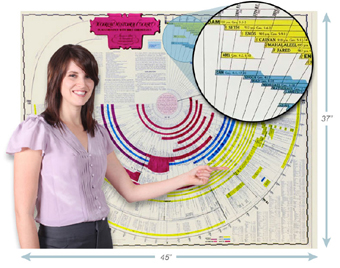
Explore church history alongside governments, discoveries and changes in everyday life. Read across a time band to see what was happening around the world. This resource works on its own; the wall chart is not required.
Related articles offer further reading. Each entry’s sources support its specific explanation.
Each band covers 25 years, not one simultaneous event. A long reign or development can appear in more than one band; uncertain dates remain uncertain. Event coverage ends in 2022; the edition date identifies later editorial revisions, not additional events.
Poster themes and short labels
These labels belong to the wall chart’s broader story or Christian interpretation. They are kept here without forcing them into a single dated event.
End of the temporal power of the Pope 1798
Theme or label, not a separate dated event
Wall-chart themes and labels
This entry concerns the interruption of papal government in 1798, not a permanent end to all papal territorial rule. See the dated events and the poster’s additional papal entries.
French forces occupied Rome and the Roman Republic deposed Pius VI as temporal ruler in February 1798. This was an interruption, not the final end: papal government was restored in 1799–1800, and the Papal States continued until Rome was incorporated into the Kingdom of Italy in 1870. The nearby poster line ‘Napolean abolished the temporal power of the Pope 1798’ describes the same 1798 episode, so the online research layer counts the pair once while keeping both printed lines visible.
Sources
Other themes and labelsReading options
Turkey under Christian sway 1830
Theme or label, not a separate dated event
Wall-chart themes and labels
This concise Christian-perspective label does not identify its specific historical referent clearly enough to equate it with Greek independence or the whole Ottoman Empire coming under Christian rule.
Sources
Other themes and labelsReading options
Slavery in America
Theme or label, not a separate dated event
Wall-chart themes and labels
A theme spanning centuries: enslavement, resistance, abolition and emancipation. “America” is a broad geographical label, not one country or one event.
Slavery and emancipation in colonial America and the United States
Sources
Other themes and labelsReading options
Turkey loses domain generally
Theme or label, not a separate dated event
Wall-chart themes and labels
Ottoman territorial contraction unfolded through wars, treaties, revolts and nationalist movements over the eighteenth to twentieth centuries. It is not a single dated event.
Ottoman territorial contraction and dissolution, 18th-20th centuries
Sources
Other themes and labelsReading options
“And in the days of these Kings shall the God of Heaven set up a kingdom.” Dan. 2:34-44
Theme or label, not a separate dated event
Wall-chart themes and labels
The quoted words are from Daniel 2:44; verses 34–44 give the wider Biblical context. Connecting this passage to the diagram’s named European peoples is a Christian interpretive tradition.
“And in the days of these kings shall the God of heaven set up a kingdom…” – Daniel 2:44 (KJV)
Sources
Other themes and labelsReading options
Lombards
Theme or label, not a separate dated event
Wall-chart themes and labels
One of the historical peoples named in the poster’s “Ten Kingdoms” diagram. The connection with Daniel’s ten kingdoms is a historicist Christian interpretation.
Lombards
Word help: Historicist interpretation
- Historicist interpretation
- An approach that connects Biblical prophecy with a sequence of events across later history. Christians differ over those connections.
Sources
Other themes and labelsReading options
Franks
Theme or label, not a separate dated event
Wall-chart themes and labels
One of the historical peoples named in the poster’s “Ten Kingdoms” diagram. Interpretive traditions differ over which kingdoms belong in that list.
Franks
Sources
Other themes and labelsReading options
Huns
Theme or label, not a separate dated event
Wall-chart themes and labels
The Huns were a late-antique people. Their place in the poster’s “Ten Kingdoms” diagram reflects an interpretive tradition, not a modern-period event.
Huns
Sources
Other themes and labelsReading options
Burgundians
Theme or label, not a separate dated event
Wall-chart themes and labels
A historical people included in the poster’s “Ten Kingdoms” diagram. The prophetic connection is an interpretation.
Burgundians
Sources
Other themes and labelsReading options
Saxons
Theme or label, not a separate dated event
Wall-chart themes and labels
A historical people included in the poster’s “Ten Kingdoms” diagram. The prophetic connection is an interpretation.
Saxons
Sources
Other themes and labelsReading options
Japan
Theme or label, not a separate dated event
Wall-chart themes and labels
A geographical heading for the chart’s Japan track, not a dated event.
Japan
Sources
Other themes and labelsReading options
National Awakening
Theme or label, not a separate dated event
Wall-chart themes and labels
The short label does not identify a particular nation or movement. No event or date is inferred from it.
Other themes and labelsReading options
China
Theme or label, not a separate dated event
Wall-chart themes and labels
A geographical heading for the chart’s China track, not a dated event.
China
Sources
Other themes and labelsReading options
Sources for the chart’s interpretive diagram
These references include historical scholarship and examples of Christian interpretation; they do not establish a single agreed list of kingdoms.