Start with these entries, then explore the wider-world comparison. These are reading pointers, not a scale of elapsed time or a complete list of events.
Read across a time band to explore different regions during the same broad period. Biblical dates follow this resource’s timeline chronology; other dates follow their stated sources and traditions. A shared band shows overlap within that framework, not necessarily the same year or independent confirmation of the Biblical dates.
The extended royal track leads through changing imperial control, the Hasmonean state and Herod’s Roman-supported kingdom. These were different forms of government, not a continuous Davidic monarchy.
This is the political setting into which the Gospel birth narratives lead.
Context, sources and timeline wording
On the Amazing Bible Timeline with World History
The Time of the Kings.
Selected label(s) from the corresponding poster track; joined fragments share this quotation and explanation.
Ancestral Pueblo communities farmed and made sophisticated woven containers long before the famous cliff dwellings. “Basketmaker” is an archaeological period label with regional subdivisions.
“Anasazi” is an older name; it should not imply these people disappeared without descendants.
Dates: A regional archaeological sequence, not one precise invention date.
Monte Albán, approximately 500 BC–AD 850; Mitla flourished later · Historical estimate
Americas
Monte Albán began around 500 BC and became a major Zapotec center. Its decline preceded the later prominence of Mitla.
The poster’s 400 BC–AD 1500 band combines places with different histories; it is not the lifespan of one city or the disappearance of the Zapotec people.
Dates: The cities have different chronologies; Mitla is the modern place-name corresponding to the printed “Miktla.”
Cerros, also called Cerro Maya, developed into a ceremonial center on the coast of present-day Belize during the Late Preclassic. Its construction and settlement history spans several phases.
The poster’s 50 BC rise and abandonment within a hundred years are a compressed account, not a complete chronology of occupation.
Names and identities: The named century-wide rise-and-abandonment sequence is not fully established by the cited overview.
Ptolemy gained control in Egypt after Alexander’s death in 323 BC and later adopted the royal title. His dynasty ended with Cleopatra VII’s death and Roman annexation in 30 BC.
Thus 323 and 305 mark different stages rather than contradictory starting dates.
Word help: Dynasty
Dynasty
A line of rulers, usually from the same family. A dynasty’s dates describe its rule, not one person’s lifetime.
Pentateuch translation in the third century BC; further books over time · Historical estimate
Judea and Egypt
The Septuagint tradition begins with the Greek translation of the Torah in Hellenistic Egypt. The Letter of Aristeas tells of seventy-two translators under Ptolemy II.
This later account is important to the translation tradition, but it does not establish that the entire Old Testament was translated in one operation in 280 BC.
Context: The seventy-two-translator tradition concerns the Torah; the larger Greek collection developed over time.
Connected with Greek-speaking kingdoms and cultural influence after Alexander the Great. It does not mean every local culture became Greek.
Torah / Pentateuch
In this timeline, the first five books of the Bible: Genesis, Exodus, Leviticus, Numbers and Deuteronomy.
Septuagint / LXX
Ancient Greek translations of Jewish Scriptures, commonly called the Greek Old Testament. LXX is its traditional abbreviation; the translations were not all made at one time.
Context, sources and timeline wording
On the Amazing Bible Timeline with World History
72 Jews translate the Old Testament into Greek at Alexandria. SEPTUAGINT 280
Selected label(s) from the corresponding poster track; joined fragments share this quotation and explanation.
Judea came under Ptolemaic rule in the struggles following Alexander’s death, before Seleucid conquest in the early second century BC. Josephus’s Antiquities, book 12, discusses Jewish life and rulers in this changing Hellenistic world.
Word help: Hellenistic
Hellenistic
Connected with Greek-speaking kingdoms and cultural influence after Alexander the Great. It does not mean every local culture became Greek.
Approximately 273–232 BC in the cited museum chronology · Historical estimate
South Asia
Ashoka ruled the Maurya empire and promoted Buddhist institutions and an ethic of moral government. His inscriptions are important evidence of imperial policy.
Magadha was the empire’s heartland, not its entire extent.
Qin dynasty, 221–206 BC; wall linking around 220 BC
East Asia
Qin rulers unified the competing states and linked earlier northern defenses. The Great Wall was not a single structure finished in one year; later dynasties rebuilt and extended many sections.
The visible Ming walls are much later than Qin.
Context: Earlier walls, Qin linking and later construction are distinguished.
Word help: Dynasty
Dynasty
A line of rulers, usually from the same family. A dynasty’s dates describe its rule, not one person’s lifetime.
Hannibal crossed the Alps into Italy in 218 BC. After Roman defeats, Fabius Maximus led a strategy of delay rather than risking another immediate pitched battle.
His dictatorship belongs to 217 BC, not to the crossing itself.
Han rulers expanded contacts westward, including Zhang Qian’s diplomatic missions in the second century BC. Trade routes developed through many intermediaries; opening western exchange did not mean direct Chinese control of every route to the Mediterranean.
Word help: Dynasty
Dynasty
A line of rulers, usually from the same family. A dynasty’s dates describe its rule, not one person’s lifetime.
Context, sources and timeline wording
On the Amazing Bible Timeline with World History
202 BC – 220 AD Han Dynasty: opens trade with West.
Selected label(s) from the corresponding poster track; joined fragments share this quotation and explanation.
War in 200–197 BC, settlement in 196; further conquest by 146
Mediterranean
Rome defeated Philip V in the Second Macedonian War and proclaimed Greek freedom in 196 BC. Further wars brought increasingly direct Roman control, with 146 a conventional marker for domination of the mainland.
The earlier Philip II and Alexander had died long before the poster’s 301–146 span.
Context: The war, peace settlement and later provincial arrangements are distinct.
Seleucid rule from about 198 BC; revolt beginning in the 160s BC · Historical estimate
Judea and West Asia
Antiochus III’s victories transferred Judea from Ptolemaic to Seleucid rule. Under Antiochus IV, persecution and conflict over Jewish worship helped provoke the Maccabean revolt.
Judas and his successors fought and negotiated over decades; the chart’s 167–130 band is a summary of this struggle, not uninterrupted warfare of equal intensity.
Judas Maccabeus was followed in leadership by Jonathan and Simon; later Hasmonean rulers included John Hyrcanus and Alexander Jannaeus. Josephus describes their conflicts and changing relations with the Pharisees.
The poster’s individual numbers are not a reliable set of accession dates: for example, Alexander Jannaeus’s reign is normally placed at 103–76 BC, not beginning in 98.
Dates: The sequence is retained; adjacent chart numbers should not all be interpreted as accessions.
Word help: Reign · Accession
Reign
The time a king, queen or other ruler holds power. These are not necessarily the years of that person’s life.
Growth before AD 1; major monumental city in the following centuries · Historical estimate
Americas
Teotihuacan developed in the Valley of Mexico before becoming a major religious, political and commercial center. Its monumental growth belongs largely to the first several AD centuries.
The poster’s broad description should not place the whole mature city at one BC date.
Marius and Sulla, then Pompey and Julius Caesar, belong to successive struggles for power. Cicero was a statesman and orator amid these conflicts.
The poster’s birth markers for Cicero and Caesar do not date all their political activity. Caesar’s dictatorship ended with his assassination in 44 BC.
Dates: Birth labels and periods of leadership are different kinds of dates.
Himyar flourished from the first century BC into late antiquity · Historical estimate
Arabia
The Arabs band is a broad geographic thread. Himyar was one of several South Arabian kingdoms, centered in what is now Yemen, and flourished much later than the beginning of this page.
It must not stand for every Arab people or all earlier South Arabian states.
Context: The Himyarite kingdom belongs mainly to later periods.
Approximately 100 BC–AD 700; some chronologies begin around AD 100 · Historical estimate
Americas
Nasca communities on Peru’s south coast are known for ceramics, textiles and geoglyphs. Museum chronologies differ on the early boundary, but do not extend the main Nasca sequence from 400 BC to AD 1000 as the poster does.
Paracas is a related earlier coastal tradition, not simply another name for the same period.
Context: The poster’s broad range includes time outside the commonly defined Nasca sequence.
Pompey’s reorganization brought the remaining Seleucid territory in Syria under Roman provincial rule. The new province was not identical in boundaries to the modern country of Syria.
Pompey intervened in the Hasmonean succession conflict and took Jerusalem in 63 BC. Roman supremacy did not immediately mean identical provincial administration across all Judea.
Josephus describes the siege and Pompey’s entry into the temple.
Biblical reference: The relevant Pompey narrative is in Antiquities book 14, not the printed book 13 reference.
Caesar’s Gallic War, book 1, describes his campaign against Ariovistus and allied forces, including Suebi. It is Caesar’s own account of his victories and should be read with awareness of that perspective.
Cleopatra VII reigns 51–30 BC; annexation in 30 BC
Egypt and Rome
Cleopatra VII’s reign began before her alliance with Julius Caesar. She later allied with Mark Antony; their defeat by Octavian led to Egypt’s annexation in 30 BC.
The poster’s “made Queen … by Caesar 63–30” and Egypt-to-Rome 146–30 band compress and misdate separate developments.
Dates: Cleopatra ruled from 51 BC; Egypt was annexed in 30, not 146.
Word help: Reign
Reign
The time a king, queen or other ruler holds power. These are not necessarily the years of that person’s life.
Julius Caesar reorganized the Roman calendar around the solar year. The transition year was extended to restore alignment with the seasons, and the new calendar took effect in 45 BC.
This calendar reform did not create the much later BC/AD era system.
Octavian’s victory over Antony and Cleopatra at Actium in 31 BC was decisive in the civil wars. He received the title Augustus in 27 BC.
The poster’s repeated 31 marker points to the victory, not the date he first received that name or the instant disappearance of all republican institutions.
Context: Military victory and the Augustan settlement are separate stages.
Roman forces campaigned east of the Rhine, and Drusus reached the Elbe in 9 BC. Reaching a river did not create permanent Roman control over every people between it and the Rhine.
These campaigns also differ from the Roman disaster of AD 9.
Context: 9 BC and AD 9 are different events; conquest here was not permanently secured.
Explore family lines, successive Biblical episodes, cultural traditions and themes spanning several generations. Their date lines identify the kind of connection and any uncertainty.
Biblical account
John the Baptist’s birth
Luke 1, before Jesus’s birth
Biblical account
Luke 1 recounts the announcement to Zechariah, Elizabeth’s pregnancy, John’s birth and his prophetic calling. The narrative places these events during Herod’s reign.
It does not supply an exact BC year for John’s birth.
Word help: Reign
Reign
The time a king, queen or other ruler holds power. These are not necessarily the years of that person’s life.
Matthew describes Jesus’s birth in Bethlehem during Herod’s reign. Luke also recounts his birth and its Roman setting.
The chart’s central era boundary expresses the Christian organization of the timeline; neither Gospel names a “year zero,” and the BC/AD calendar has no year zero.
Dates: The era boundary is not an exact date supplied by the Gospels.
Word help: Reign
Reign
The time a king, queen or other ruler holds power. These are not necessarily the years of that person’s life.
Leviticus 25 prescribes a seventh-year rest for the land and a Jubilee after seven cycles of seven years. The long chart track illustrates this recurring pattern; it is not a dated record proving that every cycle was observed throughout Israel’s history.
A proposed voyage by sailors from China and Japan along the American coast remains unconfirmed. Research on the ancient peopling of the Americas does not establish this particular named voyage.
The sailors, route and period lack a dated archaeological or documentary link in the sources used here.
Unconfirmed detail: The specific sailors, route and period are unconfirmed.
Context, sources and timeline wording
On the Amazing Bible Timeline with World History
Sailors from China and Japan follow coast of America from Alaska to South America
Selected label(s) from the corresponding poster track; joined fragments share this quotation and explanation.
Haida and Kwakwaka’wakw communities have distinct histories, languages and homelands on the Pacific Northwest coast. The poster’s “Haida and Kwakiutl” label is a broad regional reference, not a date for their first existence or evidence that they were one people.
Dates: The chart position should not be read as a founding date.
The familiar prayer-writing system is documented much later
Americas
Mi’kmaq people have rich oral and visual traditions. The best-documented hieroglyphic prayer system is associated with missionary work from the seventeenth century.
That evidence does not establish a script in Nova Scotia in this BC period; earlier graphic practices and the later prayer system are separate questions.
Dates: A BC date for the specific script is not established.
“Migration of Nations,” “Aryan Stock” and “Indo-German Tribes” are older organizing labels on the chart. Indo-Iranian and Indo-European are language-family terms; they do not establish one biological race, a single migrating nation or an exact route in this period.
Names and identities: Language relationships are not a complete migration history or racial classification.
Distinct ancient groups, not a single migrating nation
West Asia and Europe
Scythians and Cimmerians appear in ancient records as different groups associated with the steppe and neighboring regions. Their histories cannot be reduced to a single line of ancestry or a uniform migration in this century.
Context: The chart’s shared track is a comparison device, not a proven family tree.
Zoroaster is the Iranian religious teacher associated with the origins of Zoroastrianism. His date is disputed; linguistic arguments often place him in the second millennium BC.
The poster’s probable 2200 BC date is not an established consensus. “Indo-German” is an older label related to Indo-European language classification, not a single dated tribe or biological race.
Dates: The date remains uncertain, and language-family terms are not racial categories.
China experienced major conflicts, but “Time of incessant warfare” is too broad to describe every year, region or dynasty. Qin unification and the long Han era should be distinguished from later periods of fragmentation.
Context: The short label is retained without turning it into a literal claim of continuous warfare.
Word help: Dynasty
Dynasty
A line of rulers, usually from the same family. A dynasty’s dates describe its rule, not one person’s lifetime.
Context, sources and timeline wording
On the Amazing Bible Timeline with World History
Time of incessant warfare
Selected label(s) from the corresponding poster track; joined fragments share this quotation and explanation.
These entries appear in this part of the wall chart, but the explained dates fall outside this page’s boundaries. They are retained here so you can find them.
Moche communities flourished on Peru’s north coast, producing monumental architecture and elaborate ceramics and metalwork. “Mochica” is an alternative name used in older accounts.
Dates: The poster begins this culture at 400 BC; the archaeological sequence described here is approximately AD 100–800.
Monumental activity at La Venta ended around 400 BC, while other centers and related traditions continued. The poster’s 300 BC “collapse” compresses a regional transformation; it should not imply that all Olmec people or practices suddenly vanished.
Names and identities: A regional transition, not the disappearance of a people.
The Later Han history records Buddhist patronage associated with the prince of Chu in AD 65. This is evidence of an existing presence, not proof of the religion’s first arrival.
The chart prints “65” on the BC side; the cited historical reference is AD 65.
BC means “Before Christ.” AD stands for anno Domini, Latin for “in the year of the Lord”; it does not mean “after death.” BC year numbers decrease as time moves forward: 1000 BC comes before 500 BC. AD year numbers increase. There is no year zero between 1 BC and AD 1.
BCE and CE
“Before Common Era” and “Common Era” use the same year numbering as BC and AD, respectively. You may see these labels in sources.
About, approximately, c. or ca.
The date is an estimate, not a known exact year. The abbreviations c. and ca. stand for circa, meaning “about.”
Century
A span of 100 years. The first century AD is AD 1–100; the fifth century BC is 500–401 BC.
A range or a time band
A range may describe a lifetime, reign, war or longer development; the entry says which. A comparison band groups events within a span of time, not necessarily the same year. A lifespan bar shows duration within this timeline’s chronological framework, not an independently measured date.
Timeline chronology
A date calculated within this resource’s Biblical framework.
Historical estimate
A date or range drawn from historical or archaeological research. “About” and “approximately” mark an estimate.
Dating debated
More than one dating proposal remains in use. Read the entry for the particular disagreement.
Traditional dating
Dates drawn from a culture’s historical or literary traditions, such as the traditional foundation of Rome or the Trojan War. These are not labeled as Ussher-based Biblical dates. The entry explains its basis.
Biblical account, Christian interpretation and historical evidence
A Biblical account describes what the Bible says. Christian interpretation explains a religious understanding of a text or event and may differ among Christians. Historical evidence includes documents, inscriptions, objects and other sources used to investigate the past. These descriptions identify the kind of information, not a score for its importance.
Dating disputed / undated / outside this period
“Disputed” means different dates or interpretations remain in use. “Undated” means no reliable absolute year is assigned here. “Outside this period” keeps an entry findable when its explained dates fall beyond this page’s boundaries.
Context, sources and timeline wording
Each entry works on its own. Open its notes for sources, fuller explanations and original wording from the wall chart. Significant differences in date or meaning are identified beside the entry.
Short definitions for this reading page. Entry cards also offer word help that opens in place, so you can read a definition without leaving the entry.
Chronology
The order of events and the dates assigned to them. Different calculations or sources can produce different dates.
Dynasty
A line of rulers, usually from the same family. A dynasty’s dates describe its rule, not one person’s lifetime.
Reign
The time a king, queen or other ruler holds power. These are not necessarily the years of that person’s life.
Accession
The beginning of a ruler’s time in power.
Regnal year
A year counted from the start of a ruler’s reign. Different calendar and counting practices can affect its conversion to a BC or AD year.
Hellenistic
Connected with Greek-speaking kingdoms and cultural influence after Alexander the Great. It does not mean every local culture became Greek.
Torah / Pentateuch
In this timeline, the first five books of the Bible: Genesis, Exodus, Leviticus, Numbers and Deuteronomy.
Septuagint / LXX
Ancient Greek translations of Jewish Scriptures, commonly called the Greek Old Testament. LXX is its traditional abbreviation; the translations were not all made at one time.
Bible references and KJV
Genesis 5:5 means the book of Genesis, chapter 5, verse 5; 5:5–8 means verses 5 through 8. “II Kings” means Second Kings. Gen., Exod. and Rev. shorten Genesis, Exodus and Revelation. KJV means King James Version, the English Bible translation used by many linked passages.
These Articles are Written by the Publishers of The Amazing Bible Timeline with World History.
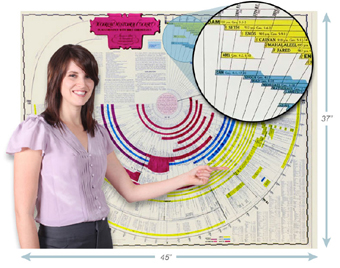
Quickly See Over 6000 Years of Bible and World History Together
Unique circular format - over 1,000 references at your fingertips on this wonderful study companion
Discover interesting facts - Biblical events with scripture references plotted alongside world history showcase fun chronological relationships
Attractive, easy to use design - People will stop to look at and talk about this beautifully laid out Jesus history timeline poster ideal for your home, office, church ...