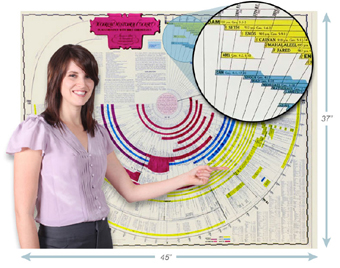
Related articles offer further reading. Each entry’s sources support its specific explanation.
What else was happening?
Read across a time band to explore different regions during the same broad period. Biblical dates follow this resource’s timeline chronology; other dates follow their stated sources and traditions. A shared band shows overlap within that framework, not necessarily the same year or independent confirmation of the Biblical dates.
People and events
Noah’s continuing lifespan
2948–1998 BC · Timeline chronology
Biblical account
Genesis 9:28–29 gives Noah 950 years, including 350 after the Flood. His lifespan continues across this period within this timeline’s Biblical chronology.
Context, sources and timeline wording
On the Amazing Bible Timeline with World History
NOAH 950 yrs. Gen. 5:32, 9:18, 19, 28, 29
Selected label(s) from the corresponding poster track; joined fragments share this quotation and explanation.
Compare 2348 BC–2300 BCCompare 2300 BC–2200 BCCompare 2200 BC–2100 BCCompare 2100 BC–2004 BCReading options
Shem’s continuing lifespan
2446–1846 BC · Timeline chronology
Biblical account
Genesis 11:10–11 gives Shem 100 years before Arphaxad’s birth and 500 afterward: 600 in total. The BC endpoints follow this timeline’s chronology, not dates written in the passage.
Context, sources and timeline wording
On the Amazing Bible Timeline with World History
SHEM 600 yrs. Gen. 11:10-11
Selected label(s) from the corresponding poster track; joined fragments share this quotation and explanation.
Compare 2348 BC–2300 BCCompare 2300 BC–2200 BCCompare 2200 BC–2100 BCCompare 2100 BC–2004 BCReading options
Arphaxad
2346–1908 BC · Timeline chronology
Biblical account
Arphaxad is part of the Genesis 11 genealogy. Genesis 11:12–13 gives 438 years by adding the years before and after the named son’s birth.
Word help: Genealogy
- Genealogy
- An account of family descent: who is related to whom across generations.
Context, sources and timeline wording
On the Amazing Bible Timeline with World History
ARPHAXAD 438 yrs. Gen. 11:12-13
Selected label(s) from the corresponding poster track; joined fragments share this quotation and explanation.
The dates shown here reproduce the chart’s 4004 BC framework; they are not independently dated lifespans.
Compare 2348 BC–2300 BCCompare 2300 BC–2200 BCCompare 2200 BC–2100 BCCompare 2100 BC–2004 BCReading options
Salah / Selah
2311–1878 BC · Timeline chronology
Biblical account
Salah / Selah is part of the Genesis 11 genealogy. Genesis 11:14–15 gives 433 years by adding the years before and after the named son’s birth.
Names and identities: The poster uses Selah; the KJV passage uses Salah. These identify the same member of this genealogy.
Word help: Genealogy
- Genealogy
- An account of family descent: who is related to whom across generations.
Context, sources and timeline wording
On the Amazing Bible Timeline with World History
SELAH 433 yrs. Gen. 11:14-15
Selected label(s) from the corresponding poster track; joined fragments share this quotation and explanation.
The dates shown here reproduce the chart’s 4004 BC framework; they are not independently dated lifespans.
Compare 2348 BC–2300 BCCompare 2300 BC–2200 BCCompare 2200 BC–2100 BCCompare 2100 BC–2004 BCReading options
Eber
2281–1817 BC · Timeline chronology
Biblical account
Eber is part of the Genesis 11 genealogy. Genesis 11:16–17 gives 464 years by adding the years before and after the named son’s birth.
Word help: Genealogy
- Genealogy
- An account of family descent: who is related to whom across generations.
Context, sources and timeline wording
On the Amazing Bible Timeline with World History
EBER 464 yrs. Gen. 11:15-18
Selected label(s) from the corresponding poster track; joined fragments share this quotation and explanation.
The dates shown here reproduce the chart’s 4004 BC framework; they are not independently dated lifespans.
Compare 2300 BC–2200 BCCompare 2200 BC–2100 BCCompare 2100 BC–2004 BCReading options
Peleg
2247–2008 BC · Timeline chronology
Biblical account
Peleg is part of the Genesis 11 genealogy. Genesis 11:18–19 gives 239 years by adding the years before and after the named son’s birth.
Word help: Genealogy
- Genealogy
- An account of family descent: who is related to whom across generations.
Context, sources and timeline wording
On the Amazing Bible Timeline with World History
PELEG 239 yrs. Gen. 11:18-19
Selected label(s) from the corresponding poster track; joined fragments share this quotation and explanation.
The dates shown here reproduce the chart’s 4004 BC framework; they are not independently dated lifespans.
Compare 2300 BC–2200 BCCompare 2200 BC–2100 BCCompare 2100 BC–2004 BCReading options
Reu
2217–1978 BC · Timeline chronology
Biblical account
Reu is part of the Genesis 11 genealogy. Genesis 11:20–21 gives 239 years by adding the years before and after the named son’s birth.
Word help: Genealogy
- Genealogy
- An account of family descent: who is related to whom across generations.
Context, sources and timeline wording
On the Amazing Bible Timeline with World History
REU 239 yrs. Gen. 11:20-21
Selected label(s) from the corresponding poster track; joined fragments share this quotation and explanation.
The dates shown here reproduce the chart’s 4004 BC framework; they are not independently dated lifespans.
Compare 2300 BC–2200 BCCompare 2200 BC–2100 BCCompare 2100 BC–2004 BCReading options
The Tower of Babel
About 2200 BC · Timeline chronology
Biblical account
Genesis 11:1–9 tells of a city and tower in Shinar, God’s confounding of language, and the scattering of its builders. The poster’s approximate date belongs to its traditional chronology; the passage gives no BC year.
Dates: The date is a chart estimate, not a date stated in Genesis.
Context, sources and timeline wording
On the Amazing Bible Timeline with World History
TOWER OF BABEL about 2200 B.C.
Selected label(s) from the corresponding poster track; joined fragments share this quotation and explanation.
Compare 2200 BC–2100 BCReading options
Serug
2185–1955 BC · Timeline chronology
Biblical account
Serug is part of the Genesis 11 genealogy. Genesis 11:22–23 gives 230 years by adding the years before and after the named son’s birth.
Word help: Genealogy
- Genealogy
- An account of family descent: who is related to whom across generations.
Context, sources and timeline wording
On the Amazing Bible Timeline with World History
SERUG 230 yrs. Gen. 11:22-23
Selected label(s) from the corresponding poster track; joined fragments share this quotation and explanation.
The dates shown here reproduce the chart’s 4004 BC framework; they are not independently dated lifespans.
Compare 2200 BC–2100 BCCompare 2100 BC–2004 BCReading options
Nahor, Terah’s father
2155–2007 BC · Timeline chronology
Biblical account
Nahor, Terah’s father is part of the Genesis 11 genealogy. Genesis 11:24–25 gives 148 years by adding the years before and after the named son’s birth.
Word help: Genealogy
- Genealogy
- An account of family descent: who is related to whom across generations.
Context, sources and timeline wording
On the Amazing Bible Timeline with World History
NAHOR 148 yrs. Gen. 11:24-26
Selected label(s) from the corresponding poster track; joined fragments share this quotation and explanation.
The dates shown here reproduce the chart’s 4004 BC framework; they are not independently dated lifespans.
Compare 2200 BC–2100 BCCompare 2100 BC–2004 BCReading options
Terah
2126–1921 BC · Timeline chronology
Biblical account
Terah is part of the Genesis 11 genealogy. Genesis 11:26–32 gives 205 years as Terah’s total life.
Word help: Genealogy
- Genealogy
- An account of family descent: who is related to whom across generations.
Context, sources and timeline wording
On the Amazing Bible Timeline with World History
TERAH 205 yrs. Gen. 11:26-32
Selected label(s) from the corresponding poster track; joined fragments share this quotation and explanation.
The dates shown here reproduce the chart’s 4004 BC framework; they are not independently dated lifespans.
Compare 2200 BC–2100 BCCompare 2100 BC–2004 BCReading options
Egypt alongside the Biblical chronology
Old Kingdom, approximately 2649–2130 BC · Historical estimate
Egypt
The Metropolitan Museum places Egypt’s Old Kingdom approximately 2649–2130 BC. These historical estimates can be explored alongside Genesis without requiring the two chronological frameworks to agree.
The timeline’s Egypt track uses a different arrangement.
Dates: Archaeological chronology differs from the poster’s arrangement.
Context, sources and timeline wording
On the Amazing Bible Timeline with World History
EGYPT
Selected label(s) from the corresponding poster track; joined fragments share this quotation and explanation.
Compare 2348 BC–2300 BCCompare 2300 BC–2200 BCCompare 2200 BC–2100 BCReading options
Japan: Jōmon communities
Jōmon culture during this period
East Asia
Archaeological evidence supplies a history of the Japanese islands long before written chronicles: Jōmon communities made pottery, lived in settlements and exchanged materials. Later Chinese cultural influence should not be projected back as the whole explanation of Japan’s early history.
Context: The poster’s broad Chinese-influence statement does not describe all of early Japan.
Word help: Jōmon
- Jōmon
- A long prehistoric cultural period in Japan, named for cord-marked pottery. It is earlier than Japan’s written historical chronicles.
Context, sources and timeline wording
On the Amazing Bible Timeline with World History
JAPAN
Regional heading; the longer influence statement continues farther along the track.
Compare 2348 BC–2300 BCCompare 2300 BC–2200 BCCompare 2200 BC–2100 BCCompare 2100 BC–2004 BCReading options
Families, traditions and undated themes
Explore family lines, successive Biblical episodes, cultural traditions and themes spanning several generations. Their date lines identify the kind of connection and any uncertainty.
Haran and Nahor in Terah’s family
Family relationship; no separate dated event
Biblical account
Genesis 11:26–29 names Abram, Nahor and Haran as Terah’s sons and Haran as Lot’s father. This younger Nahor is not the earlier Nahor who was Terah’s father.
Names and identities: Two people named Nahor are distinguished.
Context, sources and timeline wording
On the Amazing Bible Timeline with World History
HARAN Gen. 11:27
Selected label(s) from the corresponding poster track; joined fragments share this quotation and explanation.
Other families and themesReading options
Ham and the Genesis 10 family branches
Family relationships; no BC dates stated
Biblical account
Genesis 10:6 names Cush, Mizraim, Phut and Canaan as Ham’s sons; verses 15–19 trace Canaan’s descendants. These are Biblical family branches.
They should not be read as a modern genetic classification or as a date for the founding of every later nation.
Context, sources and timeline wording
On the Amazing Bible Timeline with World History
HAM — CUSH, MIZRAIM, PHUT, CANAAN
Family names on the poster, joined by punctuation for readability.
Other families and themesReading options
The Gibeonites
Later Biblical context for the family diagram
Biblical account
Joshua 9 relates Israel’s covenant with the Gibeonites. Second Samuel 21:1–2 describes them as a remnant of the Amorites and recalls Saul’s violence against them.
These passages are later narrative references, not events dated to this early period.
Biblical reference: The poster prints 21:12; verses 1–2 introduce the Gibeonites more directly.
Context, sources and timeline wording
On the Amazing Bible Timeline with World History
THE GIBEONITES II Sam. 21:12
Selected label(s) from the corresponding poster track; joined fragments share this quotation and explanation.
Other families and themesReading options
The Hittites in the Biblical list
Later Biblical reference
Biblical account
Exodus 3:8,17 includes the Hittites among the peoples of the land promised to Israel. This label follows that Biblical list; it does not by itself date the Anatolian Hittite kingdom.
Context, sources and timeline wording
On the Amazing Bible Timeline with World History
THE HITTITES Ex. 3:8-17
Selected label(s) from the corresponding poster track; joined fragments share this quotation and explanation.
Other families and themesReading options
The Jebusites
Later Biblical reference
Biblical account
Exodus 3:17 and 23:23 name the Jebusites among peoples in the land. The poster also prints Exodus 31:5, which concerns skilled workmanship, not the Jebusites.
Biblical reference: For the Jebusites, read Exodus 3:17; the printed 31:5 reference concerns a different subject.
Context, sources and timeline wording
On the Amazing Bible Timeline with World History
THE JEBUSITES Ex. 31:5; 23:23-28
Selected label(s) from the corresponding poster track; joined fragments share this quotation and explanation.
Other families and themesReading options
The Perizzites
Later Biblical reference
Biblical account
Joshua 11:3 names the Perizzites among peoples opposed to Israel; 1 Kings 9:20 includes them among remaining peoples in Solomon’s kingdom. The poster’s John 11:3 reference instead belongs to the Lazarus narrative.
Biblical reference: Read Joshua 11:3 for the Perizzites; the poster prints John 11:3.
Context, sources and timeline wording
On the Amazing Bible Timeline with World History
THE PERIZZITES John 11:3. I Kings 9:20
Selected label(s) from the corresponding poster track; joined fragments share this quotation and explanation.
Other families and themesReading options
Japheth and his sons
Family relationships; no BC dates stated
Biblical account
Genesis 10:2 lists Japheth’s sons as Gomer, Magog, Madai, Javan, Tubal, Meshech and Tiras. The poster spells the first name Gomar.
This is the Biblical family branch shown on the chart, not evidence that each name directly identifies a modern nation or population.
Biblical reference: The Biblical spelling Gomer is used in the explanation.
Context, sources and timeline wording
On the Amazing Bible Timeline with World History
JAPHETH — GOMAR, MAGOG, MADAI, JAVAN, TUBAL, MESHECH, TIRAS
Names from the branching diagram, joined by punctuation for readability.
Other families and themesReading options
Cities of the Levantine coast
A regional track spanning more than this period
Levant
Arwad (Arvad), Byblos (Gebal), Tyre and Sidon (Zidon) became major Phoenician cities. Their histories are not one foundation event: Byblos was a center in the third millennium BC, while “Phoenician” usually describes the later coastal culture.
Dates: The city names are retained; the label does not date all four cities to one founding.
Word help: Levant
- Levant
- The eastern Mediterranean region. Its boundaries vary by context; it is not the name of one present-day country.
Context, sources and timeline wording
On the Amazing Bible Timeline with World History
PHOENICIA — FOUNDED THE CITIES OF ARVAD, GEBAL, TYRE AND ZIDON
Two adjacent poster labels, joined by a dash for readability.
Other families and themesReading options
Elam and Asshur
Biblical genealogy and regional headings
Mesopotamia
Genesis 10:22 names Elam and Asshur among Shem’s sons. On the poster these names also introduce regional tracks.
The genealogy itself is not a dated founding account for either Elam or the Assyrian state.
Word help: Mesopotamia · Genealogy
- Mesopotamia
- The region around the Tigris and Euphrates rivers, largely in present-day Iraq and neighboring areas.
- Genealogy
- An account of family descent: who is related to whom across generations.
Context, sources and timeline wording
On the Amazing Bible Timeline with World History
ELAM and ASSHUR
Selected label(s) from the corresponding poster track; joined fragments share this quotation and explanation.
Other families and themesReading options
Menes and Memphis
Early Egyptian kingship; traditional attribution
Egypt
Memphis was an early Egyptian capital. Egyptian tradition associates its foundation with Menes; the name’s relationship to the earliest archaeologically attested kings is not a secure one-to-one identification.
This short label is retained as tradition, not a dated event within 2348–2004 BC.
Dates: The traditional founding attribution is not an exact historical date.
Context, sources and timeline wording
On the Amazing Bible Timeline with World History
KING MENES — MEMPHIS capital
Adjacent poster labels joined with a dash.
Other families and themesReading options
China’s silk and origin traditions
Legendary origins, not a securely dated invention
East Asia
Fu Hi (Fuxi) belongs to Chinese origin traditions. Stories about the discovery of silk also feature the legendary Empress Leizu; the two names are not interchangeable.
Archaeological silk evidence must be distinguished from stories crediting a single founder. The poster also connects the name China with yellow earth; that proposed etymology is not established by the sources cited here.
Dates: The founder, approximate date and yellow-earth explanation are retained as poster wording, not presented as verified historical conclusions.
Context, sources and timeline wording
On the Amazing Bible Timeline with World History
CHINA — Took title from color of the earth, yellow. — FU-HI — The great benefactor and founder of the silk industry, probably about 2000 B.C.
Adjacent China and Fu-Hi labels joined with dashes.
Other families and themesReading options