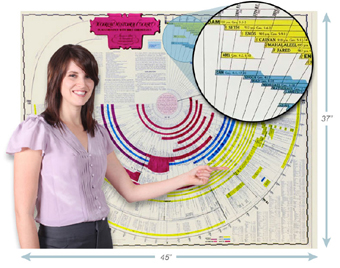
Related articles offer further reading. Each entry’s sources support its specific explanation.
What else was happening?
Read across a time band to explore different regions during the same broad period. Biblical dates follow this resource’s timeline chronology; other dates follow their stated sources and traditions. A shared band shows overlap within that framework, not necessarily the same year or independent confirmation of the Biblical dates.
People and events
Isaac’s continuing family line
Isaac’s lifespan continues to 1716 BC · Timeline chronology
Biblical account
Genesis 35:28–29 gives Isaac 180 years and describes Esau and Jacob burying him. This continuing family label links the patriarchal story to Jacob’s household; it is not a separate Egyptian event.
Context, sources and timeline wording
On the Amazing Bible Timeline with World History
ISAAC 180 yrs.
Selected label(s) from the corresponding poster track; joined fragments share this quotation and explanation.
Compare 1754 BC–1700 BCReading options
Jacob
1836–1689 BC · Timeline chronology
Biblical account
Genesis 25 names Jacob and Esau as Isaac and Rebekah’s twins. Genesis 47:28 gives Jacob a lifespan of 147 years, including 17 in Egypt.
His lifespan continues into this period, including his years in Egypt.
Context, sources and timeline wording
On the Amazing Bible Timeline with World History
JACOB 147 yrs. Gen. 25:26,27; 35:28,29; 47:28.
Selected label(s) from the corresponding poster track; joined fragments share this quotation and explanation.
Compare 1754 BC–1700 BCCompare 1700 BC–1600 BCReading options
Joseph interprets dreams and prepares for famine
1697 BC: end of the famine · Timeline chronology
Biblical account
Genesis 39–41 recounts Joseph’s imprisonment, his interpretation of the cupbearer’s dream, and his appearance before Pharaoh. Genesis 41 gives seven years of plenty followed by seven years of famine and says Joseph was 30 when he entered Pharaoh’s service.
It supplies no BC year. The poster’s 1697 BC endpoint is a chart calculation, not an Egyptian archival date.
Dates: The famine’s BC endpoint belongs to the chart’s chronology; Pharaoh is unnamed in Genesis.
Context, sources and timeline wording
On the Amazing Bible Timeline with World History
JOSEPH in prison. — Plenteous years. — Years of dearth. — End of 7 years of dearth. B.C. 1697.
Selected Joseph annotations; short fragments joined with dashes.
Compare 1700 BC–1600 BCReading options
Moses leaves Egypt
Moses aged 40; 1531 BC · Timeline chronology
Biblical account
Exodus 2:11–15 recounts Moses killing an Egyptian who was beating a Hebrew and fleeing to Midian. Acts 7:23 supplies the age of 40.
The BC year here comes from the poster’s 1571 BC birth placement, not a year stated in Exodus.
Context, sources and timeline wording
On the Amazing Bible Timeline with World History
MOSES 40 years, slew the Egyptian. Ex. 2:12-15. Acts 7:23-24,29,30.
Selected label(s) from the corresponding poster track; joined fragments share this quotation and explanation.
Compare 1600 BC–1504 BCReading options
A new king and Israel’s oppression
1530 BC; not a date stated in Exodus · Timeline chronology
Biblical account
Exodus 1:8 introduces a new king who did not know Joseph and describes Israel’s forced labor. Exodus 2:23 later mentions a king’s death during the oppression.
These are separate notices; the text supplies neither a royal name nor the poster’s 1530 BC date.
Dates: The death and the start of oppression should not be collapsed into one securely dated event.
Context, sources and timeline wording
On the Amazing Bible Timeline with World History
Pharaoh’s death Israel enslaved 1530
Selected label(s) from the corresponding poster track; joined fragments share this quotation and explanation.
Compare 1600 BC–1504 BCReading options
Japan before written chronicles
Jōmon culture during this period
East Asia
Japan’s archaeological history long predates the chart’s 660 BC marker. Jōmon settlements, pottery and exchange networks provide evidence for life in this period.
The much later influence of Chinese learning is important, but does not make early Japanese culture simply Chinese in origin.
Dates: The 660 BC marker is not the beginning of human history in Japan.
Word help: Jōmon
- Jōmon
- A long prehistoric cultural period in Japan, named for cord-marked pottery. It is earlier than Japan’s written historical chronicles.
Context, sources and timeline wording
On the Amazing Bible Timeline with World History
Mystery surrounds the early history of Japan. Culture and learning largely Chinese. The history of Japan begins about 660 B.C.
Selected label(s) from the corresponding poster track; joined fragments share this quotation and explanation.
Compare 1754 BC–1700 BCCompare 1700 BC–1600 BCCompare 1600 BC–1504 BCReading options
The Second Intermediate Period and the Hyksos
Approximately 1650–1550 BC · Historical estimate
Egypt
Hyksos rulers controlled the Nile Delta during Egypt’s Second Intermediate Period. Ahmose’s expulsion of them helped usher in the New Kingdom around 1550 BC.
The chart’s compact victory label does not establish a particular battle date or identify the Hyksos with the Israelites.
Names and identities: No identification of the Hyksos with Biblical Israel is assumed.
Context, sources and timeline wording
On the Amazing Bible Timeline with World History
Intermediate Kingdoms — Victory’s of Hyksos
Two Egypt-track labels, joined with a dash.
Compare 1700 BC–1600 BCCompare 1600 BC–1504 BCReading options
Shang China
Approximately 1600–1050 BC · Historical estimate
East Asia
The Shang dynasty is attested through writing and archaeology. Its oracle-bone records and ritual life provide evidence for early Chinese society.
The poster’s “Tang-Shang” label belongs to this ancient dynasty; it should not be confused with the much later Tang dynasty of AD 618–907.
Dates: The dynasty is distinguished from medieval Tang China; “great astronomers” is a broad characterization, not a dated discovery.
Word help: Dynasty
- Dynasty
- A line of rulers, usually from the same family. A dynasty’s dates describe its rule, not one person’s lifetime.
Context, sources and timeline wording
On the Amazing Bible Timeline with World History
TANG-SHANG Dynasty — Ancient Chinese great astronomers
Selected label(s) from the corresponding poster track; joined fragments share this quotation and explanation.
Compare 1600 BC–1504 BCReading options
Kassite rule in Babylonia
Approximately 1595–1155 BC; extends into later periods · Historical estimate
Mesopotamia
Kassite kings ruled Babylonia during much of the later second millennium BC. The British Museum uses approximately 1595–1155 BC.
Their position under the chart’s Nimrod track does not identify Nimrod as a Kassite king or make the whole dynasty contemporary with Joseph.
Names and identities: The regional track continues across distinct rulers and dynasties.
Word help: Dynasty · Mesopotamia
- Dynasty
- A line of rulers, usually from the same family. A dynasty’s dates describe its rule, not one person’s lifetime.
- Mesopotamia
- The region around the Tigris and Euphrates rivers, largely in present-day Iraq and neighboring areas.
Context, sources and timeline wording
On the Amazing Bible Timeline with World History
Govt. of the Kassites over Babylon.
Selected label(s) from the corresponding poster track; joined fragments share this quotation and explanation.
Compare 1600 BC–1504 BCReading options
Families, traditions and undated themes
Explore family lines, successive Biblical episodes, cultural traditions and themes spanning several generations. Their date lines identify the kind of connection and any uncertainty.
Jacob’s twelve sons
Family branches in Genesis 29–30 and 35
Biblical account
Genesis 35:23–26 lists Jacob’s sons by their mothers: Leah—Reuben, Simeon, Levi, Judah, Issachar and Zebulun; Rachel—Joseph and Benjamin; Bilhah—Dan and Naphtali; Zilpah—Gad and Asher. The chart’s separate boxes show these relationships, not twelve events occurring in the same year.
Context, sources and timeline wording
On the Amazing Bible Timeline with World History
The 12 sons of JACOB. Gen. 35:23-26. — RACHEL’S Sons. — LEAH’S Sons. — ZILPAH’S Sons. (Leah’s maid.) — BILHAH’S Sons. (Rachel’s maid.)
Shared family heading and mother headings. Individual son names are retained in the reading text; repeated Leah headings form one branch.
Other families and themesReading options
Joseph is sold into Egypt
Joseph aged 17 in Genesis 37
Biblical account
Genesis 37 introduces Joseph at age 17 and recounts his sale and arrival in Egypt. The chapter uses both Ishmaelite and Midianite merchant designations.
The account is retained without inventing a named pharaoh or treating the merchants as a securely identified modern population.
Dates: The Biblical narrative is not independently dated by a named Egyptian king.
Context, sources and timeline wording
On the Amazing Bible Timeline with World History
JOSEPH 17 years old, sold into Egypt. Gen. 37:28-36. — ISHMAELITES buy Joseph.
Selected label(s) from the corresponding poster track; joined fragments share this quotation and explanation.
Other families and themesReading options
Asenath, Manasseh, Ephraim and Jacob’s blessings
Genesis 41, 48 and 49; successive episodes
Biblical account
Genesis 41:45,50–52 names Asenath, daughter of Potipherah the priest of On, as Joseph’s wife and Manasseh and Ephraim as their sons. Genesis 48 recounts Jacob blessing those sons; Genesis 49 records his words to his own sons.
These are separate scenes across the family’s life in Egypt.
Context, sources and timeline wording
On the Amazing Bible Timeline with World History
JOSEPH’S sons born in Egypt by ASENATH, daughter of Potipherah, Priest of On. — JACOB blessed Joseph’s sons. — JACOB blessed his sons.
Three annotations; the sons’ names appear in the adjacent branches.
Other families and themesReading options
Levi, Kohath, Amram, Aaron and Moses
Exodus 6 genealogy
Biblical account
Exodus 6:16–20 presents Levi, Kohath and Amram in the family line of Aaron and Moses and names Jochebed as their mother. The text gives 137 years for Levi, 133 for Kohath and 137 for Amram.
These relationships do not by themselves settle the number of years Israel spent in Egypt or identify an Egyptian dynasty.
Word help: Dynasty · Genealogy
- Dynasty
- A line of rulers, usually from the same family. A dynasty’s dates describe its rule, not one person’s lifetime.
- Genealogy
- An account of family descent: who is related to whom across generations.
Context, sources and timeline wording
On the Amazing Bible Timeline with World History
LEVI 137 years of age when he died. — KOHATH 133 years of age when he died. — AMRAM — AARON — MOSES
Genealogical labels joined with dashes; not a quotation of every printed cross-reference.
Other families and themesReading options
Caleb
Numbers 13–14; Joshua 14
Biblical account
Caleb, son of Jephunneh, represents Judah among the men sent to explore Canaan. Numbers 14 commends his faithfulness; Joshua 14 says he was 40 when sent and 85 when he asked for Hebron.
His main story belongs with the Exodus and settlement in the next period.
Context, sources and timeline wording
On the Amazing Bible Timeline with World History
CALEB Josh. 14:1-12
Selected label(s) from the corresponding poster track; joined fragments share this quotation and explanation.
Other families and themesReading options
Esau and Edom
A continuing Biblical family and regional track
Biblical account
Genesis 36 identifies Esau with Edom and describes his descendants and Edomite rulers. The chapter is a genealogy and king list, not a set of independently dated BC reigns.
Word help: Reign · Genealogy
- Reign
- The time a king, queen or other ruler holds power. These are not necessarily the years of that person’s life.
- Genealogy
- An account of family descent: who is related to whom across generations.
Context, sources and timeline wording
On the Amazing Bible Timeline with World History
The Generation of Esau. Gen. 36:9-34. — EDOMITES
Selected label(s) from the corresponding poster track; joined fragments share this quotation and explanation.
Other families and themesReading options
Moabites and Ammonites
Continuing peoples in the Biblical narrative
Biblical account
Deuteronomy 2 recalls the lands of Moab and Ammon; Deuteronomy 23:3–6 addresses their relationship to Israel’s assembly. These later references explain the chart’s continuing family tracks rather than marking their foundation in this period.
Biblical reference: The poster’s citations cover broader passages; the assembly restriction is specifically in Deuteronomy 23:3–6.
Context, sources and timeline wording
On the Amazing Bible Timeline with World History
MOABITES, AMMONITES Deut. 2:20. 23:3-20.
Selected label(s) from the corresponding poster track; joined fragments share this quotation and explanation.
Other families and themesReading options
Peoples of Canaan
Genealogical labels with later narrative references
Biblical account
Genesis 10:15–18 includes Heth and the Jebusites in Canaan’s genealogy. The Gibeonites and Perizzites are named in later Biblical narratives, including Joshua 9 and 11.
The four chart tracks are not all names explicitly listed in Genesis 10:15–18.
Names and identities: The shared Genesis reference does not explicitly list every name on the adjoining tracks.
Word help: Genealogy
- Genealogy
- An account of family descent: who is related to whom across generations.
Context, sources and timeline wording
On the Amazing Bible Timeline with World History
For generations of Canaan see Gen. 10:15-18
Selected label(s) from the corresponding poster track; joined fragments share this quotation and explanation.
Other families and themesReading options
Early colonies to America: the chart’s interpretation
Undated interpretive connection
Americas
This timeline’s Christian interpretation connects the dispersal after Babel with settlement in the Americas. Josephus, Antiquities 1.5, describes sea travel and islands but does not identify the Americas or establish a date or route for settlement there.
Christian interpretation: The American connection is the chart’s interpretation, not a place named in Josephus.
Context, sources and timeline wording
On the Amazing Bible Timeline with World History
EARLY COLONIES TO AMERICA
Selected label(s) from the corresponding poster track; joined fragments share this quotation and explanation.
Other families and themesReading options
Hagar and Sarah in Paul’s interpretation
Galatians 4 is a later Christian interpretation
Biblical interpretation
Galatians 4:21–31 uses Hagar and Sarah in Paul’s argument about two covenants and freedom. It is a first-century Christian interpretation of the Genesis story, not an event occurring in this BC period.
Dates: The New Testament reference explains the story; it does not date it.
Context, sources and timeline wording
On the Amazing Bible Timeline with World History
HAGAR and ISHMAEL cast out. Gen. 21:10. Gal. 4:20-30.
Selected label(s) from the corresponding poster track; joined fragments share this quotation and explanation.
Other families and themesReading options
Syria and the name Aram
Biblical family connection; not a dated national origin
Levant
Genesis 22:21 calls Kemuel the father of Aram. That family notice does not establish that every Syrian descended from him.
Aramean and Armenian are not interchangeable names; the chart’s short label should not be read as equating those peoples.
Context: The parenthetical “Armenians” is not a synonym for Arameans.
Word help: Levant
- Levant
- The eastern Mediterranean region. Its boundaries vary by context; it is not the name of one present-day country.
Context, sources and timeline wording
On the Amazing Bible Timeline with World History
DAMASCUS — SYRIA
Place/region headings; the adjacent ancestry phrase is addressed in the explanation.
Other families and themesReading options
Phoenicia and Canaanite religion
Regional and religious context
Levant
Baal and Astarte occur in evidence for Canaanite religion. The chart also names Moloch, but that compressed list should not imply that every coastal city had the same cult or that all three names identify one dated event.
Leviticus 18:21 is a Biblical reference to Molech.
Names and identities: Religious names are context, not a single event or a uniform religion across all cities.
Word help: Levant
- Levant
- The eastern Mediterranean region. Its boundaries vary by context; it is not the name of one present-day country.
Context, sources and timeline wording
On the Amazing Bible Timeline with World History
Chief Gods: Baal, Astarte, and Moloch.
Selected label(s) from the corresponding poster track; joined fragments share this quotation and explanation.
Other families and themesReading options
Assyrian power
A continuing regional development
Mesopotamia
Assyrian power developed unevenly during the second millennium BC. Shamshi-Adad I’s kingdom belongs earlier in that millennium.
The continuing Elam-and-Asshur track follows a regional development; its rising arrow does not identify one independently dated conquest.
Word help: Mesopotamia
- Mesopotamia
- The region around the Tigris and Euphrates rivers, largely in present-day Iraq and neighboring areas.
Context, sources and timeline wording
On the Amazing Bible Timeline with World History
Rise of Assyrian power
Selected label(s) from the corresponding poster track; joined fragments share this quotation and explanation.
Other families and themesReading options
The Pelasgians in Greek tradition
Traditional name, not a securely dated state
Mediterranean
Ancient Greek writers used “Pelasgians” for several peoples and for inhabitants imagined to precede later Greek groups. Herodotus discusses the name but acknowledges uncertainty about their language.
The label does not establish one kingdom or a foundation year for Greece.
Names and identities: A traditional people-name is distinguished from an archaeological state.
Context, sources and timeline wording
On the Amazing Bible Timeline with World History
GREECE — THE PELASGI
Selected label(s) from the corresponding poster track; joined fragments share this quotation and explanation.
Other families and themesReading options
Iran and Indo-European language relationships
Language and regional headings
West Asia
The “Persia” and “Indo-German” tracks are broad labels. Iranian and Indo-Aryan languages form related branches within Indo-European; that linguistic relationship is not proof of one biological race or of an established Persian Empire during this period.
Context: The later Persian Empire must not be projected into this early regional heading.
Context, sources and timeline wording
On the Amazing Bible Timeline with World History
PERSIA — INDO-GERMAN TRIBES
Selected label(s) from the corresponding poster track; joined fragments share this quotation and explanation.
Other families and themesReading options