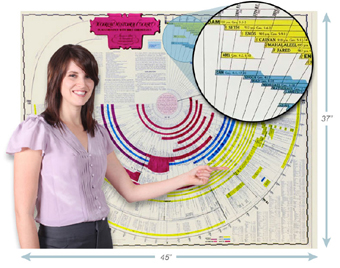
Related articles offer further reading. Each entry’s sources support its specific explanation.
People and events
Noah’s continuing lifespan
2948–1998 BC · Timeline chronology
Biblical account
Genesis 9:28–29 gives Noah 950 years, including 350 after the Flood. His lifespan continues across this period within this timeline’s Biblical chronology.
Context, sources and timeline wording
On the Amazing Bible Timeline with World History
NOAH 950 yrs. Gen. 5:32, 9:18, 19, 28, 29
Selected label(s) from the corresponding poster track; joined fragments share this quotation and explanation.
Compare 2004 BC–2000 BCCompare 2000 BC–1900 BCReading options
Shem’s continuing lifespan
2446–1846 BC · Timeline chronology
Biblical account
Genesis 11:10–11 gives Shem 100 years before Arphaxad’s birth and 500 afterward: 600 in total. The BC endpoints follow this timeline’s chronology, not dates written in the passage.
Context, sources and timeline wording
On the Amazing Bible Timeline with World History
SHEM 600 yrs. Gen. 11:10-11
Selected label(s) from the corresponding poster track; joined fragments share this quotation and explanation.
Compare 2004 BC–2000 BCCompare 2000 BC–1900 BCCompare 1900 BC–1800 BCReading options
Arphaxad
2346–1908 BC · Timeline chronology
Biblical account
Arphaxad is part of the Genesis 11 genealogy. Genesis 11:12–13 gives 438 years by adding the years before and after the named son’s birth.
Word help: Genealogy
- Genealogy
- An account of family descent: who is related to whom across generations.
Context, sources and timeline wording
On the Amazing Bible Timeline with World History
ARPHAXAD 438 yrs. Gen. 11:12-13
Selected label(s) from the corresponding poster track; joined fragments share this quotation and explanation.
The dates shown here reproduce the chart’s 4004 BC framework; they are not independently dated lifespans.
Compare 2004 BC–2000 BCCompare 2000 BC–1900 BCReading options
Salah / Selah
2311–1878 BC · Timeline chronology
Biblical account
Salah / Selah is part of the Genesis 11 genealogy. Genesis 11:14–15 gives 433 years by adding the years before and after the named son’s birth.
Names and identities: The poster uses Selah; the KJV passage uses Salah. These identify the same member of this genealogy.
Word help: Genealogy
- Genealogy
- An account of family descent: who is related to whom across generations.
Context, sources and timeline wording
On the Amazing Bible Timeline with World History
SELAH 433 yrs. Gen. 11:14-15
Selected label(s) from the corresponding poster track; joined fragments share this quotation and explanation.
The dates shown here reproduce the chart’s 4004 BC framework; they are not independently dated lifespans.
Compare 2004 BC–2000 BCCompare 2000 BC–1900 BCCompare 1900 BC–1800 BCReading options
Eber
2281–1817 BC · Timeline chronology
Biblical account
Eber is part of the Genesis 11 genealogy. Genesis 11:16–17 gives 464 years by adding the years before and after the named son’s birth.
Word help: Genealogy
- Genealogy
- An account of family descent: who is related to whom across generations.
Context, sources and timeline wording
On the Amazing Bible Timeline with World History
EBER 464 yrs. Gen. 11:15-18
Selected label(s) from the corresponding poster track; joined fragments share this quotation and explanation.
The dates shown here reproduce the chart’s 4004 BC framework; they are not independently dated lifespans.
Compare 2004 BC–2000 BCCompare 2000 BC–1900 BCCompare 1900 BC–1800 BCReading options
Reu
2217–1978 BC · Timeline chronology
Biblical account
Reu is part of the Genesis 11 genealogy. Genesis 11:20–21 gives 239 years by adding the years before and after the named son’s birth.
Word help: Genealogy
- Genealogy
- An account of family descent: who is related to whom across generations.
Context, sources and timeline wording
On the Amazing Bible Timeline with World History
REU 239 yrs. Gen. 11:20-21
Selected label(s) from the corresponding poster track; joined fragments share this quotation and explanation.
The dates shown here reproduce the chart’s 4004 BC framework; they are not independently dated lifespans.
Compare 2004 BC–2000 BCCompare 2000 BC–1900 BCReading options
Serug
2185–1955 BC · Timeline chronology
Biblical account
Serug is part of the Genesis 11 genealogy. Genesis 11:22–23 gives 230 years by adding the years before and after the named son’s birth.
Word help: Genealogy
- Genealogy
- An account of family descent: who is related to whom across generations.
Context, sources and timeline wording
On the Amazing Bible Timeline with World History
SERUG 230 yrs. Gen. 11:22-23
Selected label(s) from the corresponding poster track; joined fragments share this quotation and explanation.
The dates shown here reproduce the chart’s 4004 BC framework; they are not independently dated lifespans.
Compare 2004 BC–2000 BCCompare 2000 BC–1900 BCReading options
Terah
2126–1921 BC · Timeline chronology
Biblical account
Terah is part of the Genesis 11 genealogy. Genesis 11:26–32 gives 205 years as Terah’s total life.
Word help: Genealogy
- Genealogy
- An account of family descent: who is related to whom across generations.
Context, sources and timeline wording
On the Amazing Bible Timeline with World History
TERAH 205 yrs. Gen. 11:26-32
Selected label(s) from the corresponding poster track; joined fragments share this quotation and explanation.
The dates shown here reproduce the chart’s 4004 BC framework; they are not independently dated lifespans.
Compare 2004 BC–2000 BCCompare 2000 BC–1900 BCReading options
Were Abraham and Shem contemporaries?
150-year overlap within this chart’s chronology · Timeline chronology
Biblical account
Within this timeline’s chronology, Abraham’s life (1996–1821 BC) and Shem’s life (2446–1846 BC) overlap by 150 years. Genesis does not narrate a meeting between them or say that Shem personally taught Abraham about the Flood.
The suggested transmission of that knowledge is an inference.
Dates: Chronological overlap does not establish a narrated meeting or conversation.
Context, sources and timeline wording
On the Amazing Bible Timeline with World History
Abraham lived 150 years during the life of Shem. He was no doubt familiar with antediluvian events and would have given to his generation a very direct account of the same.
Selected label(s) from the corresponding poster track; joined fragments share this quotation and explanation.
Compare 2000 BC–1900 BCCompare 1900 BC–1800 BCReading options
Abraham and Sarah
Abraham: 1996–1821 BC · Timeline chronology
Biblical account
Genesis 25:7 gives Abraham 175 years. Genesis 23:1 gives Sarah 127 years.
Their importance in the Biblical narrative centers on God’s promises and the birth of Isaac; the chart’s BC placement is a traditional calculation, not a date given in those verses.
Context, sources and timeline wording
On the Amazing Bible Timeline with World History
ABRAHAM 175 yrs. — SARAH
Abraham lifespan label and adjacent Sarah label, joined with a dash.
Compare 2000 BC–1900 BCCompare 1900 BC–1800 BCReading options
Abraham leaves Haran
Abraham aged 75; 1921 BC · Timeline chronology
Biblical account
Genesis 12:4 says Abram was 75 when he left Haran with Lot. The destination in the next verse is Canaan.
The 1921 BC date comes from the chart’s traditional framework.
Context, sources and timeline wording
On the Amazing Bible Timeline with World History
ABRAHAM, 75 years old, departed with Lot from Haran. Gen. 12:4-6. Acts 7:1-4.
Selected label(s) from the corresponding poster track; joined fragments share this quotation and explanation.
Compare 2000 BC–1900 BCReading options
Hagar and Ishmael
Ishmael’s birth: 1910 BC · Timeline chronology
Biblical account
Genesis 16 names Hagar as Ishmael’s mother and says Abram was 86 when Ishmael was born. Genesis 21 later recounts Hagar and Ishmael leaving Abraham’s household and God’s care for them.
The departure is a later episode, not an event dated to Ishmael’s birth.
Context: The birth and later departure are distinct events.
Context, sources and timeline wording
On the Amazing Bible Timeline with World History
HAGAR — ABRAHAM 86 years old when Ishmael born. — HAGAR and ISHMAEL
Selected adjacent Hagar/Ishmael labels and the age-at-birth note.
Compare 2000 BC–1900 BCReading options
Covenant and circumcision
Abraham aged 99; 1897 BC · Timeline chronology
Biblical account
Genesis 17 describes God’s covenant with Abraham and circumcision as its sign. Abraham is 99 in this chapter.
The online date is calculated from the chart’s birth year for Abraham.
Context, sources and timeline wording
On the Amazing Bible Timeline with World History
God’s Covenant with Abraham, the law of circumcision. Gen. 17:1-27.
Selected label(s) from the corresponding poster track; joined fragments share this quotation and explanation.
Compare 1900 BC–1800 BCReading options
Isaac’s life and Abraham’s test
Isaac: 1896–1716 BC · Timeline chronology
Biblical account
Genesis 35:28 records Isaac’s 180-year lifespan. Genesis 22 recounts Abraham being commanded to offer Isaac and God providing a ram in his place.
It does not state Abraham’s or Isaac’s age in that episode; the poster’s age of 120 for Abraham is an additional chronology estimate.
Dates: Abraham’s age of 120 at this event is not stated in Genesis 22.
Context, sources and timeline wording
On the Amazing Bible Timeline with World History
ISAAC 180 yrs. — ISAAC is offered. ABRAHAM 120 years old. Gen. 22:1,2.
Lifespan heading and adjacent binding-of-Isaac annotation.
Compare 1900 BC–1800 BCCompare 1800 BC–1754 BCReading options
Isaac marries Rebekah
Isaac aged 40; 1856 BC · Timeline chronology
Biblical account
Genesis 24 tells of Rebekah’s journey to Isaac. Genesis 25:20 says he was 40 when they married and names her as Bethuel’s daughter and Laban’s sister.
Context, sources and timeline wording
On the Amazing Bible Timeline with World History
ISAAC marries REBECCA. Gen. 25:20.
Selected label(s) from the corresponding poster track; joined fragments share this quotation and explanation.
Compare 1900 BC–1800 BCReading options
Jacob
1836–1689 BC · Timeline chronology
Biblical account
Genesis 25 names Jacob and Esau as Isaac and Rebekah’s twins. Genesis 47:28 gives Jacob a lifespan of 147 years, including 17 in Egypt.
Much of his story continues into the next period.
Context, sources and timeline wording
On the Amazing Bible Timeline with World History
JACOB 147 yrs. Gen. 25:26,27; 35:28,29; 47:28.
Selected label(s) from the corresponding poster track; joined fragments share this quotation and explanation.
Compare 1900 BC–1800 BCCompare 1800 BC–1754 BCReading options
Ceremonial centers in ancient Peru
Caral-Supe: approximately 3000–1800 BC · Historical estimate
Americas
Monumental ceremonial centers existed in Peru during this broad period. Caral-Supe is a documented example, with radiocarbon evidence spanning approximately 3000–1800 BC.
The poster’s 2000 BC marker is a useful approximate comparison, not the founding date of every Peruvian center.
Dates: The archaeological example supports a broader span around the poster’s date.
Context, sources and timeline wording
On the Amazing Bible Timeline with World History
2000 BC Peruvian ceremonial centers
Selected label(s) from the corresponding poster track; joined fragments share this quotation and explanation.
Compare 2004 BC–2000 BCCompare 2000 BC–1900 BCCompare 1900 BC–1800 BCReading options
Egypt’s Middle Kingdom and later Hyksos rule
Middle Kingdom approximately 2030–1650 BC · Historical estimate
Egypt
Egypt’s Middle Kingdom includes the Twelfth Dynasty and extends through much of this page’s span. The Hyksos ruled later, in the Second Intermediate Period, approximately 1650–1550 BC.
The poster’s “Intermediate Kingdoms” and “Colonial States” labels are kept as broad chart labels, not precise modern dynasty names.
Dates: The Hyksos belong later than this page’s 2004–1754 BC boundaries.
Word help: Dynasty
- Dynasty
- A line of rulers, usually from the same family. A dynasty’s dates describe its rule, not one person’s lifetime.
Context, sources and timeline wording
On the Amazing Bible Timeline with World History
EGYPT — Intermediate Kingdoms — The 12th Dynasty — THE HYKSOS — COLONIAL STATES
Five labels from the Egypt track, joined with dashes.
Compare 2004 BC–2000 BCCompare 2000 BC–1900 BCCompare 1900 BC–1800 BCCompare 1800 BC–1754 BCReading options
Japan: Jōmon communities
Jōmon culture during this period
East Asia
Archaeological evidence supplies a history of the Japanese islands long before written chronicles: Jōmon communities made pottery, lived in settlements and exchanged materials. Later Chinese cultural influence should not be projected back as the whole explanation of Japan’s early history.
Context: The poster’s broad Chinese-influence statement does not describe all of early Japan.
Word help: Jōmon
- Jōmon
- A long prehistoric cultural period in Japan, named for cord-marked pottery. It is earlier than Japan’s written historical chronicles.
Context, sources and timeline wording
On the Amazing Bible Timeline with World History
JAPAN
Regional heading; the longer influence statement continues farther along the track.
Compare 2004 BC–2000 BCCompare 2000 BC–1900 BCCompare 1900 BC–1800 BCCompare 1800 BC–1754 BCReading options
Amraphel and Hammurabi
Hammurabi: 1792–1750 BC in the cited chronology
Mesopotamia
Genesis 14:1 calls Amraphel king of Shinar; it does not say he founded Babylon. Hammurabi was a documented Babylonian ruler, conventionally dated 1792–1750 BC.
The poster places the names together, but that juxtaposition is not proof that they are the same man.
Names and identities: The Amraphel–Hammurabi identification is not established by Genesis.
Word help: Mesopotamia
- Mesopotamia
- The region around the Tigris and Euphrates rivers, largely in present-day Iraq and neighboring areas.
Context, sources and timeline wording
On the Amazing Bible Timeline with World History
AMRAPHAEL HAMMURABI founds the Babyl. Kingdom Gen. 14:1.
Selected label(s) from the corresponding poster track; joined fragments share this quotation and explanation.
Compare 1800 BC–1754 BCReading options
Families, traditions and undated themes
Explore family lines, successive Biblical episodes, cultural traditions and themes spanning several generations. Their date lines identify the kind of connection and any uncertainty.
Nahor’s family and the patriarchal marriages
Family connections across generations
Biblical account
Nahor, Abraham’s brother, and his wife Milcah are parents of Bethuel in Genesis 22:20–23. Bethuel is Rebekah’s father; Laban is her brother.
Genesis 29 names Leah and Rachel as Laban’s daughters. The diagram connects Isaac’s and Jacob’s marriages through this family.
Context, sources and timeline wording
On the Amazing Bible Timeline with World History
NAHOR, the son of TERAH. — MILCAH, Nahor’s wife. — BETHUEL the Syrian. Rebecca’s father. — LABAN, Rebecca’s brother. — LEAH AND RACHEL, Laban’s daughters.
Five family labels, joined with dashes; Biblical references are supplied in the reading context.
Other families and themesReading options
Abraham and Melchizedek
During Abraham’s life; exact year not stated
Biblical account
Genesis 14:18–20 introduces Melchizedek as king of Salem and priest of God Most High. He blesses Abram, who gives him a tenth.
The text does not identify Melchizedek as Shem.
Context, sources and timeline wording
On the Amazing Bible Timeline with World History
ABRAHAM gave tithes to MELCHIZEDEK, and was blessed by him. Gen. 14:18-20.
Selected label(s) from the corresponding poster track; joined fragments share this quotation and explanation.
Other families and themesReading options
Esau and his marriages
Genesis family narrative; no precise BC date supplied here
Biblical account
Genesis 26:34 names Judith and Bashemath, daughters of Hittites, as wives Esau took at age 40. Genesis 36 gives a differently named marriage list.
The online version identifies the specific passage instead of silently treating the lists as identical.
Names and identities: The marriage lists in Genesis 26 and 36 use different names.
Context, sources and timeline wording
On the Amazing Bible Timeline with World History
ESAU — Esau married Judith and Bashmeth Hittites Gen. 26:34-35.
Esau track heading and marriage annotation joined with a dash.
Other families and themesReading options
Haran, Lot, Sodom, Moab and Ammon
Family relationships and the events of Genesis 19
Biblical account
Genesis 11:27 names Haran as Lot’s father. Genesis 19 tells of the destruction of Sodom and Gomorrah and Lot’s escape; it later identifies Moab and Ben-ammi as ancestors of the Moabites and Ammonites.
These connected labels describe successive parts of the story, not one simultaneous event.
Context, sources and timeline wording
On the Amazing Bible Timeline with World History
HARAN — LOT — Sodom and Gomorrah destroyed Gen. 19. — MOAB AND AMMON
Selected labels from the connected family tracks, joined with dashes.
Other families and themesReading options
Ham and the Genesis 10 family branches
Family relationships; no BC dates stated
Biblical account
Genesis 10:6 names Cush, Mizraim, Phut and Canaan as Ham’s sons; verses 15–19 trace Canaan’s descendants. These are Biblical family branches.
They should not be read as a modern genetic classification or as a date for the founding of every later nation.
Context, sources and timeline wording
On the Amazing Bible Timeline with World History
HAM — CUSH, MIZRAIM, PHUT, CANAAN
Family names on the poster, joined by punctuation for readability.
Other families and themesReading options
The Gibeonites
Later Biblical context for the family diagram
Biblical account
Joshua 9 relates Israel’s covenant with the Gibeonites. Second Samuel 21:1–2 describes them as a remnant of the Amorites and recalls Saul’s violence against them.
These passages are later narrative references, not events dated to this early period.
Biblical reference: The poster prints 21:12; verses 1–2 introduce the Gibeonites more directly.
Context, sources and timeline wording
On the Amazing Bible Timeline with World History
THE GIBEONITES II Sam. 21:12
Selected label(s) from the corresponding poster track; joined fragments share this quotation and explanation.
Other families and themesReading options
The Hittites in the Biblical list
Later Biblical reference
Biblical account
Exodus 3:8,17 includes the Hittites among the peoples of the land promised to Israel. This label follows that Biblical list; it does not by itself date the Anatolian Hittite kingdom.
Context, sources and timeline wording
On the Amazing Bible Timeline with World History
THE HITTITES Ex. 3:8-17
Selected label(s) from the corresponding poster track; joined fragments share this quotation and explanation.
Other families and themesReading options
The Jebusites
Later Biblical reference
Biblical account
Exodus 3:17 and 23:23 name the Jebusites among peoples in the land. The poster also prints Exodus 31:5, which concerns skilled workmanship, not the Jebusites.
Biblical reference: For the Jebusites, read Exodus 3:17; the printed 31:5 reference concerns a different subject.
Context, sources and timeline wording
On the Amazing Bible Timeline with World History
THE JEBUSITES Ex. 31:5; 23:23-28
Selected label(s) from the corresponding poster track; joined fragments share this quotation and explanation.
Other families and themesReading options
The Perizzites
Later Biblical reference
Biblical account
Joshua 11:3 names the Perizzites among peoples opposed to Israel; 1 Kings 9:20 includes them among remaining peoples in Solomon’s kingdom. The poster’s John 11:3 reference instead belongs to the Lazarus narrative.
Biblical reference: Read Joshua 11:3 for the Perizzites; the poster prints John 11:3.
Context, sources and timeline wording
On the Amazing Bible Timeline with World History
THE PERIZZITES John 11:3. I Kings 9:20
Selected label(s) from the corresponding poster track; joined fragments share this quotation and explanation.
Other families and themesReading options
Abraham among the Canaanites and with Abimelech
Events in Abraham’s life
Biblical account
Genesis 12 places Abram in Canaan. Genesis 20–21 describes his encounters with Abimelech and their agreement at Beer-sheba.
These are narrative settings, not precise archaeological dates or an identification of every ruler bearing the title Abimelech.
Context, sources and timeline wording
On the Amazing Bible Timeline with World History
ABRAHAM IN THE LAND OF THE CANAANITES — ABRAHAM IN THE LAND OF ABIMELECH
Two adjacent poster annotations; Biblical references supplied in the explanation.
Other families and themesReading options
Nimrod’s kingdom in Genesis
Biblical account; no BC reign dates supplied
Biblical account
Genesis 10:8–12 associates Nimrod with Babel, Erech, Accad and Calneh in Shinar. It does not give him a dated reign or explicitly identify him with Ninus, Hammurabi or the later Kassite dynasty.
Names and identities: Biblical Nimrod is not automatically identified with a later historical ruler.
Word help: Dynasty · Reign
- Dynasty
- A line of rulers, usually from the same family. A dynasty’s dates describe its rule, not one person’s lifetime.
- Reign
- The time a king, queen or other ruler holds power. These are not necessarily the years of that person’s life.
Context, sources and timeline wording
On the Amazing Bible Timeline with World History
NIMROD was the founder of BABEL ERECH, ACAD, CALNEH Gen. 10:10
Selected label(s) from the corresponding poster track; joined fragments share this quotation and explanation.
Other families and themesReading options
Early colonies to America: the chart’s interpretation
Undated interpretive connection
Americas
This timeline’s Christian interpretation connects the dispersal after Babel with settlement in the Americas. Josephus, Antiquities 1.5, describes sea travel and islands but does not identify the Americas or establish a date or route for settlement there.
Christian interpretation: The American connection is the chart’s interpretation, not a place named in Josephus.
Context, sources and timeline wording
On the Amazing Bible Timeline with World History
EARLY COLONIES TO AMERICA
Selected label(s) from the corresponding poster track; joined fragments share this quotation and explanation.
Other families and themesReading options
Syria and the name Aram
Biblical family connection; not a dated national origin
Levant
Genesis 22:21 calls Kemuel the father of Aram. That family notice does not establish that every Syrian descended from him.
Aramean and Armenian are not interchangeable names; the chart’s short label should not be read as equating those peoples.
Context: The parenthetical “Armenians” is not a synonym for Arameans.
Word help: Levant
- Levant
- The eastern Mediterranean region. Its boundaries vary by context; it is not the name of one present-day country.
Context, sources and timeline wording
On the Amazing Bible Timeline with World History
DAMASCUS — SYRIA
Place/region headings; the adjacent ancestry phrase is addressed in the explanation.
Other families and themesReading options
Cities of the Levantine coast
A regional track spanning more than this period
Levant
Arwad (Arvad), Byblos (Gebal), Tyre and Sidon (Zidon) became major Phoenician cities. Their histories are not one foundation event: Byblos was a center in the third millennium BC, while “Phoenician” usually describes the later coastal culture.
Dates: The city names are retained; the label does not date all four cities to one founding.
Word help: Levant
- Levant
- The eastern Mediterranean region. Its boundaries vary by context; it is not the name of one present-day country.
Context, sources and timeline wording
On the Amazing Bible Timeline with World History
PHOENICIA — FOUNDED THE CITIES OF ARVAD, GEBAL, TYRE AND ZIDON
Two adjacent poster labels, joined by a dash for readability.
Other families and themesReading options
Mesopotamia: written evidence and a legendary king
Developments spanning many centuries
Mesopotamia
Cuneiform developed before this period and remained in use long afterward. Astronomy and astrology also developed over time, not in a single year.
Shamshi-Adad I was a historical ruler of upper Mesopotamia (about 1813–1781 BC in the British Museum’s chronology). Ninus belongs to the later Greek literary account of Assyria; his conquests should not be presented as equally documented contemporary records.
Context: Historical evidence for Shamshi-Adad is distinguished from the Ninus tradition.
Word help: Mesopotamia · Cuneiform
- Mesopotamia
- The region around the Tigris and Euphrates rivers, largely in present-day Iraq and neighboring areas.
- Cuneiform
- Writing made with wedge-shaped marks, often pressed into clay. It was used to write several ancient languages.
Context, sources and timeline wording
On the Amazing Bible Timeline with World History
Astronomy — Astrology — CUNEIFORM writing — KING NINUS subdues Babylon — SHAMSHI ADAD
Separate labels from the Elam/Asshur track, joined with dashes.
Other families and themesReading options
Horses and routes of transmission
A broad movement, not one dated origin
West Asia
Ancient-DNA research identifies the lower Volga–Don region as the source of the lineage that became dominant among modern domestic horses. A route of transmission toward Egypt is a different question from the original domestication of horses.
The timeline’s arrow from Iran toward Egypt is a compressed account of movement, not evidence that all horses were first domesticated in Iran.
Context: A possible route of movement and the origin of a domestic lineage are different questions.
Context, sources and timeline wording
On the Amazing Bible Timeline with World History
HORSES came from Iran
Selected label(s) from the corresponding poster track; joined fragments share this quotation and explanation.
Other families and themesReading options
Zoroaster and the Indo-European language headings
Zoroaster’s date is disputed · Dating debated
West Asia
Zoroaster is the Iranian religious teacher associated with the origins of Zoroastrianism. His date is disputed; linguistic arguments often place him in the second millennium BC.
The poster’s probable 2200 BC date is not an established consensus. “Indo-German” is an older label related to Indo-European language classification, not a single dated tribe or biological race.
Dates: The date remains uncertain, and language-family terms are not racial categories.
Context, sources and timeline wording
On the Amazing Bible Timeline with World History
INDO-GERMAN TRIBES — Doctrine of Zoroaster (probably 2200 B.C.)
Track heading and doctrine annotation joined with a dash.
Other families and themesReading options
China’s silk and origin traditions
Legendary origins, not a securely dated invention
East Asia
Fu Hi (Fuxi) belongs to Chinese origin traditions. Stories about the discovery of silk also feature the legendary Empress Leizu; the two names are not interchangeable.
Archaeological silk evidence must be distinguished from stories crediting a single founder. The poster also connects the name China with yellow earth; that proposed etymology is not established by the sources cited here.
Dates: The founder, approximate date and yellow-earth explanation are retained as poster wording, not presented as verified historical conclusions.
Context, sources and timeline wording
On the Amazing Bible Timeline with World History
CHINA — Took title from color of the earth, yellow. — FU-HI — The great benefactor and founder of the silk industry, probably about 2000 B.C.
Adjacent China and Fu-Hi labels joined with dashes.
Other families and themesReading options
Yu the Great
Legendary ruler; 1919 BC is the poster’s estimate
East Asia
Chinese tradition remembers Yu the Great for controlling floods. The National Palace Museum explicitly identifies him as a legendary emperor.
The poster’s 1919 BC rule date should therefore be read as a traditional chronology, not a securely established accession year.
Dates: 1919 BC is not independently verified by the cited evidence.
Word help: Accession
- Accession
- The beginning of a ruler’s time in power.
Context, sources and timeline wording
On the Amazing Bible Timeline with World History
Emperor Yu Great colonizer — Rules 1919 B.C.
Two adjacent Yu annotations joined with a dash.
Other families and themesReading options