Start with these entries, then explore the wider-world comparison. These are reading pointers, not a scale of elapsed time or a complete list of events.
Read across a time band to explore different regions during the same broad period. Biblical dates follow this resource’s timeline chronology; other dates follow their stated sources and traditions. A shared band shows overlap within that framework, not necessarily the same year or independent confirmation of the Biblical dates.
Begin with Israel’s deliverance from Egypt, the wilderness journey and the crossing of the Jordan. Then explore the wider world alongside the Biblical account.
Follow the Biblical story
This sequence follows the narrative. The steps are equally spaced for reading; they do not measure elapsed time.
Shang dynastyApproximately 1600–1050 BC · Historical estimate
Kassite ruleApproximately 1595–1155 BC · Historical estimate
Gray band: this page’s 1504–1254 BC period. Dashed-outline bar: Timeline chronology. Solid bars: Historical estimates. The alignment shows overlap within this framework, not independent confirmation of the Biblical dates. How dates work.
What else was happening?
Compare four regions during the same broad period. Select a place for its fuller explanation and sources.
Selected world-history connections, 1504–1254 BC
Place and period
At a glance
Connection to remember
Shang ChinaEast Asia Approximately 1600–1050 BC Historical estimate
Ritual practices
Bronze production
Silk textiles
Silk production preceded the much later Silk Road networks.
Later trade: Silk production belongs to this period. The sources used here do not confirm exports to Europe during the Shang dynasty.
BabyloniaMesopotamia Approximately 1595–1155 BC Historical estimate
Kassite kings rule Babylonia
The dynasty continued beyond this page’s period, to about 1155 BC.
Exodus follows Israel’s departure from Egypt, the wilderness journey and the giving of the commandments. Chapters 12–14 tell of departure and deliverance; chapter 16 describes manna; chapters 19–20 describe Sinai.
These are successive stages of the Biblical story.
Selected label(s) from the corresponding poster track; joined fragments share this quotation and explanation.
The chart’s references to Exodus 16 and 19 concern events after the departure. The 1491 BC date follows its traditional chronology; historical dating and the identification of the pharaoh remain debated.
Selected label(s) from the corresponding poster track; joined fragments share this quotation and explanation.
The BC years are calculated chronology, rather than dates written in the Biblical narrative. They do not by themselves identify an Egyptian king. The chart’s short labels also give the lifespans of Moses and Aaron.
Joshua 3 recounts Israel crossing the Jordan as the priests carry the ark. Joshua 1:14 addresses the armed men of the eastern tribes; chapter 3 gives the fuller crossing narrative.
Selected label(s) from the corresponding poster track; joined fragments share this quotation and explanation.
The 1451 BC date follows the chart’s traditional chronology. The cited verses describe the crossing and the people involved without supplying a BC year.
Shang China had complex ritual practices, bronze production and silk textiles. Silk production preceded the much later development of the well-documented Silk Road networks.
Later trade: Silk production belongs to this period. The sources used here do not confirm exports to Europe during the Shang dynasty.
A line of rulers, usually from the same family. A dynasty’s dates describe its rule, not one person’s lifetime.
Context, sources and timeline wording
On the Amazing Bible Timeline with World History
Animals for sacrifice. — High degree of civilization. — Export silk to Europe.
Selected label(s) from the corresponding poster track; joined fragments share this quotation and explanation.
The “Export silk to Europe” label and early silk production describe different developments. The Metropolitan Museum documents westward silk trade in the much later Han period. The sources consulted here do not substantiate Europe-bound exports during the Shang period; that is a limit of this research, not proof that no earlier exchange occurred.
Approximately 1595–1155 BC; extends into later periods · Historical estimate
Mesopotamia
Kassite kings ruled Babylonia during much of the later second millennium BC. Their dynasty continued beyond this page’s period, to approximately 1155 BC.
Word help: Dynasty · Mesopotamia
Dynasty
A line of rulers, usually from the same family. A dynasty’s dates describe its rule, not one person’s lifetime.
Mesopotamia
The region around the Tigris and Euphrates rivers, largely in present-day Iraq and neighboring areas.
Selected label(s) from the corresponding poster track; joined fragments share this quotation and explanation.
The British Museum gives approximately 1595–1155 BC. The continuing regional track includes distinct rulers and dynasties: its Nimrod heading does not identify Nimrod as a Kassite king or make the whole dynasty contemporary with Joseph.
Selected label(s) from the corresponding poster track; joined fragments share this quotation and explanation.
“Ruled by Egypt” summarizes a changing regional relationship. It does not describe all of modern Syria as one continuously administered Egyptian province.
Jōmon settlements, pottery and exchange networks provide archaeological evidence for life in Japan during this period. Chinese learning became influential much later; early Japanese culture has its own earlier archaeological record.
Earlier history: Japan’s history extends before the 660 BC starting point used in this timeline. Jōmon settlements belong to that earlier history.
Word help: Jōmon
Jōmon
A long prehistoric cultural period in Japan, named for cord-marked pottery. It is earlier than Japan’s written historical chronicles.
Mystery surrounds the early history of Japan. Culture and learning largely Chinese. The history of Japan begins about 660 B.C.
Selected label(s) from the corresponding poster track; joined fragments share this quotation and explanation.
The 660 BC marker is not the beginning of human history in Japan. The later influence of Chinese learning does not make early Japanese culture simply Chinese in origin.
The New Kingdom includes successive reigns of Thutmose I and II, Amenhotep III and IV, Seti I and Ramesses II. Amenhotep IV is also known as Akhenaten.
Egypt’s antiquities ministry dates Ramesses II’s reign to about 1279–1213 BC.
Royal names: The timeline’s “Greatest Egyptian Power” label names Thutmose II; major imperial expansion is especially associated with Thutmose III. These are different pharaohs.
Word help: Reign
Reign
The time a king, queen or other ruler holds power. These are not necessarily the years of that person’s life.
THUTMOS I — THUTMOS II Greatest Egyptian Power — AMENHOTEP III — AMENHOTEP IV — SETHI I — RAMSES II 1270
Selected royal labels and the adjoining “greatest power” phrase, joined with dashes. These are selected labels, not every printed royal annotation.
The selected labels span several centuries, rather than one simultaneous reign. The chart’s “1270” appears alongside Ramesses II; the fuller reign range is given in the main entry.
Explore family lines, successive Biblical episodes, cultural traditions and themes spanning several generations. Their date lines identify the kind of connection and any uncertainty.
Biblical account
Caleb
Numbers 13–14; Joshua 14
Biblical account
Caleb, son of Jephunneh, represents Judah among the men sent to explore Canaan. Numbers 14 commends his faithfulness.
Joshua 14 says he was 40 when sent and 85 when he asked for Hebron. His story connects the wilderness journey with settlement in Canaan.
Judges 3 tells successive stories of deliverance: Othniel after eight years under Cushan-rishathaim, Ehud from Eglon, and Shamgar’s defeat of Philistines. The chapter marks periods of oppression and rest.
OTHNIEL of Judah Judg. 3:9-11 — EHUD Judge — SHAMGAR defeats the Philistines. Judg. 3:31.
Selected names and role annotations from three separate bands.
These names come from separate narrative episodes and separate chart bands. Judges 3 gives the sequence and durations, not BC accession years or three simultaneous judgeships.
Thou art greatly despised. Obad. 1:1-9. — Kings of Edom 1 Chr. 1:43-54.
Selected label(s) from the corresponding poster track; joined fragments share this quotation and explanation.
Obadiah’s words appear on the chart’s continuing Esau and Edom track as a later textual connection. Their placement does not date the prophecy to Esau’s lifetime or to this page’s period.
Judges 3:12–14 identifies Eglon as king of Moab and describes his alliance with Ammon and Amalek against Israel, followed by 18 years of service. Deuteronomy 2 and 23 provide further Biblical context for Moab and Ammon.
These passages give a sequence of events rather than a BC reign date for Eglon.
Word help: Reign
Reign
The time a king, queen or other ruler holds power. These are not necessarily the years of that person’s life.
Selected label(s) from the corresponding poster track; joined fragments share this quotation and explanation.
The chart brings together a regional heading and the account of Eglon. The Deuteronomy passages provide additional context, not an independently dated reign.
Judges 3:8 describes eight years under Cushan-rishathaim before Othniel’s deliverance. Judges 4:1–4 describes 20 years of oppression under Jabin, king of Canaan, and introduces Deborah.
These are separate episodes, later in the narrative than Joshua’s crossing of the Jordan.
This timeline’s Christian interpretation connects the dispersal after Babel with settlement in the Americas. Josephus describes peoples spreading by sea and reaching islands, but does not name the Americas or establish a date or route for settlement there.
Context, sources and timeline wording
On the Amazing Bible Timeline with World History
EARLY COLONIES TO AMERICA
Selected label(s) from the corresponding poster track; joined fragments share this quotation and explanation.
The “Early colonies to America” heading expresses an interpretive connection with Josephus, Antiquities 1.5. The American connection belongs to the chart’s interpretation, not to a place identified in that passage.
Sidon was an important coastal city among the ports of the Levant. Phoenician trading settlements in the western Mediterranean are especially documented in the first millennium BC, later than this page’s Bronze Age setting.
Trade history: Sidon was an important port, but the cited sources do not identify one “first trading nation”.
Word help: Levant
Levant
The eastern Mediterranean region. Its boundaries vary by context; it is not the name of one present-day country.
ZIDON the principle sea-port. — The first trading nation. — Colonized western Europe and Africa.
Selected label(s) from the corresponding poster track; joined fragments share this quotation and explanation.
The western European and African expansion labels span later centuries. Sidon’s place among Bronze Age ports and the later western settlements belong to different stages of Phoenician history.
This timeline includes a Hittite capture of Nineveh in 1450 BC. The event and year have not been corroborated in the historical sources consulted here.
This is an unconfirmed event, not simply a difference between chronological calculations.
Word help: Mesopotamia
Mesopotamia
The region around the Tigris and Euphrates rivers, largely in present-day Iraq and neighboring areas.
Selected label(s) from the corresponding poster track; joined fragments share this quotation and explanation.
The label remains available as an unresolved entry. The better-known Hittite attack on Babylon concerns a different city and cannot simply be substituted for Nineveh.
Heracles (Hercules), Danaus and Cadmus belong to Greek heroic and city-foundation traditions. Ancient stories connect Danaus with Egypt and Argos, and Cadmus with Phoenicia and Thebes.
Traditional dating: Hercules appears at about 1300 BC in this timeline. The stories do not establish a year for his life.
HERCULES (about 1300) — DANOS from Egypt founds the citadel of Argos — CADMUS from Phoenicia founds the citadel of Thebes — The Lydians take possession of Mycenae
Selected label(s) from the corresponding poster track; joined fragments share this quotation and explanation.
These stories are retained as traditions. The statement about Lydians taking Mycenae is not a securely dated migration event, and the combined labels do not establish a verified invasion timetable.
Aryan is a historical term used in linguistics for Indo-Iranian peoples and languages. Here it describes linguistic relationships, not a biological racial group or the founding of the later Persian Empire.
Zoroaster is the Iranian religious teacher associated with the origins of Zoroastrianism. His date is disputed; linguistic arguments often place him in the second millennium BC.
“Indo-German” is an older term related to Indo-European language classification, not one dated tribe or biological race.
Dating debated: This timeline places Zoroaster at about 2200 BC; the cited research discusses other dating proposals.
INDO-GERMAN TRIBES — Doctrine of Zoroaster (probably 2200 B.C.)
Track heading and doctrine annotation joined with a dash.
The quotation joins a broad language heading with an annotation about Zoroaster. Their juxtaposition does not establish a single people, event or agreed year.
Burial companions, poetry and care for older people
Different social themes; no single date established
East Asia
Archaeological research documents burial attendants and sacrificial victims in late Shang elite contexts. These findings concern particular elite practices, not everyone’s burial.
The adjoining themes of poetry and care for older people remain undated; the short labels identify no particular text, institution or ruler.
BC means “Before Christ.” AD stands for anno Domini, Latin for “in the year of the Lord”; it does not mean “after death.” BC year numbers decrease as time moves forward: 1000 BC comes before 500 BC. AD year numbers increase. There is no year zero between 1 BC and AD 1.
BCE and CE
“Before Common Era” and “Common Era” use the same year numbering as BC and AD, respectively. You may see these labels in sources.
About, approximately, c. or ca.
The date is an estimate, not a known exact year. The abbreviations c. and ca. stand for circa, meaning “about.”
Century
A span of 100 years. The first century AD is AD 1–100; the fifth century BC is 500–401 BC.
A range or a time band
A range may describe a lifetime, reign, war or longer development; the entry says which. A comparison band groups events within a span of time, not necessarily the same year. A lifespan bar shows duration within this timeline’s chronological framework, not an independently measured date.
Timeline chronology
A date calculated within this resource’s Biblical framework.
Historical estimate
A date or range drawn from historical or archaeological research. “About” and “approximately” mark an estimate.
Dating debated
More than one dating proposal remains in use. Read the entry for the particular disagreement.
Traditional dating
Dates drawn from a culture’s historical or literary traditions, such as the traditional foundation of Rome or the Trojan War. These are not labeled as Ussher-based Biblical dates. The entry explains its basis.
Biblical account, Christian interpretation and historical evidence
A Biblical account describes what the Bible says. Christian interpretation explains a religious understanding of a text or event and may differ among Christians. Historical evidence includes documents, inscriptions, objects and other sources used to investigate the past. These descriptions identify the kind of information, not a score for its importance.
Dating disputed / undated / outside this period
“Disputed” means different dates or interpretations remain in use. “Undated” means no reliable absolute year is assigned here. “Outside this period” keeps an entry findable when its explained dates fall beyond this page’s boundaries.
Context, sources and timeline wording
Each entry works on its own. Open its notes for sources, fuller explanations and original wording from the wall chart. Significant differences in date or meaning are identified beside the entry.
Short definitions for this reading page. Entry cards also offer word help that opens in place, so you can read a definition without leaving the entry.
Chronology
The order of events and the dates assigned to them. Different calculations or sources can produce different dates.
Dynasty
A line of rulers, usually from the same family. A dynasty’s dates describe its rule, not one person’s lifetime.
Reign
The time a king, queen or other ruler holds power. These are not necessarily the years of that person’s life.
Accession
The beginning of a ruler’s time in power.
Levant
The eastern Mediterranean region. Its boundaries vary by context; it is not the name of one present-day country.
Mesopotamia
The region around the Tigris and Euphrates rivers, largely in present-day Iraq and neighboring areas.
Genealogy
An account of family descent: who is related to whom across generations.
Jōmon
A long prehistoric cultural period in Japan, named for cord-marked pottery. It is earlier than Japan’s written historical chronicles.
Septuagint / LXX
Ancient Greek translations of Jewish Scriptures, commonly called the Greek Old Testament. LXX is its traditional abbreviation; the translations were not all made at one time.
Bible references and KJV
Genesis 5:5 means the book of Genesis, chapter 5, verse 5; 5:5–8 means verses 5 through 8. “II Kings” means Second Kings. Gen., Exod. and Rev. shorten Genesis, Exodus and Revelation. KJV means King James Version, the English Bible translation used by many linked passages.
These Articles are Written by the Publishers of The Amazing Bible Timeline with World History.
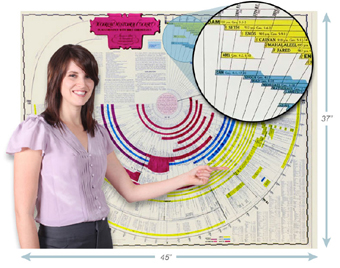
Quickly See Over 6000 Years of Bible and World History Together
Unique circular format - over 1,000 references at your fingertips on this wonderful study companion
Discover interesting facts - Biblical events with scripture references plotted alongside world history showcase fun chronological relationships
Attractive, easy to use design - People will stop to look at and talk about this beautifully laid out Jesus history timeline poster ideal for your home, office, church ...