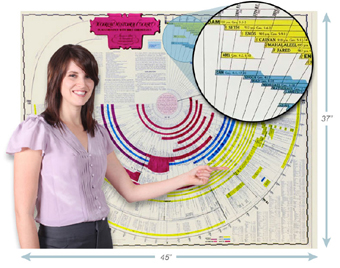
Follow the early Genesis families, compare overlapping lifespans in the chart’s chronology, and distinguish people who share a name.
Biblical and Christian connections
Start with these entries, then explore the wider-world comparison. These are reading pointers, not a scale of elapsed time or a complete list of events.
These bars use the chart’s 4004 BC anchor and the ages in Genesis. They visualize that traditional calculation, not independently corroborated dates. Bars are clipped to this page’s period; the printed ranges show the whole lifespan. Enoch’s ending marks God taking him, not a stated death.
Genesis 5 supplies successive fatherhood ages: 130, 105, 90, 70, 65, 162, 65, 187 and 182 years. Starting at the chart’s 4004 BC anchor yields the dates above. Genesis 7 places the Flood in Noah’s six-hundredth year. Genesis 11:10–11 places Shem’s hundredth year two years after the Flood. The calculation explains this chart; it does not settle other chronological interpretations.
No exact dates are assigned to Cain’s family from the lengths or positions of its diagram lines.
The line from Adam through Seth
Read the lifespans together above, then compare the individual labels and their Biblical context below. Some lives continue into the next period.
Biblical account
Adam and Eve
Adam: 930 years in Genesis; Eve’s lifespan not stated here
Biblical account
Genesis 5:5 gives Adam a lifespan of 930 years. Eve is named beside him on the poster, but this passage does not give her lifespan.
Dates: 930 years applies to Adam, not a stated age for both Adam and Eve
Genesis 5:21–24 gives Enoch 365 years and says that he walked with God and God took him. The passage does not use the usual “and he died” ending for Enoch.
This is the Enoch in Seth’s line, not Cain’s son of the same name.
Dates: Two Enochs distinguished; the Biblical wording is not reduced to a death date
These entries share the early Genesis setting but are not given numerical lifespans in these passages. The Enoch and Lamech named in Cain’s line are kept separate from the same-named people in Genesis 5.
Biblical account
Abel
No age or BC date stated in this passage
Biblical account
Genesis 4 describes Abel as a keeper of sheep and recounts Cain killing him. It does not state Abel’s age at death or a BC date.
Genesis 4:20 describes Jabal, Adah’s son, as the ancestor of people who live in tents and keep livestock. The short poster label summarizes that Biblical description.
Genesis 4:22 associates Tubalcain with working brass and iron. The poster’s printed phrase includes the extra word “officer”; that word is not in this KJV verse.
BC means “Before Christ.” AD stands for anno Domini, Latin for “in the year of the Lord”; it does not mean “after death.” BC year numbers decrease as time moves forward: 1000 BC comes before 500 BC. AD year numbers increase. There is no year zero between 1 BC and AD 1.
BCE and CE
“Before Common Era” and “Common Era” use the same year numbering as BC and AD, respectively. You may see these labels in sources.
About, approximately, c. or ca.
The date is an estimate, not a known exact year. The abbreviations c. and ca. stand for circa, meaning “about.”
Century
A span of 100 years. The first century AD is AD 1–100; the fifth century BC is 500–401 BC.
A range or a time band
A range may describe a lifetime, reign, war or longer development; the entry says which. A comparison band groups events within a span of time, not necessarily the same year. A lifespan bar shows duration within this timeline’s chronological framework, not an independently measured date.
Timeline chronology
A date calculated within this resource’s Biblical framework.
Historical estimate
A date or range drawn from historical or archaeological research. “About” and “approximately” mark an estimate.
Dating debated
More than one dating proposal remains in use. Read the entry for the particular disagreement.
Traditional dating
Dates drawn from a culture’s historical or literary traditions, such as the traditional foundation of Rome or the Trojan War. These are not labeled as Ussher-based Biblical dates. The entry explains its basis.
Biblical account, Christian interpretation and historical evidence
A Biblical account describes what the Bible says. Christian interpretation explains a religious understanding of a text or event and may differ among Christians. Historical evidence includes documents, inscriptions, objects and other sources used to investigate the past. These descriptions identify the kind of information, not a score for its importance.
Dating disputed / undated / outside this period
“Disputed” means different dates or interpretations remain in use. “Undated” means no reliable absolute year is assigned here. “Outside this period” keeps an entry findable when its explained dates fall beyond this page’s boundaries.
Context, sources and timeline wording
Each entry works on its own. Open its notes for sources, fuller explanations and original wording from the wall chart. Significant differences in date or meaning are identified beside the entry.
Short definitions for this reading page. Entry cards also offer word help that opens in place, so you can read a definition without leaving the entry.
Chronology
The order of events and the dates assigned to them. Different calculations or sources can produce different dates.
Septuagint / LXX
Ancient Greek translations of Jewish Scriptures, commonly called the Greek Old Testament. LXX is its traditional abbreviation; the translations were not all made at one time.
Bible references and KJV
Genesis 5:5 means the book of Genesis, chapter 5, verse 5; 5:5–8 means verses 5 through 8. “II Kings” means Second Kings. Gen., Exod. and Rev. shorten Genesis, Exodus and Revelation. KJV means King James Version, the English Bible translation used by many linked passages.
These Articles are Written by the Publishers of The Amazing Bible Timeline with World History.
Quickly See Over 6000 Years of Bible and World History Together
Unique circular format - over 1,000 references at your fingertips on this wonderful study companion
Discover interesting facts - Biblical events with scripture references plotted alongside world history showcase fun chronological relationships
Attractive, easy to use design - People will stop to look at and talk about this beautifully laid out Jesus history timeline poster ideal for your home, office, church ...