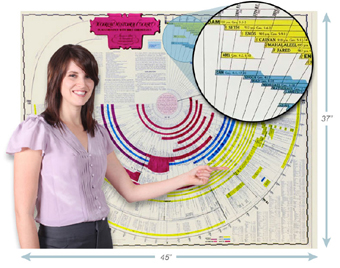
Related articles offer further reading. Each entry’s sources support its specific explanation.
People and events
The last centuries of Judah’s monarchy
Chart framework through Jerusalem’s destruction · Timeline chronology
Biblical account
The Judah track continues the Davidic royal sequence while the northern kingdom ends earlier. Its Judah–Benjamin–Levi label is a chart summary; the Babylonian exile does not mean every inhabitant was deported, as Second Kings 25 also describes people remaining in the land.
Word help: Exile
- Exile
- Living away from one’s homeland, especially after being forced to leave. A reference to exile does not necessarily mean every inhabitant left.
Context, sources and timeline wording
On the Amazing Bible Timeline with World History
The Time of the Kings. — The Kingdom of Judah (Judah, Benjamin, Levi)
Selected label(s) from the corresponding poster track; joined fragments share this quotation and explanation.
Compare 754 BC–700 BCCompare 700 BC–600 BCCompare 600 BC–504 BCReading options
Jerusalem’s deliverance in Kings
Sennacherib’s Judah campaign, 701 BC
Biblical account
Second Kings 19:35 attributes the death of 185,000 Assyrian soldiers to the angel of the Lord. Sennacherib’s inscriptions independently attest his campaign and tribute from Hezekiah, but do not verify that casualty figure or the miraculous explanation.
Biblical reference: The campaign is externally attested; the number and angelic deliverance are Biblical testimony.
Context, sources and timeline wording
On the Amazing Bible Timeline with World History
185,000 smote by angel. II Kings 19:35.
Selected label(s) from the corresponding poster track; joined fragments share this quotation and explanation.
Both the Biblical testimony and the limits of external corroboration are kept clear.
Compare 754 BC–700 BCReading options
Return under Cyrus and rebuilding
Return and early rebuilding, approximately 538–536 BC · Historical estimate
Biblical account
Ezra 1 attributes permission to return and rebuild to Cyrus. Ezra 3 describes worship and the laying of the temple foundations after the return.
The Cyrus Cylinder provides broader evidence of royal restoration policies but does not name Jerusalem or directly reproduce Ezra’s decree.
Biblical reference: The Biblical decree and the Cyrus Cylinder are related historical context, not identical documents.
Context, sources and timeline wording
On the Amazing Bible Timeline with World History
Jews return from Babylon and begin to rebuild the temple.
Selected label(s) from the corresponding poster track; joined fragments share this quotation and explanation.
Compare 600 BC–504 BCReading options
Darius confirms the temple work
Temple completed about 515 BC · Historical estimate
Biblical account
Ezra 6 describes the search for Cyrus’s decree, Darius’s confirmation and support, and completion in Darius’s sixth year. The conventional BC conversion is about 515 BC.
The decree and completion are separate stages; the poster’s nearby 519 marker should not date both together.
Dates: Darius’s sixth regnal year, not a single shared decree-and-completion date, supplies the completion anchor.
Word help: Regnal year
- Regnal year
- A year counted from the start of a ruler’s reign. Different calendar and counting practices can affect its conversion to a BC or AD year.
Context, sources and timeline wording
On the Amazing Bible Timeline with World History
The Second Decree (Darius) to build Temple. — Temple finished. Ez. 6:1-18.
Selected label(s) from the corresponding poster track; joined fragments share this quotation and explanation.
Compare 600 BC–504 BCReading options
The oracle at Delphi
Sanctuary develops from the eighth century BC
Mediterranean
Delphi’s sanctuary of Apollo became an influential religious center for Greek communities. Its oracle and political prestige developed over time, especially in the sixth century BC, rather than beginning on one date supplied by the chart.
Context, sources and timeline wording
On the Amazing Bible Timeline with World History
ORACLE OF DELPHOS
Selected label(s) from the corresponding poster track; joined fragments share this quotation and explanation.
Compare 754 BC–700 BCCompare 700 BC–600 BCCompare 600 BC–504 BCReading options
Rome’s foundation and early peoples
753 BC: traditional foundation date · Traditional dating
Mediterranean
Rome’s traditional foundation date is 753 BC. Livy’s stories of Romans, Sabines and Etruscans describe several episodes in the early city’s development, not one documented war and union all occurring that year.
Dates: 753 BC is a traditional foundation date, not a contemporary written record.
Context, sources and timeline wording
On the Amazing Bible Timeline with World History
ETRUSCAN WAR ROMANS AND SABINES UNITE 753
Selected label(s) from the corresponding poster track; joined fragments share this quotation and explanation.
Compare 754 BC–700 BCReading options
Rome’s kings and the early Republic
Traditional royal era, 753–509 BC · Traditional dating
Mediterranean
Roman tradition names Romulus, Numa Pompilius, Tullus Hostilius, Ancus Marcius, Tarquinius Priscus, Servius Tullius and Tarquinius Superbus before the Republic. Livy wrote long after these events.
The chart’s short dates and names summarize that tradition; “Beginning of Roman history” is not the beginning of human settlement in the region.
Dates: The early royal narrative and precise reign dates are traditional, not contemporary annals.
Word help: Reign
- Reign
- The time a king, queen or other ruler holds power. These are not necessarily the years of that person’s life.
Context, sources and timeline wording
On the Amazing Bible Timeline with World History
Time of the Kings — NUMA POMPILIUS — TILIUS HOSTILLIUS 640 — ANCUS MARCIUS 616 — TARQUINIUS PRISCUS 575 — SERVIUS TILLIUS 534 — TARQUINIUS The Proud — Time of the Republic
Selected label(s) from the corresponding poster track; joined fragments share this quotation and explanation.
Compare 754 BC–700 BCCompare 700 BC–600 BCCompare 600 BC–504 BCReading options
Assyria’s successive rulers
Tiglath-pileser III through Sennacherib
Mesopotamia
Tiglath-pileser III, Shalmaneser V, Sargon II and Sennacherib are successive Assyrian rulers. They must be distinguished from the earlier Tiglath-pileser I and Shalmaneser III.
The campaigns affecting Israel and Judah belong to different reigns within the later eighth and early seventh centuries BC.
Word help: Reign · Mesopotamia
- Reign
- The time a king, queen or other ruler holds power. These are not necessarily the years of that person’s life.
- Mesopotamia
- The region around the Tigris and Euphrates rivers, largely in present-day Iraq and neighboring areas.
Context, sources and timeline wording
On the Amazing Bible Timeline with World History
TIGLATH PILESER III — SHALMANEZZER — SARGON II — SENNACHERIB
Selected label(s) from the corresponding poster track; joined fragments share this quotation and explanation.
Compare 754 BC–700 BCCompare 700 BC–600 BCReading options
Assyrian rule in Babylon
Tiglath-pileser III takes Babylon in 729 BC
Mesopotamia
Tiglath-pileser III captured Babylon in 729 BC. Assyria’s control was contested and changed under later kings.
The poster’s “unite 727” should not suggest a peaceful, permanent merger of two modern-style states. Nimrod remains the chart’s earlier Biblical organizing label, not this ruler’s name.
Dates: The cited conquest is dated 729, not a single permanent union in 727.
Word help: Mesopotamia
- Mesopotamia
- The region around the Tigris and Euphrates rivers, largely in present-day Iraq and neighboring areas.
Context, sources and timeline wording
On the Amazing Bible Timeline with World History
ASSHUR and BABYLON unite 727
Selected label(s) from the corresponding poster track; joined fragments share this quotation and explanation.
Compare 754 BC–700 BCReading options
Pekah, Hoshea and Samaria’s fall
Samaria falls, approximately 722–721 BC · Historical estimate
Israel and Assyria
Second Kings 15–17 follows Pekah and Hoshea, the Assyrian siege of Samaria, and deportation. Assyrian history places the city’s fall around the transition from Shalmaneser V to Sargon II.
The campaign, fall and resettlements were a process, not the removal of every Israelite on a single day.
Context, sources and timeline wording
On the Amazing Bible Timeline with World History
PEKAH — HOSHEA — The Assyrian Captivity II Kings 17:4-6.
Selected label(s) from the corresponding poster track; joined fragments share this quotation and explanation.
Compare 754 BC–700 BCReading options
The Spring and Autumn tradition
The annals cover approximately 722–481 BC · Traditional dating
East Asia
The Spring and Autumn Annals preserve a chronology associated with the state of Lu. Their date span is not necessarily identical to every modern boundary assigned to the broader Eastern Zhou period.
The chart’s warlord label summarizes declining central authority and competing regional states.
Dates: A text’s date span and a wider historical period are related but distinct.
Context, sources and timeline wording
On the Amazing Bible Timeline with World History
722-481 Spring and Autumn Period: decentralized power and war lords
Selected label(s) from the corresponding poster track; joined fragments share this quotation and explanation.
Compare 754 BC–700 BCCompare 700 BC–600 BCCompare 600 BC–504 BCReading options
Carthage’s maritime power
Developing influence during the first millennium BC
North Africa
Carthage grew from a Phoenician settlement into a major Mediterranean maritime power. Its influence developed over centuries; this comparison band is period-wide context, not a dated founding or a single naval victory.
Context, sources and timeline wording
On the Amazing Bible Timeline with World History
CARTHAGE a Naval Power
Selected label(s) from the corresponding poster track; joined fragments share this quotation and explanation.
Compare 700 BC–600 BCCompare 600 BC–504 BCReading options
Assyrian invasions of Egypt
Approximately 671–663 BC · Historical estimate
Egypt and Assyria
Assyrian invasions disrupted Kushite rule in Egypt. After attacks beginning around 671 BC and the sack of Thebes in 663 BC, Kushite rulers retreated south.
These campaigns involved successive rulers, not one undated conquest of all Egypt.
Context, sources and timeline wording
On the Amazing Bible Timeline with World History
King of Asshur conquers Egypt
Selected label(s) from the corresponding poster track; joined fragments share this quotation and explanation.
Compare 700 BC–600 BCReading options
Ashurbanipal’s library and Sardanapalus
Ashurbanipal, approximately 668–631 BC · Historical estimate
Mesopotamia
Ashurbanipal assembled a major collection of cuneiform texts at Nineveh. Surviving tablets preserve literature and scholarship.
Later classical stories about Sardanapalus are not a reliable biography of Assyria’s last king, and the poster’s 621 should not be used as Ashurbanipal’s secure accession or death date.
Context: Library evidence and the later Sardanapalus legend are different kinds of sources.
Word help: Accession · Mesopotamia · Cuneiform
- Accession
- The beginning of a ruler’s time in power.
- Mesopotamia
- The region around the Tigris and Euphrates rivers, largely in present-day Iraq and neighboring areas.
- Cuneiform
- Writing made with wedge-shaped marks, often pressed into clay. It was used to write several ancient languages.
Context, sources and timeline wording
On the Amazing Bible Timeline with World History
SARDANAPALUS 621 — Great library preserved.
Selected label(s) from the corresponding poster track; joined fragments share this quotation and explanation.
Compare 700 BC–600 BCReading options
Nabopolassar and Nebuchadnezzar II
Neo-Babylonian rise; Nebuchadnezzar II reigns 605–562 BC
Mesopotamia
Nabopolassar’s dynasty established a new Babylonian power. His son Nebuchadnezzar II reigned from 605 to 562 BC and expanded both the empire and Babylon’s monuments.
The poster’s 605 and 561 beside Nebuchadnezzar are endpoints of a reign band, not two separate kings.
Dates: The cited end of Nebuchadnezzar’s reign is 562 BC; the chart ends it at 561.
Word help: Dynasty · Reign · Mesopotamia
- Dynasty
- A line of rulers, usually from the same family. A dynasty’s dates describe its rule, not one person’s lifetime.
- Reign
- The time a king, queen or other ruler holds power. These are not necessarily the years of that person’s life.
- Mesopotamia
- The region around the Tigris and Euphrates rivers, largely in present-day Iraq and neighboring areas.
Context, sources and timeline wording
On the Amazing Bible Timeline with World History
626 NAPOPOLASSER — 605 NEBUCHADNEZZAR 561 — New CHALDAIC Kingdom
Selected label(s) from the corresponding poster track; joined fragments share this quotation and explanation.
Compare 700 BC–600 BCCompare 600 BC–504 BCReading options
Athens: lawgivers and tyrants
Late seventh through sixth centuries BC
Mediterranean
Athens’s political development included Draco’s laws, Solon’s reforms in 594/593 BC, and the rule of Peisistratus’s sons after his death, including Hippias. The poster’s 527 belongs to that later succession, not the beginning of all Athenian prosperity.
These changes did not create full modern democracy.
Names and identities: Different constitutional phases and rulers are separated.
Context, sources and timeline wording
On the Amazing Bible Timeline with World History
ATHENS THRIVES — Draco Legislation — 594 Solons Legislation — HIPPIUS 527
Selected label(s) from the corresponding poster track; joined fragments share this quotation and explanation.
Compare 700 BC–600 BCCompare 600 BC–504 BCReading options
Nineveh’s fall
612 BC
Mesopotamia
Nineveh fell in 612 BC. The collapse of Assyrian power involved further resistance and campaigns beyond the loss of its capital; the poster’s 602 endpoint does not match the established date for Nineveh’s destruction.
Dates: Nineveh’s fall is 612 BC; the poster gives 602 for the imperial endpoint.
Word help: Mesopotamia
- Mesopotamia
- The region around the Tigris and Euphrates rivers, largely in present-day Iraq and neighboring areas.
Context, sources and timeline wording
On the Amazing Bible Timeline with World History
NINEVEH DESTROYED — End of Assyrian Empire 602
Selected label(s) from the corresponding poster track; joined fragments share this quotation and explanation.
Compare 700 BC–600 BCReading options
Nebuchadnezzar and Judah: several campaigns
605 BC accession; Jerusalem campaign documented in 597 BC
Judah and Babylonia
Daniel 1 places a siege in Jehoiakim’s third year, while the Babylonian Chronicle directly records Nebuchadnezzar’s capture of Jerusalem in 597 BC. His accession was in 605 BC.
These pieces of evidence must not be collapsed into a claim that the Chronicle independently verifies every detail of a 605 siege of Judah.
Dates: 605 and 597 refer to different chronological claims and evidence.
Word help: Accession
- Accession
- The beginning of a ruler’s time in power.
Context, sources and timeline wording
On the Amazing Bible Timeline with World History
NEBUCHADNEZZAR invades Judea 605 B.C.
Selected label(s) from the corresponding poster track; joined fragments share this quotation and explanation.
Compare 700 BC–600 BCCompare 600 BC–504 BCReading options
Jerusalem’s destruction and the exile
587/586 BC; calendar reconstructions differ · Dating debated
Judah and Babylonia
Second Kings 25 recounts the burning of Jerusalem and the temple, deportation, Gedaliah’s appointment and assassination. Historical reconstructions commonly place the destruction in 587 or 586 BC, depending on regnal and calendar reckoning.
The poster uses 586.
Dates: The 587/586 alternatives are retained rather than silently selecting a single calendar reconstruction.
Word help: Regnal year · Exile
- Regnal year
- A year counted from the start of a ruler’s reign. Different calendar and counting practices can affect its conversion to a BC or AD year.
- Exile
- Living away from one’s homeland, especially after being forced to leave. A reference to exile does not necessarily mean every inhabitant left.
Context, sources and timeline wording
On the Amazing Bible Timeline with World History
586 — GEDALIAH — Destruction of Jerusalem — BABYLONIAN CAPTIVITY
Selected label(s) from the corresponding poster track; joined fragments share this quotation and explanation.
Compare 600 BC–504 BCReading options
Cyrus and the conquest of Media
Cyrus’s reign, about 559–530 BC; Media defeated 550/549 · Historical estimate
West Asia
Cyrus rose from Persian kingship to a much larger empire. He defeated the Median ruler Astyages around 550/549 BC and later conquered Babylon.
The poster’s 559 and 550 refer to different stages of that rise.
Word help: Reign
- Reign
- The time a king, queen or other ruler holds power. These are not necessarily the years of that person’s life.
Context, sources and timeline wording
On the Amazing Bible Timeline with World History
CYRUS 559 — Media conquered 550
Selected label(s) from the corresponding poster track; joined fragments share this quotation and explanation.
Compare 600 BC–504 BCReading options
Confucius
Traditional dates, 551–479 BC · Traditional dating
East Asia
Confucius is remembered as a teacher concerned with ethical cultivation, ritual and good government. The traditional lifespan is 551–479 BC.
Accounts and sayings were transmitted and compiled by later followers; those texts require interpretation rather than being a stenographic record of his life.
Context, sources and timeline wording
On the Amazing Bible Timeline with World History
CONFUCIUS 551-479
Selected label(s) from the corresponding poster track; joined fragments share this quotation and explanation.
Compare 600 BC–504 BCReading options
Belshazzar and Babylon’s conquest
539 BC
Mesopotamia
Belshazzar was Nabonidus’s son and acted as regent during his father’s absence. Daniel 5 recounts Belshazzar’s feast and downfall.
Babylon was conquered by Cyrus in 539 BC; that is distinct from later return-and-restoration dates.
Dates: The conquest is dated 539 BC, not the poster’s 538.
Word help: Regent · Mesopotamia
- Regent
- Someone who governs on behalf of a ruler, for example while that ruler is young or absent.
- Mesopotamia
- The region around the Tigris and Euphrates rivers, largely in present-day Iraq and neighboring areas.
Context, sources and timeline wording
On the Amazing Bible Timeline with World History
BELSHAZZAR subject to Persia 538 Dan. 5.
Selected label(s) from the corresponding poster track; joined fragments share this quotation and explanation.
Compare 600 BC–504 BCReading options
Persia conquers Egypt
525 BC
Egypt and Persia
Cambyses’s Persian conquest ended Egypt’s Saite dynasty in 525 BC. The poster’s 521 marker differs from this date and should not be treated as the conquest year.
Dates: The Persian conquest is conventionally dated 525 BC.
Word help: Dynasty
- Dynasty
- A line of rulers, usually from the same family. A dynasty’s dates describe its rule, not one person’s lifetime.
Context, sources and timeline wording
On the Amazing Bible Timeline with World History
EGYPT to PERSIA 521
Selected label(s) from the corresponding poster track; joined fragments share this quotation and explanation.
Compare 600 BC–504 BCReading options
Darius I organizes the empire
Darius I, 522–486 BC
West Asia
Darius I consolidated Achaemenid rule after the succession crisis of 522 BC and organized imperial administration. His own inscriptions proclaim royal authority; they should be read as royal representations as well as historical evidence.
Context, sources and timeline wording
On the Amazing Bible Timeline with World History
DARIUS I, organizer of the Persian Kingdom 522
Selected label(s) from the corresponding poster track; joined fragments share this quotation and explanation.
Compare 600 BC–504 BCReading options
Families, traditions and undated themes
Explore family lines, successive Biblical episodes, cultural traditions and themes spanning several generations. Their date lines identify the kind of connection and any uncertainty.
Tribute and the first deportations
Different episodes in 2 Kings 15
Biblical account
Second Kings 15:19 records Menahem paying tribute to Pul. The deportations under Tiglath-pileser are described later, in verse 29 during Pekah’s reign.
The chart’s “first carrying away” citation to verse 19 should not turn a tribute payment into the deportation itself.
Biblical reference: The carrying away is in verse 29; verse 19 describes tribute.
Word help: Reign
- Reign
- The time a king, queen or other ruler holds power. These are not necessarily the years of that person’s life.
Context, sources and timeline wording
On the Amazing Bible Timeline with World History
The FIRST CARRYING AWAY II Kings 15:19.
Selected label(s) from the corresponding poster track; joined fragments share this quotation and explanation.
Other families and themesReading options
Josiah and Huldah
2 Kings 22–23
Biblical account
During Josiah’s reign, the book of the law is found and officials consult the prophetess Huldah. Her response and Josiah’s subsequent reforms are related parts of the narrative; Huldah’s testimony is not incidental to the account.
Word help: Reign
- Reign
- The time a king, queen or other ruler holds power. These are not necessarily the years of that person’s life.
Context, sources and timeline wording
On the Amazing Bible Timeline with World History
JOSIAH — The Prophetess HULDAH II Kings 22:14-20.
Selected label(s) from the corresponding poster track; joined fragments share this quotation and explanation.
Other families and themesReading options
Habakkuk and the Chaldeans
Habakkuk 1
Biblical account
Habakkuk’s opening dialogue asks about violence and injustice and announces the rise of the Chaldeans. The book does not name a reigning king in its heading.
Its chart position is a historical interpretation of that setting, not an explicit BC date supplied by Habakkuk.
Word help: Reign
- Reign
- The time a king, queen or other ruler holds power. These are not necessarily the years of that person’s life.
Context, sources and timeline wording
On the Amazing Bible Timeline with World History
HABAKKUK Habak. 1:1.
Selected label(s) from the corresponding poster track; joined fragments share this quotation and explanation.
Other families and themesReading options
Judah’s kings before Josiah
Jotham, Ahaz, Hezekiah, Manasseh and Amon
Biblical account
Judah’s royal line continues through Jotham, Ahaz, Hezekiah, Manasseh and Amon. Second Kings 16 describes Ahaz’s conflict with the Israel–Aram alliance and appeal to Assyria; chapters 18–20 recount Hezekiah’s reign.
These were successive rulers with different policies, not a single common alliance.
Context: The alliance of Israel and Aram opposed Ahaz; Ahaz appealed to Assyria.
Word help: Reign
- Reign
- The time a king, queen or other ruler holds power. These are not necessarily the years of that person’s life.
Context, sources and timeline wording
On the Amazing Bible Timeline with World History
JOTHAM — AHAZ — HEZEKIAH — MANASSEH — AMON — Alliance with Syria.
Selected label(s) from the corresponding poster track; joined fragments share this quotation and explanation.
Other families and themesReading options
Judah’s final kings
Jehoahaz, Jehoiakim, Jehoiachin and Zedekiah
Biblical account
Jehoahaz is removed by Pharaoh Necho, who installs Jehoiakim. Jehoiachin later surrenders to Babylon, and Zedekiah is installed before the final rebellion and destruction of Jerusalem.
The similar names belong to different rulers.
Context, sources and timeline wording
On the Amazing Bible Timeline with World History
JEHOAZ — JEHOIAKIM — JEHOICHIN — ZEDEKIAH
Selected label(s) from the corresponding poster track; joined fragments share this quotation and explanation.
Other families and themesReading options
The chart’s Ezra interval
The “79 yrs.” annotation is a calculation
Biblical chronology
Ezra 8 narrates a journey to Jerusalem, including the people, preparations and arrival. It does not itself state a seventy-nine-year interval.
The chart’s “79 yrs.” is an organizing calculation connecting stages of the return, not a verse quotation.
Context: Do not read the chart’s calculated interval as a number stated in Ezra 8.
Context, sources and timeline wording
On the Amazing Bible Timeline with World History
EZRA 8: 79 yrs.
Selected label(s) from the corresponding poster track; joined fragments share this quotation and explanation.
Other families and themesReading options
Jehoiachin released from prison
2 Kings 25:27–30
Biblical account
Second Kings ends by describing Jehoiachin’s release in the thirty-seventh year of his captivity, during the accession year of Evil-merodach. The poster cites verse 22, but that concerns Gedaliah; the release is in verses 27–30.
Biblical reference: The helpful reference is 2 Kings 25:27–30, not the printed verse 22.
Word help: Accession
- Accession
- The beginning of a ruler’s time in power.
Context, sources and timeline wording
On the Amazing Bible Timeline with World History
JEHOIACHIN released from prison II Kings 25:22.
Selected label(s) from the corresponding poster track; joined fragments share this quotation and explanation.
Other families and themesReading options
Jeremiah, Ezekiel and Daniel
Judah, exile and royal courts
Biblical account
Jeremiah’s opening places his ministry from Josiah’s reign through Jerusalem’s captivity. Ezekiel opens among the exiles by the Chebar in Jehoiachin’s fifth year.
Daniel’s narrative opens in the setting of deportation and a Babylonian court. These are distinct settings; narrative setting and a book’s composition history are separate questions.
Word help: Reign · Exile
- Reign
- The time a king, queen or other ruler holds power. These are not necessarily the years of that person’s life.
- Exile
- Living away from one’s homeland, especially after being forced to leave. A reference to exile does not necessarily mean every inhabitant left.
Context, sources and timeline wording
On the Amazing Bible Timeline with World History
JEREMIAH — DANIEL — EZEKIEL
Selected label(s) from the corresponding poster track; joined fragments share this quotation and explanation.
Other families and themesReading options
Azariah and neighboring peoples
Uzziah/Azariah’s reign
Biblical account
Second Chronicles 26 describes Uzziah’s campaigns against Philistines and Arabs; Second Kings uses the name Azariah for this king. The chart’s wars label sits on that royal band and should not be transferred to Jotham merely because his name follows it.
Word help: Reign
- Reign
- The time a king, queen or other ruler holds power. These are not necessarily the years of that person’s life.
Context, sources and timeline wording
On the Amazing Bible Timeline with World History
Wars with Arabs and Philistine etc.
Selected label(s) from the corresponding poster track; joined fragments share this quotation and explanation.
Other families and themesReading options
Micah and the divided kingdoms
Micah 1:1
Biblical account
Micah’s heading names Jotham, Ahaz and Hezekiah and identifies both Samaria and Jerusalem as the subjects of his vision. This connects his ministry to both kingdoms rather than to one isolated chart year.
Context, sources and timeline wording
On the Amazing Bible Timeline with World History
MICAH
Selected label(s) from the corresponding poster track; joined fragments share this quotation and explanation.
Other families and themesReading options
Sabbatical years and Jubilee
Leviticus 25
Biblical teaching
Leviticus 25 prescribes a seventh-year rest for the land and a Jubilee after seven cycles of seven years. The long chart track illustrates this recurring pattern; it is not a dated record proving that every cycle was observed throughout Israel’s history.
Context, sources and timeline wording
On the Amazing Bible Timeline with World History
Sabbatical and Jubilee Years. Lev. 25:1-17.
Selected label(s) from the corresponding poster track; joined fragments share this quotation and explanation.
Other families and themesReading options
Moab and Ammon in the late monarchy
2 Kings 24:1–2
Biblical account
Second Kings 24 describes bands of Chaldeans, Arameans, Moabites and Ammonites coming against Judah during Jehoiakim’s reign. The passage frames those attacks within its theological account of judgment.
Word help: Reign
- Reign
- The time a king, queen or other ruler holds power. These are not necessarily the years of that person’s life.
Context, sources and timeline wording
On the Amazing Bible Timeline with World History
MOAB and AMMON II Kings 24:1-2
Selected label(s) from the corresponding poster track; joined fragments share this quotation and explanation.
Other families and themesReading options
Aram-Damascus and Judah
2 Kings 16
Biblical account
Rezin of Damascus allies with Pekah of Israel against Ahaz of Judah. Ahaz appeals to Tiglath-pileser, and the Assyrian king takes Damascus.
Ancient Aram-Damascus should not be equated with all of modern Syria.
Context, sources and timeline wording
On the Amazing Bible Timeline with World History
SYRIA
Selected label(s) from the corresponding poster track; joined fragments share this quotation and explanation.
Other families and themesReading options
Hoshea’s appeal to Egypt
2 Kings 17:4
Biblical account
Second Kings 17 says Hoshea sent messengers to So, king of Egypt, and withheld tribute from Assyria. The identity of So is not supplied by that verse.
The nearby “King of Ethiopia” track should not be treated as proof that So and the Kushite ruler were the same person.
Biblical reference: The identity of So is not settled by the Biblical text.
Context, sources and timeline wording
On the Amazing Bible Timeline with World History
King of Ethiopia — ISRAEL seeks alliance with King SO. II Kings 17:4.
Selected label(s) from the corresponding poster track; joined fragments share this quotation and explanation.
Other families and themesReading options
Necho and Josiah
2 Kings 23
Biblical account
Second Kings 23 recounts Josiah’s death during Necho’s movement toward the Euphrates and Necho’s later removal of Jehoahaz. Those events belong to the final decades of Judah’s monarchy.
Context, sources and timeline wording
On the Amazing Bible Timeline with World History
King NECHO II Kings 23:29.
Selected label(s) from the corresponding poster track; joined fragments share this quotation and explanation.
Other families and themesReading options
The ten tribes in 2 Esdras
A later visionary account referring to the exile
Biblical interpretation
Second Esdras 13:39–46 describes the ten tribes leaving their place of captivity for a distant land called Arsareth. It belongs to an interpretation of a vision.
It does not name the Americas or establish the ancestry of a modern people. The poster’s 722 BC points to the exile being recalled, not to when this text was written.
Context: A visionary tradition is not archaeological evidence for a route to the Americas.
Word help: Exile
- Exile
- Living away from one’s homeland, especially after being forced to leave. A reference to exile does not necessarily mean every inhabitant left.
Context, sources and timeline wording
On the Amazing Bible Timeline with World History
THE APOCRYPHA ESDRAS 13:39-46. 722 B.C.
Selected label(s) from the corresponding poster track; joined fragments share this quotation and explanation.
Other families and themesReading options
Joseph’s fruitful branch
Genesis 49:22
Biblical interpretation
Jacob’s blessing compares Joseph to a fruitful bough whose branches run over a wall. It is poetic Biblical language.
It does not, by itself, identify a later migration, a continent or the ancestry of any modern nation.
Biblical reference: No overseas route is established by the metaphor.
Context, sources and timeline wording
This is additional historical context, not a label located on the current poster.
Other families and themesReading options
Ishmael and Arab peoples
Genealogical tradition and later regional history
Biblical interpretation
Genesis 25 gives Ishmael’s sons and their settlements. The chart connects that family line to later Arab nations.
This is a traditional genealogical association, not evidence that every Arab population has one traceable ancestry or that Ishmael lived through later centuries.
Context: The continuing line is a traditional association, not a modern population genealogy.
Word help: Genealogy
- Genealogy
- An account of family descent: who is related to whom across generations.
Context, sources and timeline wording
On the Amazing Bible Timeline with World History
ISHMAEL — ARAB NATIONS
Selected label(s) from the corresponding poster track; joined fragments share this quotation and explanation.
Other families and themesReading options
Tyre and Babylonian pressure
Nebuchadnezzar’s long siege; not a single verified 575 event
Levant
Josephus reports a thirteen-year siege of Tyre under Nebuchadnezzar. The poster’s 575 date compresses that prolonged conflict and the city’s relationship with Babylon.
The duration in Josephus does not by itself verify a conquest on that exact date.
Dates: The precise event intended by 575 is not established.
Word help: Levant
- Levant
- The eastern Mediterranean region. Its boundaries vary by context; it is not the name of one present-day country.
Context, sources and timeline wording
On the Amazing Bible Timeline with World History
TYRE subject to Babylon 575
Selected label(s) from the corresponding poster track; joined fragments share this quotation and explanation.
Other families and themesReading options
Egypt’s overlapping dynasty bands
Dynasties 22–30 and later foreign rule
Egypt
Egypt’s later history includes competing dynasties and foreign conquests. Dynasty 22 is conventionally placed from about 945 BC.
The 950–305 BC band is a broad overview, not exact boundaries for dynasties 22–30 or one continuous sequence.
Dates: The printed band is 950–305; it is broader than those dynasty dates.
Word help: Dynasty
- Dynasty
- A line of rulers, usually from the same family. A dynasty’s dates describe its rule, not one person’s lifetime.
Context, sources and timeline wording
On the Amazing Bible Timeline with World History
Dynasties from 22-30 and many foreign rulers in Egypt from 950-305
Selected label(s) from the corresponding poster track; joined fragments share this quotation and explanation.
Other families and themesReading options
Rome’s walls and calendar tradition
Different traditional attributions
Mediterranean
Livy associates calendar reform with Numa and describes the expansion and defenses of Rome under later kings. The chart’s “Wall around the 7 hills” and twelve-month year are different developments, not one securely dated construction-and-calendar event.
Context, sources and timeline wording
On the Amazing Bible Timeline with World History
Wall around the 7 hills — Year divided into 12 months
Selected label(s) from the corresponding poster track; joined fragments share this quotation and explanation.
Other families and themesReading options
The Medes and Deioces
A foundation account in Greek tradition
West Asia
Herodotus attributes the establishment of Median kingship to Deioces. Assyrian records instead reveal multiple local rulers during the earlier period.
The chart’s 700 BC founding is not independently established as the creation of a centralized kingdom by one documented founder.
Context: The traditional founder story and Assyrian evidence do not perfectly align.
Context, sources and timeline wording
On the Amazing Bible Timeline with World History
The Median Kingdom founded by Deïokes 700
Selected label(s) from the corresponding poster track; joined fragments share this quotation and explanation.
Other families and themesReading options
Zoroaster and the Indo-European language headings
Zoroaster’s date is disputed · Dating debated
West Asia
Zoroaster is the Iranian religious teacher associated with the origins of Zoroastrianism. His date is disputed; linguistic arguments often place him in the second millennium BC.
The poster’s probable 2200 BC date is not an established consensus. “Indo-German” is an older label related to Indo-European language classification, not a single dated tribe or biological race.
Dates: The date remains uncertain, and language-family terms are not racial categories.
Context, sources and timeline wording
On the Amazing Bible Timeline with World History
INDO-GERMAN TRIBES — Doctrine of Zoroaster (probably 2200 B.C.)
Track heading and doctrine annotation joined with a dash.
Other families and themesReading options
The tithing theme in China
An undated fiscal theme
East Asia
Mencius discusses agricultural taxation and describes a tenth as an ideal share. This is a useful parallel for the chart’s short tithing label, but the label names no author or year.
It does not establish Biblical borrowing or prove that a single system operated everywhere.
Names and identities: The proposed textual connection is explanatory, not a proven identification of the chart author’s intent.
Context, sources and timeline wording
On the Amazing Bible Timeline with World History
System of tithing advocated
Selected label(s) from the corresponding poster track; joined fragments share this quotation and explanation.
Other families and themesReading options