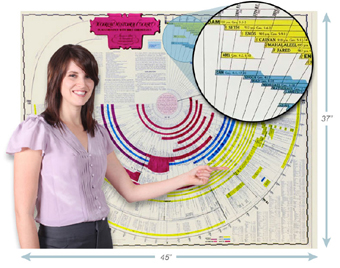
Related articles offer further reading. Each entry’s sources support its specific explanation.
People and events
Solomon’s temple
Construction: 1011–1004 BC · Timeline chronology
Biblical account
First Kings 6 dates the start of temple construction to Solomon’s fourth year and its completion to his eleventh, seven years later. First Kings 8 describes the dedication.
The poster’s 1011 BC label combines building and dedication; it should not imply that the entire project happened in one year.
Context: Building began and finished in different regnal years; the BC conversion follows the chart.
Word help: Regnal year
- Regnal year
- A year counted from the start of a ruler’s reign. Different calendar and counting practices can affect its conversion to a BC or AD year.
Context, sources and timeline wording
On the Amazing Bible Timeline with World History
Solomon builds and dedicates the temple. 1011 B.C.
Selected label(s) from the corresponding poster track; joined fragments share this quotation and explanation.
Compare 1004 BC–1000 BCReading options
Hiram and Solomon’s building project
During the chart’s traditional temple-building years · Timeline chronology
Biblical account
First Kings 5 describes Hiram’s exchange with Solomon over timber and labor for the temple. It also recalls his friendship with David.
The chart’s “Solomon’s friend” condenses this diplomatic and building relationship.
Context, sources and timeline wording
On the Amazing Bible Timeline with World History
KING HIRAM Solomon’s friend.
Selected label(s) from the corresponding poster track; joined fragments share this quotation and explanation.
Compare 1004 BC–1000 BCReading options
Solomon’s successors: Israel and Judah
This portion of the chart: division through the eighth century BC · Timeline chronology
Biblical account
After Solomon, First Kings 12 distinguishes Rehoboam’s southern kingdom from Jeroboam’s northern kingdom. Israel and Judah then have separate, sometimes simultaneous rulers.
The poster’s Judah–Benjamin–Levi heading summarizes its arrangement of tribes; it is not a complete census or a claim that all Levites lived only in Judah.
Dates: The chart prints 974 BC for the division; this broad band is its framework, not an independently dated accession for every king.
Word help: Accession
- Accession
- The beginning of a ruler’s time in power.
Context, sources and timeline wording
On the Amazing Bible Timeline with World History
DIVISION OF THE KINGDOM — REHOBOAM King — JEROBOAM of Ephraim. King — The Kingdom of Judah (Judah, Benjamin, Levi) — THE KINGDOM OF ISRAEL
Selected label(s) from the corresponding poster track; joined fragments share this quotation and explanation.
Compare 1000 BC–900 BCCompare 900 BC–800 BCCompare 800 BC–754 BCReading options
Chavín in the Andes
Broad cultural span: approximately 1500–300 BC · Historical estimate
Americas
Chavín de Huántar was an influential ceremonial and pilgrimage center. Its shared religious imagery spread widely in the Andes.
That cultural influence is not evidence for a single state that politically united all Peru in 900 BC.
Unconfirmed detail: “Unite Peru” compresses cultural influence into a political claim not established by the cited evidence.
Context, sources and timeline wording
On the Amazing Bible Timeline with World History
900 BC Chavins unite Peru
Selected label(s) from the corresponding poster track; joined fragments share this quotation and explanation.
Compare 1004 BC–1000 BCCompare 1000 BC–900 BCCompare 900 BC–800 BCCompare 800 BC–754 BCReading options
Olmec centers and influence
Approximately 1200–400 BC · Historical estimate
Americas
Olmec centers in the Gulf Coast region produced art and religious imagery with influence across Mesoamerica. San Lorenzo and La Venta were major centers, not proof of one Olmec government over all Mesoamerica.
Dates: Cultural connections do not establish political unification in 800 BC.
Context, sources and timeline wording
On the Amazing Bible Timeline with World History
800 BC Olmecs unite Mesoamerica
Selected label(s) from the corresponding poster track; joined fragments share this quotation and explanation.
Compare 1004 BC–1000 BCCompare 1000 BC–900 BCCompare 900 BC–800 BCCompare 800 BC–754 BCReading options
Egypt after the New Kingdom
Third Intermediate Period, approximately 1070–664 BC · Historical estimate
Egypt
Egypt’s later rulers shared or competed for power among several centers during the Third Intermediate Period. The poster’s broad dynasty bands and “Time of decay” summarize political fragmentation, not an absence of cultural or artistic achievement.
Dynasties 19–22 do not fit neatly into a single 1200–775 interval.
Context: Dynasty boundaries differ from the poster’s compressed range.
Word help: Dynasty
- Dynasty
- A line of rulers, usually from the same family. A dynasty’s dates describe its rule, not one person’s lifetime.
Context, sources and timeline wording
On the Amazing Bible Timeline with World History
Decay of royal power 965-775 — Egyptian power declines
Selected label(s) from the corresponding poster track; joined fragments share this quotation and explanation.
Compare 1004 BC–1000 BCCompare 1000 BC–900 BCCompare 900 BC–800 BCCompare 800 BC–754 BCReading options
Greek settlement around the Aegean
Early first-millennium BC regional context
Mediterranean
Greek-speaking communities spread around the Aegean, with Ionian and Dorian identities associated with different regions. Later Mediterranean colonies are a separate phase; the poster’s 1000 label is not a single foundation date for every settlement.
Context: Different settlements and phases should not be treated as one migration in one year.
Context, sources and timeline wording
On the Amazing Bible Timeline with World History
The IONIAN and DORIAN Colonies 1000
Selected label(s) from the corresponding poster track; joined fragments share this quotation and explanation.
Compare 1000 BC–900 BCCompare 900 BC–800 BCCompare 800 BC–754 BCReading options
Early mound building in Illinois
Early Woodland context, approximately 1000–500 BC · Historical estimate
Americas
Indigenous communities in Illinois developed mound building over a long period. The Illinois State Museum distinguishes Archaic, Woodland and much later Mississippian societies; “Mound Builders” is not the name of one vanished people.
The poster’s 1000 BC label is a broad chronological marker, not a construction date for a named mound.
Context: Do not confuse these early earthworks with the later city of Cahokia.
Context, sources and timeline wording
On the Amazing Bible Timeline with World History
1000 BC Mound builders in Illinois
Selected label(s) from the corresponding poster track; joined fragments share this quotation and explanation.
Compare 1000 BC–900 BCCompare 900 BC–800 BCCompare 800 BC–754 BCReading options
Shishak and Sheshonq I
Sheshonq I’s reign, approximately 945–924 BC · Historical estimate
Egypt and Judah
First Kings 14 describes Shishak’s campaign in Rehoboam’s fifth year. The Met identifies Shishak with Sheshonq I, whose reign it places around 945–924 BC.
This historical dating must be distinguished from a straightforward conversion of the chart’s earlier royal sequence.
Dates: The independently dated Egyptian reign does not exactly align with the chart’s traditional royal chronology.
Word help: Reign
- Reign
- The time a king, queen or other ruler holds power. These are not necessarily the years of that person’s life.
Context, sources and timeline wording
On the Amazing Bible Timeline with World History
Shishak I against Jerusalem. I Kings 14:25.
Selected label(s) from the corresponding poster track; joined fragments share this quotation and explanation.
Compare 1000 BC–900 BCReading options
Assyrian expansion and tributary states
Shalmaneser III, 858–824 BC
Mesopotamia
Assyrian kings campaigned across neighboring regions and received tribute from rulers who could also resist them. The chart’s grouped Tyre, Sidon, Medes and Israel label should not be read as four territories annexed in one year.
The Black Obelisk and Assyrian records identify specific campaigns and tribute relationships.
Context: Tribute, campaigning and direct government are different relationships.
Word help: Mesopotamia
- Mesopotamia
- The region around the Tigris and Euphrates rivers, largely in present-day Iraq and neighboring areas.
Context, sources and timeline wording
On the Amazing Bible Timeline with World History
SHALMANEZER Tyre, Zidon, Medes and Israel tributary. — ASSYRIAN Great Power
Selected label(s) from the corresponding poster track; joined fragments share this quotation and explanation.
Compare 900 BC–800 BCReading options
Jehu’s tribute to Shalmaneser III
841 BC
Israel and Assyria
The Black Obelisk of Shalmaneser III depicts and names tribute from Jehu of the House of Omri. It supplies an independent Assyrian anchor for this part of Israel’s history.
“House of Omri” is Assyria’s designation for the kingdom, not a statement that Jehu was Omri’s biological son.
Context, sources and timeline wording
On the Amazing Bible Timeline with World History
JEHU pays tribute to Shalmaneser III 841 B.C.
Selected label(s) from the corresponding poster track; joined fragments share this quotation and explanation.
Compare 900 BC–800 BCReading options
Iranian peoples in Assyrian records
Assyrian contacts in the mid-830s BC
West Asia
Assyrian records mention Medes and western Iranian rulers in this period, with tribute and campaigns involving multiple local princes. This does not establish a unified Persian kingdom subjected in 835 BC.
Scholarly chronologies differ slightly over the earliest notices.
Names and identities: Local rulers and early notices are not the later Persian Empire.
Context, sources and timeline wording
On the Amazing Bible Timeline with World History
Subject to the Assyrians 835
Selected label(s) from the corresponding poster track; joined fragments share this quotation and explanation.
Compare 900 BC–800 BCReading options
Carthage’s traditional foundation
814 BC in the foundation tradition · Traditional dating
North Africa
Carthage developed as a Phoenician settlement in North Africa. The 814 BC foundation date belongs to ancient tradition; the city’s growth and Mediterranean power developed over subsequent centuries.
Context, sources and timeline wording
On the Amazing Bible Timeline with World History
CARTHAGE founded 814 B.C.
Selected label(s) from the corresponding poster track; joined fragments share this quotation and explanation.
Compare 900 BC–800 BCReading options
The Homeric poems
Approximately the eighth century BC; formation debated · Historical estimate
Mediterranean
The Iliad and Odyssey preserve traditions about an earlier heroic world. Their formation as epic poems belongs to a later oral and literary history, commonly associated with the eighth century BC.
The poems are not eyewitness reports written during the Trojan War.
Context, sources and timeline wording
On the Amazing Bible Timeline with World History
Homeric Poems
Selected label(s) from the corresponding poster track; joined fragments share this quotation and explanation.
Compare 800 BC–754 BCReading options
The first recorded Olympiad
776 BC in the traditional victor chronology · Traditional dating
Mediterranean
The traditional Olympic victor list begins in 776 BC. This is the usual starting point for numbered Olympiads, not proof that no games were held earlier.
Context: “First recorded” is more precise than the first competition ever held.
Context, sources and timeline wording
On the Amazing Bible Timeline with World History
First OLYMPIAD 776
Selected label(s) from the corresponding poster track; joined fragments share this quotation and explanation.
Compare 800 BC–754 BCReading options
Families, traditions and undated themes
Explore family lines, successive Biblical episodes, cultural traditions and themes spanning several generations. Their date lines identify the kind of connection and any uncertainty.
From Nadab to Omri in Israel
Northern succession in 1 Kings 15–16
Biblical account
Nadab succeeds Jeroboam, Baasha kills Nadab, Elah succeeds Baasha, and Zimri kills Elah before Omri prevails. First Kings 16 describes Omri buying the hill of Samaria and building there.
This is a succession with conflict, not five kings reigning together.
Word help: Reign
- Reign
- The time a king, queen or other ruler holds power. These are not necessarily the years of that person’s life.
Context, sources and timeline wording
On the Amazing Bible Timeline with World History
NADAB King — BAASHA King — ELAH and ZIMRI — OMRI King. builds on Hill Samaria
Selected label(s) from the corresponding poster track; joined fragments share this quotation and explanation.
Other families and themesReading options
Ahab’s household and the northern kingdom
1 Kings 16–22; 2 Kings 1 and 8–10
Biblical account
Ahab marries Jezebel, daughter of the Sidonian king Ethbaal. His sons Ahaziah and Joram (Jehoram) rule Israel in succession.
The chart’s “Jehoram II” is not a different second northern king securely identified by that numeral; distinguish Joram of Israel from Jehoram of Judah.
Names and identities: The two kingdoms reuse royal names; identify each by kingdom, not by the chart’s numeral alone.
Context, sources and timeline wording
On the Amazing Bible Timeline with World History
AHAB — JEZEBEL — AHAZIAH — JEHORAM II
Selected label(s) from the corresponding poster track; joined fragments share this quotation and explanation.
Other families and themesReading options
Judah: Jehoram through Amaziah
2 Kings 8–14
Biblical account
Jehoram of Judah is followed by Ahaziah; Athaliah then rules before the child Joash (Jehoash) is installed. Amaziah succeeds Joash.
Joash of Judah must not be confused with the later king Joash of Israel, who fights Amaziah.
Names and identities: Joash and Jehoash are alternate name forms used for two different kings.
Context, sources and timeline wording
On the Amazing Bible Timeline with World History
JEHORAM King — AHAZIAH King — ATHALIAH — JEHOASH — AMAZIAH
Selected label(s) from the corresponding poster track; joined fragments share this quotation and explanation.
Other families and themesReading options
Jehu’s descendants in Israel
Jehoahaz, Joash and Jeroboam II: 2 Kings 13–14
Biblical account
Jehoahaz, his son Joash, and Joash’s son Jeroboam continue the northern royal sequence. This Jeroboam is conventionally called Jeroboam II, distinct from the earlier founder of the northern monarchy.
Second Kings describes pressure from Aram and later territorial recovery.
Context, sources and timeline wording
On the Amazing Bible Timeline with World History
JEHOAHAZ — JOASH — JEROBOAM
Selected label(s) from the corresponding poster track; joined fragments share this quotation and explanation.
Other families and themesReading options
Isaiah, Amos and Hosea
Prophetic ministries identified by named kings
Biblical account
Isaiah 1 names Uzziah, Jotham, Ahaz and Hezekiah; Amos 1 places his message under Uzziah of Judah and Jeroboam of Israel; Hosea 1 names both southern kings and Jeroboam. These headings connect the prophets to the divided kingdoms, but do not make every part of their books a single simultaneous speech.
Context, sources and timeline wording
On the Amazing Bible Timeline with World History
ISAIAH — AMOS — HOSEA
Selected label(s) from the corresponding poster track; joined fragments share this quotation and explanation.
Other families and themesReading options
Joel’s prophetic message
No king or BC year supplied in Joel’s heading
Biblical account
Joel opens with the word of the Lord coming to Joel son of Pethuel and describes devastation associated with locusts. Unlike several other prophetic books, its heading names no reigning king.
Its placement on the chart is an interpretive chronology, not an explicit Biblical date.
Christian interpretation: The book’s heading does not fix the prophet to this century.
Word help: Reign
- Reign
- The time a king, queen or other ruler holds power. These are not necessarily the years of that person’s life.
Context, sources and timeline wording
On the Amazing Bible Timeline with World History
JOEL
Selected label(s) from the corresponding poster track; joined fragments share this quotation and explanation.
Other families and themesReading options
Instability after Jeroboam II
2 Kings 15
Biblical account
Zechariah’s short reign ends when Shallum kills him; Menahem then kills Shallum, and Pekahiah succeeds Menahem. Menahem’s payment to Pul shows increasing Assyrian pressure.
The chart’s Zechariah here is a king, not the later prophet who encouraged the Second Temple.
Christian interpretation: King Zechariah and the later prophet Zechariah are different people.
Word help: Reign
- Reign
- The time a king, queen or other ruler holds power. These are not necessarily the years of that person’s life.
Context, sources and timeline wording
On the Amazing Bible Timeline with World History
ZECHARIAH — SHALLUM — MENAHEM — PEKAHIAH
Selected label(s) from the corresponding poster track; joined fragments share this quotation and explanation.
Other families and themesReading options
Abijam, Asa and Jehoshaphat in Judah
Southern succession in Kings and Chronicles
Biblical account
Abijam (Abijah), Asa and Jehoshaphat are successive kings of Judah. The Biblical accounts evaluate their worship and policies as well as recording political events.
Jehoshaphat’s alliances with Israel do not reunite the two kingdoms.
Context, sources and timeline wording
On the Amazing Bible Timeline with World History
ABIJAM King — ASA King — JEHOSHAPHAT King
Selected label(s) from the corresponding poster track; joined fragments share this quotation and explanation.
Other families and themesReading options
Jonah and Jeroboam’s time
2 Kings 14:25
Biblical account
Second Kings 14:25 identifies Jonah son of Amittai as a prophet associated with the restoration of Israel’s border under Jeroboam. This provides the royal setting for the name without assigning every episode in the book of Jonah to an exact BC year.
Context, sources and timeline wording
On the Amazing Bible Timeline with World History
JONAH
Selected label(s) from the corresponding poster track; joined fragments share this quotation and explanation.
Other families and themesReading options
Eliezer’s warning to Jehoshaphat
2 Chronicles 20:37
Biblical account
Eliezer son of Dodavah warns Jehoshaphat about his alliance with Ahaziah and their shipbuilding venture. The poster’s “Eleazar” label appears to refer to this episode, but the Biblical name is Eliezer.
Names and identities: The cited verse names Eliezer, not Eleazar.
Context, sources and timeline wording
On the Amazing Bible Timeline with World History
ELEAZAR. Prophet. II Chr. 20:37.
Selected label(s) from the corresponding poster track; joined fragments share this quotation and explanation.
Other families and themesReading options
Elijah and Elisha
1 Kings 17 onward; 2 Kings 2 onward
Biblical account
Elijah ministers during Ahab’s time and confronts royal wrongdoing and Baal worship. Elisha succeeds him and ministers through later reigns.
Their related stories span several kings rather than one year.
Word help: Reign
- Reign
- The time a king, queen or other ruler holds power. These are not necessarily the years of that person’s life.
Context, sources and timeline wording
On the Amazing Bible Timeline with World History
ELIJAH — ELISHA
Selected label(s) from the corresponding poster track; joined fragments share this quotation and explanation.
Other families and themesReading options
Sabbatical years and Jubilee
Leviticus 25
Biblical teaching
Leviticus 25 prescribes a seventh-year rest for the land and a Jubilee after seven cycles of seven years. The long chart track illustrates this recurring pattern; it is not a dated record proving that every cycle was observed throughout Israel’s history.
Context, sources and timeline wording
On the Amazing Bible Timeline with World History
Sabbatical and Jubilee Years. Lev. 25:1-17.
Selected label(s) from the corresponding poster track; joined fragments share this quotation and explanation.
Other families and themesReading options
Edom and the Israelite kingdoms
Edom’s continuing regional track
Biblical account
Second Kings 8 describes Edom’s revolt under Jehoram of Judah; chapter 14 describes Amaziah’s victory in the Valley of Salt. These are different conflicts and rulers.
The continuing Esau and Edom track connects the Biblical family association with later regional history.
Context, sources and timeline wording
On the Amazing Bible Timeline with World History
Wars with Israel
Selected label(s) from the corresponding poster track; joined fragments share this quotation and explanation.
Other families and themesReading options
Jehoshaphat, Moab and Ammon
2 Chronicles 20; compare 2 Kings 3
Biblical account
Second Chronicles 20 tells of a coalition threatening Judah and its destruction before Jehoshaphat’s army fights. Second Kings 3 describes a different campaign against Moab with Israel and Edom.
The chart’s short label should not combine them into one battle or a permanent conquest.
Context, sources and timeline wording
On the Amazing Bible Timeline with World History
JEHOSHAPHAT subdues MOAB and AMMON
Selected label(s) from the corresponding poster track; joined fragments share this quotation and explanation.
Other families and themesReading options
Ben-hadad and Hazael of Aram
Aramean kings in Kings
Biblical account
Ben-hadad is a royal name borne by more than one Aramean ruler. First Kings 20 describes conflict with Ahab; Second Kings 8 tells of Hazael succeeding Ben-hadad.
“Syria” here means the ancient Aramean setting, not today’s state boundaries.
Context, sources and timeline wording
On the Amazing Bible Timeline with World History
KING BEN HADAD — KING HAZAEL
Selected label(s) from the corresponding poster track; joined fragments share this quotation and explanation.
Other families and themesReading options
Pul and Menahem’s tribute
2 Kings 15:19–20
Biblical account
Second Kings calls the Assyrian ruler who receives Menahem’s silver Pul. The payment strengthens Menahem’s position and leads the Assyrian army to withdraw.
It is not the deportation account later in the same chapter.
Context: Tribute is distinct from the later carrying away of captives.
Context, sources and timeline wording
On the Amazing Bible Timeline with World History
King PUL
Selected label(s) from the corresponding poster track; joined fragments share this quotation and explanation.
Other families and themesReading options
Asa and Zerah’s army
2 Chronicles 14
Biblical account
Second Chronicles 14 recounts Asa’s appeal to the Lord and defeat of Zerah the Cushite, called “Ethiopian” in the KJV. That ancient term should not automatically be equated with the territory or population of the modern country Ethiopia.
Context, sources and timeline wording
On the Amazing Bible Timeline with World History
ASA defeats Ethiopians. 2 Chr. 14:8-14.
Selected label(s) from the corresponding poster track; joined fragments share this quotation and explanation.
Other families and themesReading options
Ishmael and Arab peoples
Genealogical tradition and later regional history
Biblical interpretation
Genesis 25 gives Ishmael’s sons and their settlements. The chart connects that family line to later Arab nations.
This is a traditional genealogical association, not evidence that every Arab population has one traceable ancestry or that Ishmael lived through later centuries.
Context: The continuing line is a traditional association, not a modern population genealogy.
Word help: Genealogy
- Genealogy
- An account of family descent: who is related to whom across generations.
Context, sources and timeline wording
On the Amazing Bible Timeline with World History
ISHMAEL — ARAB NATIONS
Selected label(s) from the corresponding poster track; joined fragments share this quotation and explanation.
Other families and themesReading options
Egypt’s overlapping dynasty bands
Dynasties 22–30 and later foreign rule
Egypt
Egypt’s later history includes competing dynasties and foreign conquests. Dynasty 22 is conventionally placed from about 945 BC.
The 950–305 BC band is a broad overview, not exact boundaries for dynasties 22–30 or one continuous sequence.
Dates: The printed band is 950–305; it is broader than those dynasty dates.
Word help: Dynasty
- Dynasty
- A line of rulers, usually from the same family. A dynasty’s dates describe its rule, not one person’s lifetime.
Context, sources and timeline wording
On the Amazing Bible Timeline with World History
Dynasties from 22-30 and many foreign rulers in Egypt from 950-305
Selected label(s) from the corresponding poster track; joined fragments share this quotation and explanation.
Other families and themesReading options
Lycurgus and Spartan institutions
Traditional lawgiver; date disputed in antiquity · Dating debated
Mediterranean
Spartan institutions were traditionally attributed to Lycurgus. Plutarch begins his biography by stressing disagreements about Lycurgus’s life, legislation and dates.
The chart’s concise label is a traditional attribution, not a securely dated single constitutional act.
Context, sources and timeline wording
On the Amazing Bible Timeline with World History
Lycurgian Constitution and Legislation
Selected label(s) from the corresponding poster track; joined fragments share this quotation and explanation.
Other families and themesReading options
Vedic and Brahmanical religious thought
Developments across centuries
South Asia
Brahmanical traditions encompass ritual, multiple deities and philosophical inquiry. Upanishadic teachings about Brahman introduce another layer.
The poster’s “pantheistic” description captures one way of interpreting some teachings, not the whole of Vedic religion or one dated change shared by everyone.
Context: The religious tradition is more varied than a single philosophical label.
Context, sources and timeline wording
On the Amazing Bible Timeline with World History
Development of Pantheistic Brahmanic religion
Selected label(s) from the corresponding poster track; joined fragments share this quotation and explanation.
Other families and themesReading options
Zoroaster and the Indo-European language headings
Zoroaster’s date is disputed · Dating debated
West Asia
Zoroaster is the Iranian religious teacher associated with the origins of Zoroastrianism. His date is disputed; linguistic arguments often place him in the second millennium BC.
The poster’s probable 2200 BC date is not an established consensus. “Indo-German” is an older label related to Indo-European language classification, not a single dated tribe or biological race.
Dates: The date remains uncertain, and language-family terms are not racial categories.
Context, sources and timeline wording
On the Amazing Bible Timeline with World History
INDO-GERMAN TRIBES — Doctrine of Zoroaster (probably 2200 B.C.)
Track heading and doctrine annotation joined with a dash.
Other families and themesReading options
Zhou political ideals and King Li
A broad period label and a moral judgment
East Asia
King Li of Zhou is the ruler named in the “Li, the wicked ruler” entry. The Guoyu tradition depicts him as suppressing criticism and being warned that silencing people was dangerous.
“Wicked” is a moral characterization, not a separate historical event.
Context, sources and timeline wording
On the Amazing Bible Timeline with World History
LI, the wicked ruler. — ZHOU Doctrine of “Mandate of Heaven”
Selected Li label and Zhou theme.
Our article about Li explicitly identifies King Li of Zhou. That resolves the name used here; the article’s chronology is not adopted as a new date for this entry.
Other families and themesReading options
Political and philosophical reflection in Zhou traditions
An undated theme
East Asia
Zhou traditions preserve arguments about government, moral authority and the ruler’s responsibility. “Age of vigorous thinking” is too broad to identify a single school or dated event.
The ideas need to be read in particular texts rather than assigned one unsupported founding year.
Dates: A broad theme, without a securely identified date.
Context, sources and timeline wording
This is additional historical context, not a label located on the current poster.
Other families and themesReading options