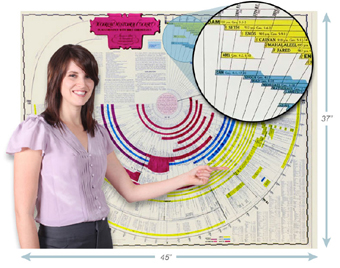
Related articles offer further reading. Each entry’s sources support its specific explanation.
People and events
Third-century and Diocletianic persecution
Major episodes around 250 and from 303 · Historical estimate
Christian history
Imperial demands and enforcement produced severe persecution of Christians under Decius and later under Diocletian and his colleagues. Experiences varied by region and ruler.
These episodes should not be read as one continuous persecution lasting the whole interval.
Context: Distinct episodes, not uninterrupted empire-wide enforcement.
Context, sources and timeline wording
On the Amazing Bible Timeline with World History
General persecution of Christians 250 — General persecution of Christians 303
Selected label(s) from the corresponding poster track; joined fragments share this quotation and explanation.
Compare AD 250–AD 300Compare AD 300–AD 400Reading options
Eusebius, Laodicea and the Biblical canon
Fourth-century evidence; Laodicea’s precise date is uncertain · Historical estimate
Christian history
Eusebius distinguishes accepted, disputed and rejected writings in Church History 3.25. Laodicea’s Canon 59 restricts church reading to canonical books; the authenticity of the attached book list in Canon 60 is disputed.
The poster’s specific list of excluded writings resembles Eusebius’s classification and should not be treated as an exact decree founding the entire Bible at one council in 360.
Dates: The canon developed through a longer process; the council date and appended list are uncertain.
Word help: Canon
- Canon
- When discussing Scripture, the collection of books accepted as authoritative by a religious community. A church council’s “canons” instead means its rules.
Context, sources and timeline wording
On the Amazing Bible Timeline with World History
EUSEBIUS Ecclesiastical writer (Greek) — Laodicean Council 360 arranged Canon of Old and New Testaments. Forbid the use of the Epistle of Barnabas, Shepherds of Hermas, the Acts of Paul and the teachings of the Apostles.
Selected label(s) from the corresponding poster track; joined fragments share this quotation and explanation.
Compare AD 300–AD 400Reading options
Constantine and Christianity’s changing position
Imperial favor after 312; baptism in 337
Christian history
Constantine’s support transformed Christianity’s public position. His patronage and profession of faith developed before his final baptism, which Eusebius describes near the end of his life.
AD 330 marks the dedication of Constantinople, not a securely identified moment when Constantine first became Christian. Christianity continued to spread through preaching, communities and institutions as well as imperial support.
Context: Conversion, patronage, baptism and the new capital are different events.
Context, sources and timeline wording
On the Amazing Bible Timeline with World History
Christianity became popular. Constantine converted 330. — Christianity spreads.
Selected label(s) from the corresponding poster track; joined fragments share this quotation and explanation.
Compare AD 300–AD 400Reading options
Nicaea and the confession of Christ
Council of Nicaea, AD 325
Christian history
The council’s creed confesses the Son as of one substance with the Father and rejects propositions associated with Arius. The dispute continued afterward; the council did not instantly end disagreement.
The familiar creed used in many churches also reflects the later council of Constantinople in 381.
Context, sources and timeline wording
On the Amazing Bible Timeline with World History
Council of Nicea. Nicene Creed. Arianism condemned 325
Selected label(s) from the corresponding poster track; joined fragments share this quotation and explanation.
Compare AD 300–AD 400Reading options
Imperial support for Nicene Christianity
Theodosius’s edict in AD 380
Christian history
The edict recorded in Theodosian Code 16.1.2 required the Trinitarian faith associated with Damasus of Rome and Peter of Alexandria. It belongs to Theodosius’s reign, not Constantine’s dedication of Constantinople.
Establishing and enforcing imperial religious policy was a process, not the instant conversion of every subject.
Dates: The poster prints 330; the relevant Nicene imperial edict is dated 380.
Word help: Reign · Nicene · Trinitarian
- Reign
- The time a king, queen or other ruler holds power. These are not necessarily the years of that person’s life.
- Nicene
- Connected with the creed and teaching of Nicaea, especially its confession that the Son shares the Father’s divine nature. The familiar creed also reflects Constantinople’s later council. Catholic Catechism, 242
- Trinitarian
- Affirming one God in three distinct persons: Father, Son and Holy Spirit. It does not mean three separate gods. Catholic Catechism, 253–255
Context, sources and timeline wording
On the Amazing Bible Timeline with World History
Christianity became the state religion 330
Selected label(s) from the corresponding poster track; joined fragments share this quotation and explanation.
Compare AD 300–AD 400Reading options
Jerome and the Latin Bible
Revision and translation over several decades · Historical estimate
Christian history
Jerome’s work on Latin Biblical texts began in Rome under Pope Damasus and continued after he moved to Bethlehem. The collection later known as the Vulgate was not a single complete translation produced in AD 380, nor was every book its later form contained translated by Jerome.
Context: The poster’s year abbreviates a longer translation and reception history.
Context, sources and timeline wording
On the Amazing Bible Timeline with World History
Vulgate (Latin Bible) 380
Selected label(s) from the corresponding poster track; joined fragments share this quotation and explanation.
Compare AD 300–AD 400Compare AD 400–AD 500Reading options
Patrick’s mission in Ireland
Fifth century; the poster uses AD 450 · Historical estimate
Christian history
Patrick’s Confession describes captivity in Ireland, his Christian faith, escape and later mission. It is a personal testimony to evangelism, not a year-by-year chronology of converting an entire island.
The chart’s 450 is an approximate period marker.
Context: The surviving first-person account does not establish a single conversion year.
Context, sources and timeline wording
On the Amazing Bible Timeline with World History
St. Patrick in Ireland
Selected label(s) from the corresponding poster track; joined fragments share this quotation and explanation.
Compare AD 400–AD 500Reading options
Zapotec cities: Monte Albán and Mitla
Monte Albán, approximately 500 BC–AD 850; Mitla flourished later · Historical estimate
Americas
Monte Albán began around 500 BC and became a major Zapotec center. Its decline preceded the later prominence of Mitla.
The poster’s 400 BC–AD 1500 band combines places with different histories; it is not the lifespan of one city or the disappearance of the Zapotec people.
Dates: The cities have different chronologies; Mitla is the modern place-name corresponding to the printed “Miktla.”
Context, sources and timeline wording
On the Amazing Bible Timeline with World History
400 BC – 1500 AD Zapotecs (Monte Alban, Miktla)
Selected label(s) from the corresponding poster track; joined fragments share this quotation and explanation.
Compare AD 250–AD 300Compare AD 300–AD 400Compare AD 400–AD 500Reading options
Nasca culture
Approximately 100 BC–AD 700; some chronologies begin around AD 100 · Historical estimate
Americas
Nasca communities on Peru’s south coast are known for ceramics, textiles and geoglyphs. Museum chronologies differ on the early boundary, but do not extend the main Nasca sequence from 400 BC to AD 1000 as the poster does.
Paracas is a related earlier coastal tradition, not simply another name for the same period.
Context: The poster’s broad range includes time outside the commonly defined Nasca sequence.
Context, sources and timeline wording
On the Amazing Bible Timeline with World History
400 BC – 1000 AD: Nazca coastal culture, western South America
Selected label(s) from the corresponding poster track; joined fragments share this quotation and explanation.
Compare AD 250–AD 300Compare AD 300–AD 400Compare AD 400–AD 500Reading options
Moche culture
Approximately AD 100–800 · Historical estimate
Americas
Moche communities flourished on Peru’s north coast, producing monumental architecture and elaborate ceramics and metalwork. “Mochica” is an alternative name used in older accounts.
Dates: The poster begins this culture at 400 BC; the archaeological sequence described here is approximately AD 100–800.
Context, sources and timeline wording
On the Amazing Bible Timeline with World History
400 BC – 600 AC: Mochica culture north Peru
Selected label(s) from the corresponding poster track; joined fragments share this quotation and explanation.
The main Moche period belongs to later AD pages, not 400 BC.
Compare AD 250–AD 300Compare AD 300–AD 400Compare AD 400–AD 500Reading options
China after the Han
Three Kingdoms 220–280; Sixteen Kingdoms conventionally 304–439
East Asia
After the Han, rival kingdoms and successive dynasties governed different parts of China. The Three Kingdoms are not the same period as the Jin dynasties beginning in 265.
“Sixteen Kingdoms” is a conventional grouping, not sixteen states all existing throughout the same 135 years. The chart’s ethnic shorthand and “all Chinafied” compress complex interaction and changing identities.
Context: Separate, partly overlapping periods rather than one dynasty.
Word help: Dynasty
- Dynasty
- A line of rulers, usually from the same family. A dynasty’s dates describe its rule, not one person’s lifetime.
Context, sources and timeline wording
On the Amazing Bible Timeline with World History
Three Kingdoms 220-280 — 304-439 Wu Hu — 16 kingdoms established in 135 years, all Chinafied.
Selected label(s) from the corresponding poster track; joined fragments share this quotation and explanation.
Compare AD 250–AD 300Compare AD 300–AD 400Compare AD 400–AD 500Reading options
Teotihuacan at its height
A major city during these centuries
Americas
Teotihuacan’s monumental city, religious spaces and extensive connections made it one of ancient Mesoamerica’s most influential centers. A “peak” describes a phase of growth and influence, not an exact event or a single universally agreed year.
Context, sources and timeline wording
On the Amazing Bible Timeline with World History
Teotihuacan reaches peak
Selected label(s) from the corresponding poster track; joined fragments share this quotation and explanation.
Compare AD 250–AD 300Compare AD 300–AD 400Compare AD 400–AD 500Reading options
Egypt within the Roman empire
Egypt under Roman and eastern Roman rule during this period
Egypt
Egypt had been annexed in 30 BC and remained a major Roman province during these centuries. Older Egyptian religious and artistic traditions continued alongside Greek and Roman practices.
Political incorporation did not instantly eliminate local culture.
Context: The band continues Roman control; it is not a new conquest in this period.
Context, sources and timeline wording
On the Amazing Bible Timeline with World History
EGYPT
Selected label(s) from the corresponding poster track; joined fragments share this quotation and explanation.
Compare AD 250–AD 300Compare AD 300–AD 400Compare AD 400–AD 500Reading options
Religious traditions in South Asia
Brahmanical and Buddhist traditions coexist
South Asia
Brahmanical traditions developed alongside Buddhism and other religious communities. Gupta-era art shows both the growth of Hindu temple forms and flourishing Buddhist images.
The chart’s “powerful in the third century” is a broad characterization, not a dated decree making one religion universal. “Indo-Germanic” is an older linguistic label, not a single state or religious community.
Context: Religious growth did not mean that competing traditions vanished.
Context, sources and timeline wording
On the Amazing Bible Timeline with World History
BRAHMANISM powerful in 3rd century
Selected label(s) from the corresponding poster track; joined fragments share this quotation and explanation.
Compare AD 250–AD 300Compare AD 300–AD 400Compare AD 400–AD 500Reading options
The Early Classic Maya period
Approximately AD 250–600 · Historical estimate
Americas
Early Classic is a conventional period in Maya archaeology, associated with growing dynasties, inscriptions and monumental centers. Its boundaries vary by region; it is not the beginning of Maya civilization, and the Maya did not disappear when the period ended.
Word help: Dynasty
- Dynasty
- A line of rulers, usually from the same family. A dynasty’s dates describe its rule, not one person’s lifetime.
Context, sources and timeline wording
On the Amazing Bible Timeline with World History
250-600 Maya Early Classic Period
Selected label(s) from the corresponding poster track; joined fragments share this quotation and explanation.
Compare AD 250–AD 300Compare AD 300–AD 400Compare AD 400–AD 500Reading options
Decius dies fighting the Goths
AD 251
Europe
Decius and his son were killed in the war against the Goths at Abritus in AD 251. The poster’s 250 compresses the campaign and death; its phrase “on the Danube” describes the frontier region rather than a precise battle coordinate.
Dates: The fatal battle was in AD 251, not 250.
Context, sources and timeline wording
On the Amazing Bible Timeline with World History
250 DECIUS fights the Goths and is killed on the Danube.
Selected label(s) from the corresponding poster track; joined fragments share this quotation and explanation.
Compare AD 250–AD 300Reading options
Roman rulers through the fourth and fifth centuries
A succession of rulers, shared offices and civil wars
Rome
The names trace Rome from Gallienus and Diocletian through Constantine’s dynasty to Theodosius and the later western emperors. Several labels compress or confuse accessions: Aurelian ruled from 270, Probus from 276; Constantius I became Caesar in 293 and Augustus in 305.
Constantine’s 312 victory was not his first proclamation as emperor. The final western line runs through Honorius, Valentinian III and Romulus Augustulus.
Dates: “Probus Aurelius” combines different emperors; reign labels need their political context.
Word help: Dynasty · Reign
- Dynasty
- A line of rulers, usually from the same family. A dynasty’s dates describe its rule, not one person’s lifetime.
- Reign
- The time a king, queen or other ruler holds power. These are not necessarily the years of that person’s life.
Context, sources and timeline wording
On the Amazing Bible Timeline with World History
GALLIENUS 260 — PROBUS AURELIUS 270 — DIOCLETIAN 284 — CONSTANTIUS I 301 — MAXENTIUS — CONSTANTINE the Great 312 — CONSTANTIUS II 337 — JULIAN THE APOSTATE 361 — VALENTINIAN I 364 — THEODOSIUS THE GREAT 379 — HONORIUS 395 — VALENTINIAN III 425 — ROMULUS AUGUSTUS 475
Selected label(s) from the corresponding poster track; joined fragments share this quotation and explanation.
Compare AD 250–AD 300Compare AD 300–AD 400Compare AD 400–AD 500Reading options
Buddhist images and local traditions in China
Western Jin example, AD 265–316
East Asia
A Western Jin funerary vessel combines Buddhist figures with imagery associated with local Chinese traditions. Such objects show how Buddhism was being incorporated into existing religious and artistic life.
“Buddhism prospers” describes a broad development with regional differences, not a uniform nationwide change in one year.
Context, sources and timeline wording
On the Amazing Bible Timeline with World History
Buddhism prospers.
Selected label(s) from the corresponding poster track; joined fragments share this quotation and explanation.
Compare AD 250–AD 300Compare AD 300–AD 400Reading options
Roman withdrawal from Dacia
Under Aurelian, in the early 270s · Historical estimate
Europe
Aurelian withdrew the Roman provincial administration from Dacia north of the Danube. This was a strategic withdrawal, not the disappearance of every inhabitant or all Roman influence from the region.
The chart’s 270 is a compressed marker for the policy during his reign.
Dates: The exact implementation should not be fixed solely by the accession year.
Word help: Reign · Accession
- Reign
- The time a king, queen or other ruler holds power. These are not necessarily the years of that person’s life.
- Accession
- The beginning of a ruler’s time in power.
Context, sources and timeline wording
On the Amazing Bible Timeline with World History
270 Rome abandons DACIA
Selected label(s) from the corresponding poster track; joined fragments share this quotation and explanation.
Compare AD 250–AD 300Reading options
Tacitus: emperor or historian?
The emperor Tacitus ruled AD 275–276
Rome
The Tacitus associated with 275 is the emperor, not the earlier author of the Annals and Histories. The poster combines the emperor’s date with the historian’s occupation.
The historian belongs to the first and early second centuries.
Context: The reader text separates two different men.
Context, sources and timeline wording
On the Amazing Bible Timeline with World History
TACITUS (Historian) 275
Selected label(s) from the corresponding poster track; joined fragments share this quotation and explanation.
Compare AD 250–AD 300Reading options
Constantinople becomes an imperial capital
AD 330
Byzantium
Constantine dedicated Constantinople on the site of Byzantium as a new imperial center. Rome retained immense symbolic and religious importance.
“Capital” here describes a changing imperial system, not the instant abolition of every other administrative center.
Context, sources and timeline wording
On the Amazing Bible Timeline with World History
BYZANTIUM or Constantinople capital — Constantinople became the capital 330
Selected label(s) from the corresponding poster track; joined fragments share this quotation and explanation.
Compare AD 300–AD 400Reading options
The Huns and Attila
Hunnic expansion in the late fourth century; Attila’s rule in the fifth · Historical estimate
Eurasia and Europe
Hunnic expansion into Europe belongs principally to the late fourth and fifth centuries. Attila led a powerful confederation, not a modern national state.
The poster’s “Mongolian tribe” is an older ethnic simplification; a direct identity with later Mongols is not established.
Context: Origin, language and the composition of the confederation remain complex.
Context, sources and timeline wording
On the Amazing Bible Timeline with World History
HUNS (Mongolian Tribe) in Europe — ATTILA the HUN
Selected label(s) from the corresponding poster track; joined fragments share this quotation and explanation.
Compare AD 300–AD 400Compare AD 400–AD 500Reading options
Teotihuacan and the Maya world
AD 378 is a major marker in the Tikal inscriptions
Americas
Tikal’s inscriptions record a political upheaval in 378 associated with people and symbols linked to central Mexico. Archaeology also shows a Teotihuacan-style complex at Tikal.
Researchers debate the balance of military intervention and other kinds of contact. This does not establish uniform Teotihuacan rule over all Maya highlands or make every regional conquest one securely documented campaign.
Context: The broader claim of domination and the specific Uaxactun invasion require more caution than the poster’s short wording.
Context, sources and timeline wording
On the Amazing Bible Timeline with World History
Teotihuacan rules the Mayan highlands — 378 Mayan city Tikal invades Uaxacion
Selected label(s) from the corresponding poster track; joined fragments share this quotation and explanation.
Compare AD 300–AD 400Reading options
The battle of Adrianople
AD 378
Europe
Emperor Valens’s army was defeated by Goths and their allies near Adrianople, and Valens was killed. Alliances and recruitment across the Roman frontier were fluid, but “Romans unite with the Goths” does not describe the opposing sides of this battle accurately.
Context: The battle was a Roman defeat by a Gothic-led coalition.
Context, sources and timeline wording
On the Amazing Bible Timeline with World History
The Romans unite with the Goths and Visigoths at the Battle of Adrianople 378
Selected label(s) from the corresponding poster track; joined fragments share this quotation and explanation.
Compare AD 300–AD 400Reading options
Western and eastern Roman government
Division after 395; western imperial deposition in 476
Rome and Byzantium
After Theodosius I, Honorius ruled in the west and Arcadius in the east. The deposition of Romulus Augustulus in 476 is a conventional endpoint for the western empire, not the end of Roman civilization or the eastern Roman state.
Constantinople remained the seat of an empire that endured for centuries.
Dates: 476 is a western political endpoint, not the end of every Roman institution.
Context, sources and timeline wording
On the Amazing Bible Timeline with World History
Division of the Roman Empire 395 — WEST ROME — Fall of West Rome. End of Empire. — EAST ROME — ARCADIUS 395
Selected label(s) from the corresponding poster track; joined fragments share this quotation and explanation.
Compare AD 300–AD 400Compare AD 400–AD 500Reading options
Monte Albán as a Zapotec capital
An established center around AD 400
Americas
Monte Albán was a major Zapotec political and ceremonial center well before AD 400 and continued afterward. The date locates the city in the timeline; it should not be read as the year it was founded or first became important.
Context, sources and timeline wording
On the Amazing Bible Timeline with World History
400 Zapotec state capital at Monte Alban
Selected label(s) from the corresponding poster track; joined fragments share this quotation and explanation.
Compare AD 400–AD 500Reading options
Migration to Britain, Iberia and North Africa
Different movements in the fifth century · Historical estimate
Europe and North Africa
Angles and Saxons settled in Britain through a long process. Vandals moved through western Europe and crossed from Iberia into North Africa in 429, taking Carthage in 439.
The poster’s combined band compresses separate migrations and kingdoms; these were not one movement completed in 407–429.
Context: North Africa, not France, is the later Vandal kingdom shown on the poster.
Context, sources and timeline wording
On the Amazing Bible Timeline with World History
ANGLES AND SAXONS in Britain — VANDALS in Spain 407-429 — VANDALS in North Africa 425-534
Selected label(s) from the corresponding poster track; joined fragments share this quotation and explanation.
Compare AD 400–AD 500Reading options
Changing Hopewell exchange networks
Late in the Ohio Hopewell sequence · Historical estimate
Americas
The elaborate ceremonial and exchange networks associated with Ohio Hopewell changed toward the end of the tradition’s approximately 200 BC–AD 500 span. “Trading declines” is a shorthand for regional changes, not the disappearance of the people or an end to all exchange.
Context, sources and timeline wording
On the Amazing Bible Timeline with World History
Hopewell trading declines
Selected label(s) from the corresponding poster track; joined fragments share this quotation and explanation.
Compare AD 400–AD 500Reading options
Tiwanaku’s urban expansion
Major urban growth around AD 400–900 · Historical estimate
Americas
Tiwanaku became a major ceremonial and political center near Lake Titicaca. UNESCO places its flourishing around AD 400–900.
The poster’s population of 50,000 and 375–600 span should be read as an older estimate and periodization, not a counted population securely fixed to those years.
Dates: The exact 50,000 estimate is not verified by the cited site account.
Context, sources and timeline wording
On the Amazing Bible Timeline with World History
375-600 City of Tiahuanaco pop 50K
Selected label(s) from the corresponding poster track; joined fragments share this quotation and explanation.
Compare AD 400–AD 500Reading options
Gothic attacks and the sack of Rome
Alaric’s sack of Rome, AD 410
Europe
Gothic attacks on Roman territory during the third century were not the same event as Alaric’s capture of the city of Rome in 410. The poster’s 265 label can describe pressure on the empire, but should not date the famous sack of Rome.
Context: Roman territory and the city of Rome must be distinguished.
Context, sources and timeline wording
On the Amazing Bible Timeline with World History
First invasion of Rome by Goths 265
Selected label(s) from the corresponding poster track; joined fragments share this quotation and explanation.
Compare AD 400–AD 500Reading options
Attila checked in Gaul
The Catalaunian battle, conventionally AD 451
Europe
A coalition led by the Roman commander Aetius, including Visigoths, fought Attila’s forces in Gaul. Jordanes’s later account gives the battle a dramatic place in Gothic history.
It was not a united army of every European people, and the result did not end all Hunnic power immediately.
Context: The alliance was specific, not all Europe.
Context, sources and timeline wording
On the Amazing Bible Timeline with World History
Battle of Chalons 451
Selected label(s) from the corresponding poster track; joined fragments share this quotation and explanation.
Compare AD 400–AD 500Reading options
Odoacer in Italy
Rule in Italy, AD 476–493
Europe
Odoacer deposed Romulus Augustulus in 476 and ruled Italy until Theodoric defeated and killed him in 493. The poster’s 493 is his end date, not the beginning of his rule.
Calling him king of the Heruli alone simplifies the mixed military following behind him.
Dates: 493 marks the end of Odoacer’s rule.
Context, sources and timeline wording
On the Amazing Bible Timeline with World History
ODOACER King of the Heruli 493
Selected label(s) from the corresponding poster track; joined fragments share this quotation and explanation.
Compare AD 400–AD 500Reading options
Families, traditions and undated themes
Explore family lines, successive Biblical episodes, cultural traditions and themes spanning several generations. Their date lines identify the kind of connection and any uncertainty.
The birth of Jesus
Matthew 2:1; the exact year is not stated
Biblical account
Matthew describes Jesus’s birth in Bethlehem during Herod’s reign. Luke also recounts his birth and its Roman setting.
The chart’s central era boundary expresses the Christian organization of the timeline; neither Gospel names a “year zero,” and the BC/AD calendar has no year zero.
Dates: The era boundary is not an exact date supplied by the Gospels.
Word help: Reign
- Reign
- The time a king, queen or other ruler holds power. These are not necessarily the years of that person’s life.
Context, sources and timeline wording
On the Amazing Bible Timeline with World History
CHRIST born Matt. 2:1.
Selected label(s) from the corresponding poster track; joined fragments share this quotation and explanation.
Other families and themesReading options
Mesoamerican calendars and comparisons with Asia
A historical comparison, not a demonstrated AD 250–500 connection
Americas
Mesoamerican calendars had a long indigenous history. A resemblance between calendars does not by itself establish borrowing, migration or a shared origin.
The nineteenth-century comparison attributed to Prescott is not evidence that the later Aztec state already existed in this period.
Unconfirmed detail: The proposed connection is not established by the calendar evidence.
Context, sources and timeline wording
This is additional historical context, not a label located on the current poster.
Other families and themesReading options
El Tajín and water management
A Gulf Coast city; its specific ethnic attribution needs care
Americas
El Tajín developed monumental architecture and managed water in the Gulf Coast region. Its name comes from Totonac tradition, but identifying all its builders simply as Huastec exceeds what the brief label establishes.
Canals and fresh-water works are best understood as local engineering, not a claim that one named people invented irrigation.
Names and identities: The poster’s categorical identification of the builders is not secure.
Context, sources and timeline wording
On the Amazing Bible Timeline with World History
Huastec Builders of El Tajin create fresh water canals for irrigation near the sea
Selected label(s) from the corresponding poster track; joined fragments share this quotation and explanation.
Other families and themesReading options
Early Tiwanaku
Earlier settlement before the city’s later expansion
Americas
Tiwanaku developed near Lake Titicaca in present-day Bolivia from an earlier settlement into a major ceremonial and political center. UNESCO emphasizes urban flourishing around AD 400–900 and a peak around 500–900.
The poster’s “first period 200–375” is an older subdivision, not a universal archaeological boundary.
Names and identities: The named period is not a securely bounded phase in the cited modern account.
Context, sources and timeline wording
On the Amazing Bible Timeline with World History
200-375 First period of Tiahuanaco, Bolivia
Selected label(s) from the corresponding poster track; joined fragments share this quotation and explanation.
Other families and themesReading options
The disputed age of Serpent Mound
Proposed construction dates differ by more than a millennium
Americas
The Great Serpent Mound in Ohio is an extraordinary effigy earthwork. Its age remains disputed: research has supported dates around 300 BC and around AD 1100.
It should not be presented as a securely dated construction within AD 250–500.
Dates: The date is disputed; the site remains visible without an invented precision.
Context, sources and timeline wording
On the Amazing Bible Timeline with World History
Great Serpent Mound constructed
Selected label(s) from the corresponding poster track; joined fragments share this quotation and explanation.
Other families and themesReading options
The Eucharist and transubstantiation
Early Eucharistic belief; later technical terminology
Christian history
Justin Martyr describes the Eucharist as more than ordinary food. The technical term transubstantiation and its conciliar formulation belong to much later Latin theology, including the Fourth Lateran Council in 1215.
Christian traditions interpret the Eucharist differently; the poster’s label should not date the medieval formulation to these early centuries.
Context: The practice, belief and later doctrinal terminology have different histories.
Context, sources and timeline wording
On the Amazing Bible Timeline with World History
Transubstantiation Mass.
Selected label(s) from the corresponding poster track; joined fragments share this quotation and explanation.
Other families and themesReading options
Describing Indigenous religious traditions
Many peoples and traditions, not one continental creed
Americas
Indigenous societies in the Americas held diverse religious traditions. A nineteenth-century description in Christian categories such as a supreme deity, evil spirit and future reward cannot establish one shared belief system for all peoples in AD 250–500.
Specific communities’ accounts and practices need to be considered on their own terms.
Unconfirmed detail: The broad historical generalization is not established; this is additional context, not a replacement for a confirmed poster entry.
Context, sources and timeline wording
This is additional historical context, not a label located on the current poster.
Other families and themesReading options
Peoples around the Roman frontiers
Changing groups along the North Sea, Rhine, Danube and Black Sea
Europe
Saxons, Alemanni, Franks and Goths formed changing coalitions and identities around different Roman frontier regions, not fixed modern nations. “German Ocean” is an older name for the North Sea.
The 200–250 marker does not date the first appearance of every group in the neighboring tracks.
Context: Regional context, not a single migration.
Context, sources and timeline wording
On the Amazing Bible Timeline with World History
SAXONS on the German Ocean 200-250 — ALEMANNI and FRANKS on the Rhine — The GOTHS on the Black Sea and the Danube
Selected label(s) from the corresponding poster track; joined fragments share this quotation and explanation.
Other families and themesReading options
Sunday worship and imperial legislation
Christian Sunday gatherings predate Constantine
Christian history
Justin Martyr describes Sunday Christian gatherings in the second century. Constantine later supported Sunday observance in imperial life.
Recognizing the day in law did not invent the earlier Christian practice; Christian traditions differ about its relationship to the Biblical Sabbath.
Context: A distinction between early worship and later state support.
Context, sources and timeline wording
On the Amazing Bible Timeline with World History
Sunday worship recognized
Selected label(s) from the corresponding poster track; joined fragments share this quotation and explanation.
Other families and themesReading options
The ten kingdoms and Biblical interpretation
A historicist reading of Daniel and Revelation
Biblical interpretation and Europe
Daniel 7 and Revelation 13 use visions of beasts and horns. The chart links them to the breakup of western Roman power and lists Heruli, Vandals, Ostrogoths, Lombards, Franks, Huns, Suevi, Burgundians, Saxons and Visigoths.
This is a historicist Christian interpretation, not a literal ten-way partition agreed in AD 476. The listed peoples formed and changed at different times.
Christian interpretation: The prophetic interpretation remains visible without presenting it as the only Christian reading.
Word help: Historicist interpretation
- Historicist interpretation
- An approach that connects Biblical prophecy with a sequence of events across later history. Christians differ over those connections.
Context, sources and timeline wording
On the Amazing Bible Timeline with World History
DIVISION of WEST ROME Dan. 7:7; Rev. 13:1 — HERULI, VANDALS, OSTROGOTHS, LOMBARDS, FRANKS, HUNS, SUEVI, BURGUNDIANS, SAXONS, VISIGOTHS
Selected label(s) from the corresponding poster track; joined fragments share this quotation and explanation.
Other families and themesReading options
The end of the ancient Olympic Games
Conventionally late fourth century; the precise endpoint is debated
Mediterranean
The ancient Olympic Games ended during the changing religious, political and economic conditions of late antiquity. Traditional accounts point to 393 or later fifth-century measures, but a single securely documented “last Olympiad” is difficult to establish.
Dates: The exact final date and a single cause are not certain.
Context, sources and timeline wording
On the Amazing Bible Timeline with World History
LAST OLYMPIAD
Selected label(s) from the corresponding poster track; joined fragments share this quotation and explanation.
Other families and themesReading options
Sushen and later Manchu ancestry traditions
An ancestry claim, not a securely dated arrival in Japan
East Asia
The Sushen appear in historical traditions about peoples northeast of China. Later accounts of Manchu ancestry drew earlier names into genealogical narratives.
The chart’s location beside Japan does not establish a dated Sushen migration into Japan or a simple unbroken ethnic identity across the centuries.
Dates: A precise arrival date and destination are not established by the label.
Word help: Genealogy
- Genealogy
- An account of family descent: who is related to whom across generations.
Context, sources and timeline wording
On the Amazing Bible Timeline with World History
Arrival of the Sushen, ancestors of the Manchu.
Selected label(s) from the corresponding poster track; joined fragments share this quotation and explanation.
Other families and themesReading options
Learning and literary activity at Chang’an
An important center; the exact “seven schools” label is uncertain
East Asia
Chang’an was a major center of government, learning and religious exchange at different times. The brief reference to seven schools does not identify their names, dates or institutional form.
Those particular institutions and their foundation dates remain unconfirmed.
Dates: The exact seven institutions and their date remain unconfirmed.
Context, sources and timeline wording
On the Amazing Bible Timeline with World History
Literary activity. 7 schools of Chang An.
Selected label(s) from the corresponding poster track; joined fragments share this quotation and explanation.
Other families and themesReading options