Last updated on August 18th, 2026 at 04:10 pm
The short answer
Matthew and Luke are not simply copying the same family list. Both connect Jesus to David, but Matthew follows David’s son Solomon while Luke follows David’s son Nathan. The Gospels also place different names immediately before Joseph: Matthew names Jacob, while Luke names Heli.
Christians have traditionally understood these differences through more than one kind of family relationship: biological descent, legal or royal succession, a family arrangement connected with levirate marriage, or the traditional view that Luke may preserve Mary’s ancestry while naming Joseph. The Bible does not identify one of these explanations for us, so a careful guide should distinguish what the Gospel texts say from the ways Christians have brought the two accounts together.
What does each Gospel actually say?
Matthew’s genealogy
Matthew 1:1–17 begins with Abraham and moves forward through David to Jesus. After David, Matthew follows the royal branch through Solomon and the kings of Judah. Near the end, Matthew names “Jacob the father of Joseph,” identifies Joseph as Mary’s husband, and then names Jesus as the one called the Messiah.
Matthew also tells readers how he has arranged the genealogy: three groups of fourteen generations. That carefully shaped structure helps explain why Matthew highlights some names and leaves other known generations unstated.
Luke’s genealogy
Luke 3:23–38 begins with Jesus and moves backward. Luke introduces Jesus as being, “as was supposed,” the son of Joseph. He then places Heli immediately after Joseph and follows a line through Nathan, another son of David, before continuing through Abraham and all the way back to Adam.
Luke ends by calling Adam “the son of God.” That phrase is not describing an ordinary father-and-son relationship. It points to Adam’s direct creation by God.
Where do the two genealogies differ?
- They move in opposite directions. Matthew begins with Abraham and moves toward Jesus. Luke begins with Jesus and moves back to Adam.
- They follow different sons of David. Matthew continues through Solomon; Luke continues through Nathan. Both Solomon and Nathan are named among David’s sons in 2 Samuel 5:14 and 1 Chronicles 3:5.
- They name Joseph differently. Matthew 1:16 names Jacob as Joseph’s father. Luke 3:23 places Heli immediately after Joseph in its repeated “son of” sequence.
- They contain different numbers of names. Matthew uses a deliberately arranged three-part pattern and omits some generations known from Kings and Chronicles. Luke gives a longer sequence.
- They briefly share Shealtiel and Zerubbabel, then separate again. Matthew places Shealtiel after Jeconiah, while Luke places him after Neri. Chronicles adds Pedaiah to the family picture surrounding Zerubbabel. This is one reason a simple one-line explanation cannot answer every question in the lists.
How have Christians traditionally understood the differences?
These explanations are not always mutually exclusive. A person could have a biological father, a legally recognized father, and a place in a royal family line. The main question is which kind of relationship each Gospel is preserving.
1. Royal/legal and biological lines
One traditional view proposes that Matthew follows the line through which the royal claim associated with David’s house passed, while Luke follows physical descent through another branch of David’s family. Both lines reach Joseph, but they describe different aspects of his family position.
This explanation fits Matthew’s strong emphasis on Jesus as the Messiah and “son of David.” It also takes seriously the fact that an ancient genealogy could preserve inheritance or succession, not only a list of immediate biological fathers.
2. The Mary-line interpretation
A common modern Christian explanation understands Matthew as Joseph’s line and Luke as Mary’s. In this reading, Heli is Mary’s father and Joseph is included as his son-in-law or as the publicly recognized head of the household. Jesus would therefore descend from David through Mary’s family while receiving a legal connection to David’s royal line through Joseph.
This interpretation is possible, and it has been widely taught, but it should be stated carefully. Luke does not call the list “Mary’s genealogy,” does not name Mary inside the list, and does not explicitly identify Heli as Joseph’s father-in-law. Those steps belong to the interpretation, not to the wording of Luke 3 itself.
3. Joseph had a biological father and a legal father through levirate marriage
One of the earliest detailed Christian explanations was preserved by Eusebius from Julius Africanus. Africanus understood both lists as relating to Joseph. He proposed that a levirate-family arrangement allowed Jacob to be Joseph’s father by physical birth while Heli was his father according to family law.
Deuteronomy 25:5–6 describes the underlying custom: when a married man died without a son, his brother could marry the widow, and the first son would continue the deceased man’s family name. In ordinary language, one man could be the child’s biological father while the child was legally counted in the family line of the deceased man.
Africanus’s proposal is historically important because it shows that early Christians recognized the difficulty and tried to account for both Gospel lists. The Gospels themselves, however, do not tell the family history needed to prove that this particular arrangement occurred.
4. Other proposed legal-family explanations
Some interpreters have proposed adoption, inheritance, remarriage, or royal succession. Such arrangements show how more than one family connection could exist, but the Gospels do not identify any specific event of this kind for Joseph. These proposals should therefore be treated as possibilities rather than established history.
Helpful terms in plain language
- Biological descent: a family line based on physical parentage.
- Legal descent: a family relationship recognized by law, inheritance, marriage, or family status even when it is not the line of physical birth.
- Royal or dynastic succession: the line through which a throne, title, or recognized claim passes within a ruling family.
- Levirate marriage: an ancient family arrangement in which a man married his deceased brother’s childless widow so that a son could continue the deceased brother’s family name.
- Genealogical compression: shortening a family list by moving from an ancestor to a later descendant without naming every generation in between.
Did Matthew leave out generations?
Yes. Matthew moves from Jehoram to Uzziah, while the Old Testament histories name Ahaziah, Joash, and Amaziah between them. Matthew also moves from Josiah to Jeconiah around the exile while the royal records include Jehoiakim.
This does not mean Matthew was unaware of the royal history. Matthew openly tells readers that he has arranged the list into three groups of fourteen. Biblical genealogies can be selective, and “father of” can describe an ancestor rather than only the immediately preceding parent. The pattern shows that Matthew is presenting a selective, carefully structured genealogy from Abraham and David to Jesus.
What about Jeconiah?
Jeconiah appears in Matthew’s royal line even though Jeremiah 22:24–30 says that none of his descendants would prosper while “sitting on the throne of David and ruling anymore in Judah.” Matthew nevertheless includes Jeconiah. The passage has produced several Christian interpretations, but neither Jeremiah nor Matthew says that a second genealogy automatically resolves the issue. The safest approach is to preserve both statements and distinguish the biblical wording from proposed solutions.
For the king’s broader story, see Jehoiachin, also called Jeconiah or Coniah.
So which explanation does this guide use?
The Bible Genealogy Explorer keeps Matthew and Luke as two visible source paths. It does not silently relabel Luke as “Mary’s genealogy,” but it gives the Mary-line interpretation a prominent place among the traditional Christian explanations.
The guide also distinguishes Joseph’s legal and social fatherhood of Jesus from biological parentage. Where the lists share names such as Shealtiel and Zerubbabel, or where a traditional harmonization goes beyond what a verse states directly, the deeper story notes explain the choice instead of presenting it as unquestioned fact.
Explore or print the family line
- Open the interactive Adam-and-Eve-to-Jesus genealogy and compare Matthew and Luke.
- Download a printable genealogy chart for study or classroom use.
- Read more about Joseph and Mary in their historical and biblical setting.
Scripture and historical references
- Matthew 1:1–17
- Luke 3:23–38
- 2 Samuel 5:14; 1 Chronicles 3:5
- Deuteronomy 25:5–6
- 1 Chronicles 3:17–19
- 2 Chronicles 21–26
- Jeremiah 22:24–30
- Eusebius, Church History, Book 1, Chapter 7, preserving the explanation of Julius Africanus
Last reviewed August 2026. This article follows a text-first Christian approach: it begins with what Matthew and Luke state, presents the best-known traditional harmonizations, and identifies where an explanation goes beyond the wording of the passage.
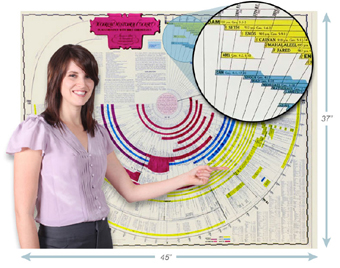
- Unique circular format - over 1,000 references at your fingertips on this wonderful study companion
- Discover interesting facts - Biblical events with scripture references plotted alongside world history showcase fun chronological relationships
- Attractive, easy to use design - People will stop to look at and talk about this beautifully laid out Jesus history timeline poster ideal for your home, office, church ... Click here to find out more about this unique and fun Bible study tool!
For the differing Geneology you need to do more research. Matthew was giving the geneology through the First surviving son of David and Bathsheba representing the Jewish line who had a blood curse put on the line Jeconiah. The other geneology detailed the line from the second surviving son of David and Bathsheba and represents the gentile bride with Boaz who is the son of Rahab the prostitute. Its part of Prophecy. If you study out the promises in Exodus and Joshua the promises made to the daughters of Zelophohad and the blood curse on Jeconiah it will show the sovereignty of God in the Virgin birth and why it was necessary. Do your homework! Study out the laws of the Levitical priesthood for adoption. It is prophetic of the coming uniting of the Messianic Kingdom in Christ.
Hi, could you tell me where you got that information? Thanks
I’m not sure which information you are referring to. The genealogies are from the Bible and the comments as to why they are different are from a variety of sources.
So witch line is correct
luke 31 clearly says that josephs (yeshuas step father)blood line is of king David though Nathan..now Mathew is speaking of marys father.in Hebrew were it says husband is reallu father..The givra of mary which means father now the geneologies would only add to thirteen if thos were not true..anf the prophecy is fourteen generations…please research this yourself .. google Nehemiah Gordons research on the messiahs genealogy..oh and by the way he is a Bible scholar who DOESN’T believe in yeshua..
So witch line is correct
When you realise their has been a teleport devise and the posabilty of a other group going back to create their own and hide all knowledge of the true Christ in the genealogy.. threw out time wiping out the Christan faith it will be to late. Time machine impossible. Oops to late start using your harts and ask would Jesus do this. Because lots will be in question.
So someone very important has come on the scene who claims 2 Jesus’s and that Jesus wrote revelation. I can’t find any truth to these claims as of yet. Army declassified teleportation documents yesterday, details would bring all religions together. Can you tell me any info to help me discern this information?
what prophecy was made about the Messiah and did it came to pass
What s the used for a genealogy if Joseph is not the father of Jesus ???