Reading copies for your study
Print and download the timeline
Quick key: BC years count down; AD years count up. “About” means approximate. Dates and label meanings · Words used here
Choose a period and the reading style that suits you. Every guide works on its own, with Biblical or Christian context first and world history alongside it.
Reading guides revised 6 October 2026. Each guide carries its revision date. Choose the style and paper size below.
Visual study guide
Keyed diagrams, comparison panels and tables support study and sharing.
Compact reference
A simpler, shorter text-led option. The same entries, qualifications and reference notes remain.
Paper sizes: Letter is 8.5 by 11 inches. A4 is 210 by 297 mm. Print at 100% / Actual size on matching paper. Single- or double-sided printing works; no facing-page assembly is needed. Try one page before printing a full guide.
Choose your period
4004 BC–3004 BC
Visual study guide
For visual reading, teaching and group study.
Compact reference
For text-led reading and fewer printed pages.
Older PDF editions
Earlier downloads may differ from the revised reading guides. These historical links are retained, not updated in place.
3004 BC–2348 BC
Visual study guide
For visual reading, teaching and group study.
Compact reference
For text-led reading and fewer printed pages.
Older PDF editions
Earlier downloads may differ from the revised reading guides. These historical links are retained, not updated in place.
2348 BC–2004 BC
Visual study guide
For visual reading, teaching and group study.
Compact reference
For text-led reading and fewer printed pages.
Older PDF editions
Earlier downloads may differ from the revised reading guides. These historical links are retained, not updated in place.
2004 BC–1754 BC
Visual study guide
For visual reading, teaching and group study.
Compact reference
For text-led reading and fewer printed pages.
Older PDF editions
Earlier downloads may differ from the revised reading guides. These historical links are retained, not updated in place.
1754 BC–1504 BC
Visual study guide
For visual reading, teaching and group study.
Compact reference
For text-led reading and fewer printed pages.
Older PDF editions
Earlier downloads may differ from the revised reading guides. These historical links are retained, not updated in place.
1504 BC–1254 BC
Visual study guide
For visual reading, teaching and group study.
Compact reference
For text-led reading and fewer printed pages.
Older PDF editions
Earlier downloads may differ from the revised reading guides. These historical links are retained, not updated in place.
1254 BC–1004 BC
Visual study guide
For visual reading, teaching and group study.
Compact reference
For text-led reading and fewer printed pages.
Older PDF editions
Earlier downloads may differ from the revised reading guides. These historical links are retained, not updated in place.
1004 BC–754 BC
Visual study guide
For visual reading, teaching and group study.
Compact reference
For text-led reading and fewer printed pages.
Older PDF editions
Earlier downloads may differ from the revised reading guides. These historical links are retained, not updated in place.
754 BC–504 BC
Visual study guide
For visual reading, teaching and group study.
Compact reference
For text-led reading and fewer printed pages.
Older PDF editions
Earlier downloads may differ from the revised reading guides. These historical links are retained, not updated in place.
504 BC–254 BC
Visual study guide
For visual reading, teaching and group study.
Compact reference
For text-led reading and fewer printed pages.
Older PDF editions
Earlier downloads may differ from the revised reading guides. These historical links are retained, not updated in place.
254 BC–1 BC
Visual study guide
For visual reading, teaching and group study.
Compact reference
For text-led reading and fewer printed pages.
Older PDF editions
Earlier downloads may differ from the revised reading guides. These historical links are retained, not updated in place.
1 AD–250 AD
Visual study guide
For visual reading, teaching and group study.
Compact reference
For text-led reading and fewer printed pages.
Older PDF editions
Earlier downloads may differ from the revised reading guides. These historical links are retained, not updated in place.
250 AD–500 AD
Visual study guide
For visual reading, teaching and group study.
Compact reference
For text-led reading and fewer printed pages.
Older PDF editions
Earlier downloads may differ from the revised reading guides. These historical links are retained, not updated in place.
500 AD–750 AD
Visual study guide
For visual reading, teaching and group study.
Compact reference
For text-led reading and fewer printed pages.
Older PDF editions
Earlier downloads may differ from the revised reading guides. These historical links are retained, not updated in place.
750 AD–1000 AD
Visual study guide
For visual reading, teaching and group study.
Compact reference
For text-led reading and fewer printed pages.
Older PDF editions
Earlier downloads may differ from the revised reading guides. These historical links are retained, not updated in place.
1000 AD–1250 AD
Visual study guide
For visual reading, teaching and group study.
Compact reference
For text-led reading and fewer printed pages.
Older PDF editions
Earlier downloads may differ from the revised reading guides. These historical links are retained, not updated in place.
1250 AD–1500 AD
Visual study guide
For visual reading, teaching and group study.
Compact reference
For text-led reading and fewer printed pages.
Older PDF editions
Earlier downloads may differ from the revised reading guides. These historical links are retained, not updated in place.
1500 AD–1750 AD
Visual study guide
For visual reading, teaching and group study.
Compact reference
For text-led reading and fewer printed pages.
Older PDF editions
Earlier downloads may differ from the revised reading guides. These historical links are retained, not updated in place.
1750 AD–Modern Era
Read 1750 AD–Modern Era online · Coverage ends in 2022; the revision date does not add later events.
Visual study guide
For visual reading, teaching and group study.
Compact reference
For text-led reading and fewer printed pages.
Older PDF editions
Earlier downloads may differ from the revised reading guides. These historical links are retained, not updated in place.
The online version and the wall chart
The Amazing Bible Timeline with World History brings the whole story together at a glance. These guides provide the full reading explanations, date keys and optional source notes. A poster is not required.
Material differences are explained beside the relevant entry; original chart wording remains in its reference notes.
Dates and label meanings
- BC and AD
- BC means “Before Christ.” AD stands for anno Domini, Latin for “in the year of the Lord”; it does not mean “after death.” BC year numbers decrease as time moves forward: 1000 BC comes before 500 BC. AD year numbers increase. There is no year zero between 1 BC and AD 1.
- BCE and CE
- “Before Common Era” and “Common Era” use the same year numbering as BC and AD, respectively. You may see these labels in sources.
- About, approximately, c. or ca.
- The date is an estimate, not a known exact year. The abbreviations c. and ca. stand for circa, meaning “about.”
- Century
- A span of 100 years. The first century AD is AD 1–100; the fifth century BC is 500–401 BC.
- A range or a time band
- A range may describe a lifetime, reign, war or longer development; the entry says which. A comparison band groups events within a span of time, not necessarily the same year. A lifespan bar shows duration within this timeline’s chronological framework, not an independently measured date.
- Timeline chronology
- A date calculated within this resource’s Biblical framework.
- Historical estimate
- A date or range drawn from historical or archaeological research. “About” and “approximately” mark an estimate.
- Dating debated
- More than one dating proposal remains in use. Read the entry for the particular disagreement.
- Traditional dating
- Dates drawn from a culture’s historical or literary traditions, such as the traditional foundation of Rome or the Trojan War. These are not labeled as Ussher-based Biblical dates. The entry explains its basis.
- Biblical account, Christian interpretation and historical evidence
- A Biblical account describes what the Bible says. Christian interpretation explains a religious understanding of a text or event and may differ among Christians. Historical evidence includes documents, inscriptions, objects and other sources used to investigate the past. These descriptions identify the kind of information, not a score for its importance.
- Dating disputed / undated / outside this period
- “Disputed” means different dates or interpretations remain in use. “Undated” means no reliable absolute year is assigned here. “Outside this period” keeps an entry findable when its explained dates fall beyond this page’s boundaries.
- Context, sources and timeline wording
- Each entry works on its own. Open its notes for sources, fuller explanations and original wording from the wall chart. Significant differences in date or meaning are identified beside the entry.
Words used on this page
Short definitions for this reading page. Entry cards also offer word help that opens in place, so you can read a definition without leaving the entry.
- Chronology
- The order of events and the dates assigned to them. Different calculations or sources can produce different dates.
- Septuagint / LXX
- Ancient Greek translations of Jewish Scriptures, commonly called the Greek Old Testament. LXX is its traditional abbreviation; the translations were not all made at one time.
- Bible references and KJV
- Genesis 5:5 means the book of Genesis, chapter 5, verse 5; 5:5–8 means verses 5 through 8. “II Kings” means Second Kings. Gen., Exod. and Rev. shorten Genesis, Exodus and Revelation. KJV means King James Version, the English Bible translation used by many linked passages.
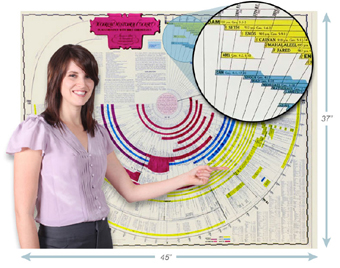
- Unique circular format - over 1,000 references at your fingertips on this wonderful study companion
- Discover interesting facts - Biblical events with scripture references plotted alongside world history showcase fun chronological relationships
- Attractive, easy to use design - People will stop to look at and talk about this beautifully laid out Jesus history timeline poster ideal for your home, office, church ... Click here to find out more about this unique and fun Bible study tool!