Last updated on July 31st, 2025 at 05:13 pm
For nearly two millennia, the Holy Bible has been translated, retranslated, and adapted into countless languages and versions. Each translation reflects not only linguistic scholarship but also the theological, cultural, and historical context of its time. From ancient Greek and Latin manuscripts to modern digital editions, the story of Bible translation is a fascinating journey through human civilization itself.
This comprehensive guide explores the most influential and widely-used Bible translations, examining their historical origins, translation philosophies, and lasting impact on Christian faith and scholarship.
Quick Reference: Major Bible Translations
| Translation | Year | Approach | Audience | Notable Features |
|---|---|---|---|---|
| King James Version (KJV) | 1611 | Formal Equivalence | Anglican Church | Elizabethan English, poetic language |
| New International Version (NIV) | 1978 | Dynamic Equivalence | Modern evangelicals | Clear, contemporary language |
| English Standard Version (ESV) | 2001 | Essentially Literal | Conservative Protestants | Literary excellence, accuracy |
| New American Standard Bible (NASB) | 1971 | Formal Equivalence | Serious Bible students | Word-for-word accuracy |
| New Living Translation (NLT) | 1996 | Dynamic Equivalence | General readers | Thought-for-thought clarity |
| New Revised Standard Version (NRSV) | 1989 | Formal Equivalence | Academic/Mainline churches | Gender-inclusive language |
Historical Timeline of Bible Translation
| Period | Key Translation/Event | Historical Significance | Impact |
|---|---|---|---|
| 3rd-2nd Century BC | Septuagint (LXX) | First major translation from Hebrew to Greek | Made Hebrew scriptures accessible to Greek-speaking Jews |
| 4th-5th Century AD | Latin Vulgate | Jerome’s translation became the Catholic standard | Dominated Western Christianity for over 1,000 years |
| 1380s | Wycliffe Bible | First complete English Bible | Sparked controversy and reform movements |
| 1525 | Tyndale New Testament | First printed English New Testament | Influenced all subsequent English translations |
| 1611 | King James Version | Authorized version for the Church of England | Became the dominant English Bible for 350+ years |
| 1952 | Revised Standard Version | Modern scholarship meets traditional language | Bridge between old and new translation approaches |
| 1978-Present | Modern Translation Era | Multiple approaches and target audiences | Unprecedented variety and accessibility |
The Pillars of English Bible Translation
King James Version (1611) 1611
Commissioned by King James I of England, this translation emerged during the height of the English Renaissance. The KJV’s committee of 54 scholars drew from the best available manuscripts and previous English translations, creating a work of both linguistic beauty and theological precision.
Historical Impact: Shaped English-speaking Christianity for over three centuries, influencing literature, law, and culture. Its phrases became embedded in the English language itself.
New International Version (1978) 1978
Born from evangelical scholarship in the post-World War II era, the NIV sought to bridge ancient texts with contemporary language. Over 100 scholars from various denominations collaborated to create a translation for modern evangelicals.
Historical Impact: Became the best-selling Bible translation of the late 20th century, reflecting the rise of evangelical Christianity in America.
English Standard Version (2001) 2001
Emerging at the dawn of the 21st century, the ESV represented a “back to the future” approach, combining modern scholarship with traditional translation principles. It arose partly as a response to debates over gender-inclusive language in Bible translation.
Historical Impact: Gained rapid acceptance among Reformed and conservative evangelical churches, becoming a standard for theological education.
Translation Philosophy Comparison
| Approach | Description | Strengths | Examples |
|---|---|---|---|
| Formal Equivalence (Word-for-Word) |
Attempts to translate each word and maintain original syntax | Preserves original structure and terminology | KJV, NASB, ESV |
| Dynamic Equivalence (Thought-for-Thought) |
Conveys the meaning and intent rather than literal words | More natural reading, clearer meaning | NIV, NLT, CEV |
| Paraphrase | Restates the Bible’s message in contemporary terms | Highly accessible, easy to understand | The Message, Living Bible |
| Optimal Equivalence | Balances accuracy with clarity based on context | Flexible approach, context-sensitive | HCSB, CSB |
Denominational Preferences and Usage
| Denomination/Tradition | Preferred Translations | Historical Reasons |
|---|---|---|
| Roman Catholic | NAB, Jerusalem Bible, NRSV-CE | Includes deuterocanonical books, approved by bishops |
| Eastern Orthodox | Orthodox Study Bible (NKJV-based) | Reflects Orthodox theological tradition and calendar |
| Anglican/Episcopal | NRSV, KJV (liturgical use) | Historical connection to KJV, scholarly tradition |
| Lutheran | ESV, NRSV | Emphasis on accurate translation and Lutheran theology |
| Baptist | KJV, NIV, ESV | Varies by congregation, conservative to moderate approaches |
| Presbyterian/Reformed | ESV, NASB, NIV | Emphasis on theological precision and Reformed doctrine |
| Pentecostal | NIV, NLT, NKJV | Accessibility and contemporary relevance |
The Modern Era: Digital Age Translations
The late 20th and early 21st centuries have witnessed an unprecedented explosion in Bible translation activity. Advances in manuscript discovery, linguistic scholarship, and digital technology have revolutionized how we approach the ancient texts.
Key Developments in Modern Translation
- Manuscript Discoveries: The Dead Sea Scrolls (1947) and other archaeological finds provided earlier Hebrew and Greek texts
- Computer Analysis: Digital tools enabled comprehensive word studies and statistical analysis
- Gender Language Debate: Discussions about inclusive language sparked new translation approaches
- Global Perspective: Input from international scholars broadened translation perspectives
Readability and Accessibility Levels
| Translation | Grade Level | Readability | Best Used For |
|---|---|---|---|
| New Living Translation | 6th Grade | Very Easy | New believers, devotional reading |
| Contemporary English Version | 6th Grade | Very Easy | Children, English language learners |
| New International Version | 7th-8th Grade | Easy | General study, church services |
| English Standard Version | 8th-9th Grade | Moderate | Serious study, preaching |
| New American Standard | 9th-10th Grade | Moderate-Difficult | Academic study, cross-referencing |
| King James Version | 12th Grade+ | Difficult | Traditional liturgy, literary study |
The Living Legacy
The story of Bible translation is far from over. Each generation faces the challenge of making ancient words speak to contemporary hearts while preserving the integrity of the original message. From the scribes of ancient Alexandria to the digital translators of today, the goal remains constant: to make the Word accessible to all people in their own language and cultural context.
Whether you prefer the majestic cadence of the King James Version, the scholarly precision of the English Standard Version, or the contemporary clarity of the New Living Translation, each represents centuries of dedication, scholarship, and faith. The diversity of translations available today reflects not confusion, but richness—multiple windows through which to view the eternal truths of Scripture.
As we look toward the future, new discoveries, technologies, and cultural shifts will undoubtedly inspire fresh approaches to Bible translation. The ancient text continues to speak across millennia, finding new voices in every age to proclaim its timeless message of hope, redemption, and divine love.
References and Further Reading
Primary Academic Sources
- Metzger, Bruce M. The Bible in Translation: Ancient and English Versions. Grand Rapids, MI: Baker Academic, 2001.
- Metzger, Bruce M. and Bart D. Ehrman. The Text of the New Testament: Its Transmission, Corruption, and Restoration. 4th ed. New York: Oxford University Press, 2005.
- McGrath, Alister E. In the Beginning: The Story of the King James Bible and How It Changed a Nation, a Language, and a Culture. New York: Anchor Books, 2001.
- Daniell, David. The Bible in English: Its History and Influence. New Haven: Yale University Press, 2003.
- Burke, David G. Translation That Openeth the Window: Reflections on the History and Legacy of the King James Bible. Atlanta: Society of Biblical Literature, 2009.
Historical and Theological Studies
- Norton, David. A Textual History of the King James Bible. Cambridge: Cambridge University Press, 2005.
- Wegner, Paul D. The Journey from Texts to Translations: The Origin and Development of the Bible. Grand Rapids: Baker Academic, 1999.
- Lewis, Jack P. The English Bible from KJV to NIV: A History and Evaluation. 2nd ed. Grand Rapids: Baker Academic, 1991.
- Fee, Gordon D. and Mark L. Strauss. How to Choose a Translation for All Its Worth: A Guide to Understanding and Using Bible Versions. Grand Rapids: Zondervan, 2007.
- Nida, Eugene A. and Charles R. Taber. The Theory and Practice of Translation. Leiden: Brill Academic Publishers, 1969.
Encyclopedia and Reference Works
- Würthwein, Ernst. The Text of the Old Testament: An Introduction to the Biblia Hebraica. 2nd ed. Grand Rapids: Eerdmans, 1995.
- Aland, Kurt and Barbara Aland. The Text of the New Testament: An Introduction to the Critical Editions and to the Theory and Practice of Modern Textual Criticism. Grand Rapids: Eerdmans, 1987.
- Comfort, Philip Wesley. The Complete Guide to Bible Versions. Wheaton: Tyndale House, 1991.
Online Resources and Databases
- Bible Gateway Translation Comparison Tools – www.biblegateway.com
- Center for the Study of New Testament Manuscripts – www.csntm.org
- United Bible Societies – www.unitedbiblesocieties.org
- Wycliffe Bible Translators – www.wycliffe.org
- Society of Biblical Literature – www.sbl-site.org
Translation Committee Publications
- NIV Translation Committee. The NIV: The Making of a Contemporary Translation. Ed. Kenneth L. Barker. Grand Rapids: Zondervan, 1986.
- ESV Translation Oversight Committee. The ESV Study Bible. Wheaton: Crossway, 2008.
- NRSV Translation Committee. The HarperCollins Study Bible: New Revised Standard Version. San Francisco: HarperOne, 2006.
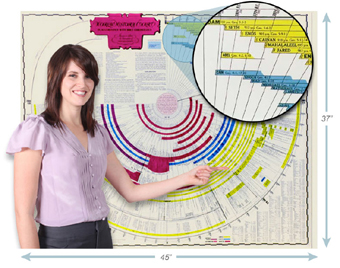
- Unique circular format - over 1,000 references at your fingertips on this wonderful study companion
- Discover interesting facts - Biblical events with scripture references plotted alongside world history showcase fun chronological relationships
- Attractive, easy to use design - People will stop to look at and talk about this beautifully laid out Jesus history timeline poster ideal for your home, office, church ... Click here to find out more about this unique and fun Bible study tool!